
Mod Bit Roof Repair on Commercial Flat Roofs
How a modified bitumen roof is patched, how open laps, splits and worn granules are fixed, which sealants belong, and the winter, torch and warranty rules in Ontario.
Call 1-833-775-7663 Oakville head office · Modified bitumen roof repair on commercial, industrial and institutional buildings across Ontario
Karol Rajkowski
Vice President, OYH Roofing
Published October 23, 2026 · 15 min read
Short answer
Mod bit roof repair patches a modified bitumen roof with the same kind of membrane. The area is swept, the granules are embedded or primed, and a base patch and a cap patch go on at least 150 mm (6 in) past the damage, torched, mopped or set in cold adhesive. Open laps are reheated and pressed shut. Mastic seals details; it does not replace a membrane patch.
What goes wrong on a mod bit roof?
Mostly the laps. A modified bitumen roof is usually two plies of asphalt modified with polymers, SBS (rubber-like) or APP (plastic-like), with a granule-surfaced cap sheet on top. The granules are the cap's protection: the Canadian Roofing Contractors Association (CRCA) warns that once a granular surface wears away, the membrane underneath is exposed to the elements and "will deteriorate more quickly".
In a field study of 53 SBS and APP roofs, the U.S. National Institute of Standards and Technology (NIST, 1993) found surface cracking, granule loss "particularly in ponded water", slippage of SBS sheets and open or heavily repaired laps on APP roofs. About 70 per cent of the roofs were still in fine condition. The same report cites NRCA surveys in which defective laps were the number one problem reported for modified bitumen, and shrinkage the second.
The CRCA's advice is to repair problems as soon as they are found, and to identify the roof system first: "If incompatible products are used, a durable repair will not be achieved." Blisters are covered in our membrane roof repair guide, and the weak points of mod bit against single-ply in our modified bitumen vs TPO comparison.
Which fixes work best in mod bit roof repair?
In modified bitumen roof repair, each common defect has its own fix in the CRCA reference manual and IKO's technical manual. Wet insulation under the damage comes out first, or the patch only hides the problem.
| Problem | What it usually means | The fix |
|---|---|---|
| 1. Open lap or void, no bleed-out at the edge | The plies never fused, or the bond failed | IKO: heat a round-nose trowel, slide it into the lap until the compound flows, then press and trowel it shut. CRCA: cut away the loose edge and patch |
| 2. Fishmouth or wrinkle at a lap | A small funnel-shaped opening that lets water in (CRCA) | Cut it with a hook blade so it lies flat, re-adhere it, then add a two-ply patch |
| 3. Split, crack or puncture in the cap | Impact, movement, or metal edges moving more than the membrane | Check how far water got, replace wet insulation, then a base and cap patch of like material |
| 4. Bare spot or exposed reinforcement | Granules and compound worn through | IKO: melt compound from a scrap of membrane, trowel it over the spot, then broadcast granules or coat it |
| 5. Granules worn thin over a large area | Age, foot traffic or ponded water | CRCA: recoat the membrane and reapply the surfacing, or add a new cap sheet; fix the drainage first |
| 6. Ridge or buckle | Movement in the deck or insulation below | CRCA: leave it and watch it unless it cracks or sits in a traffic area; then cut it down the centre, lay it flat and patch |
| 7. Loose base flashing at a wall or curb | Lost bond on the vertical | CRCA: cut away the loose flashing, then heat-apply a patch or set it in cold adhesive |
Long, straight cracks, ridges or wrinkles point to movement in the materials below, and the CRCA says those need investigating, sometimes by an engineer, before a patch will last. Flashing details are in our roof flashing repair guide, and finding the source of a leak in our flat roof leak detection guide.
How is a mod bit roof patched?
A mod bit roof repair patch is like material, in two plies, well past the damage. The CRCA manual and IKO's manual describe the same method with slightly different numbers.
| Step | CRCA manual | IKO manual |
|---|---|---|
| 1. Find the water | Find how far moisture went; replace wet insulation, vapour retarder or deck | Same steps (Part 16 reprints the CRCA's repair guidance) |
| 2. Clean and flatten | Remove debris and loose granules with a stiff broom; cut fishmouths and voids so they lie flat | Cut out significant wrinkles and all fishmouths so the sheet lies flat |
| 3. Prepare the cap | Embed the granules over small repairs; on larger ones, embed 150 mm (6 in) at the edges and prime the rest | Embed the granules when torching, or prime with IKO Mod-Bit Primer |
| 4. Base patch | Like material, at least 150 mm larger than the defect in all directions; clip or round the corners | At least 150 mm past the defect in both directions |
| 5. Cap patch | At least 150 mm larger than the base patch, often the full sheet width (about 900 mm); corners rounded slightly | At least 50 mm (2 in) past the base patch; a full-width patch is recommended for looks |
| 6. Bond | Hot Type 3 asphalt at 204°C or more where it is applied, cold adhesive or a torch, with only enough heat to bond | SBS by hot asphalt, cold adhesive or heat; APP to APP by heat welding only |
| 7. Finish | Loose granules at the patch edges, set in hot asphalt or melted membrane | Granules or a roof coating where compound is exposed |
Cutting wrinkles and fishmouths first keeps the new sheet from bridging a hump or void, and IKO does not recommend torching a patch straight onto exposed organic felt, which is a fire risk. Neither manual calls for a bead of mastic around the finished patch: the edge is finished with granules.
Open laps, splits or worn granules?
We can inspect your modified bitumen roof, check the insulation for water and set out which repairs it needs, in writing.
Call 1-833-775-7663Request an assessmentTorch, hot asphalt or cold adhesive for mod bit roof repair?
Usually the method the roof was built with, as long as the sheet allows it. The CRCA notes that "SBS and APP modified products may have slightly different repair procedures", and the biggest difference is hot asphalt.
| Method | SBS cap | APP cap | Things to know |
|---|---|---|---|
| Torch (heat welding) | Yes | Yes; IKO allows only heat welding to bond new APP to old APP | Open flame, so the Fire Code and propane rules apply |
| Hot asphalt (Type 3) | Yes, at 204°C or more where it is applied | No: APP "cannot be adhered with hot applied asphalt" (CRCA) | The Fire Code keeps kettles off the roof and out of the building, with a narrow exception for concrete roofs |
| Cold adhesive | Yes | CRCA: yes. IKO: heat welding only | No flame, but slower to cure and limited by temperature |
Identify the sheet before buying patch material. We found no maker text that allows an APP patch on an SBS roof or the reverse, so the safe course is like material from the same maker, which most warranties require anyway. Self-adhered sheet appears in makers' installation instructions rather than in the repair sections we read, so ask the maker before using it as a patch. How the original methods compare is in our modified bitumen roof installation guide.
Where do mastic and sealant belong on a mod bit roof?
At details and in emergencies, not as the main repair. Google's AI Overview for "mod bit roof repair" suggests plastic cement with reinforcing fabric for small punctures and a trowelled bead of mastic around every patch. That method comes from U.S. mastic systems such as Tremco's, which call for a three-course "mastic/reinforcement/mastic" repair. The Canadian methods are different: the CRCA and IKO repair sections use membrane patches finished with granules. IKO goes further when a roof is later recovered: the old roof must have "all roof cement removed" first.
| Product | Type | Lowest application temperature | Made for |
|---|---|---|---|
| SOPRAMASTIC (SOPREMA) | SBS-modified, solvent-based mastic; meets CAN/CGSB-37.5-M89 and ASTM D4586 | -10°C | Joints, caulking and filling with bituminous membranes; not a pitch-pocket filler |
| IKO AquaBarrier Mastic | Modified asphalt sealant with synthetic rubbers and glass fibres | -10°C, damp or dry surfaces | Terminations, penetrations and membrane edges, tooled into place |
| Resisto Supreme Roof Repair | Asphalt plastic cement; meets CAN/CGSB-37.5-M89 | 0°C, with the product at 10°C or warmer | Flashings, vents, joints, holes and cracks, in strips no wider than 1 cm |
| Resisto Super Roof Repair Low Temperature | Asphalt plastic cement | -10°C | The same uses on colder days |
Sealants also have shorter warranties than membranes: SOPREMA warrants its sealant and mastic products for five years against manufacturing defects, and on its top MAMMOUTH systems it accepts no primers, adhesives or sealants from other makers. For sealants at walls and curbs, see our roof flashing repair guide.
Does granule loss mean a mod bit roof needs replacing?
Not on its own. Granules shield the bitumen from sunlight, so a bare cap ages faster, but a roof can lose granules and still keep water out. The NIST study found SBS roofs with extensive granule loss and "mud cracking" in ponded areas that were still working, and noted that thin granule cover first shows as a "blacker" look where asphalt shows through. There is no field test for how much loss is too much: ASTM D4977, the granule adhesion test, applies to roofing "as manufactured" and "may not be applicable" once it has weathered.
- Small bare spots. IKO's method is compound melted from a scrap of membrane, spread over the spot and covered with loose granules or a roof coating. On APP caps, IKO touches up small marks with matching granules pressed into the sheet.
- Wide wear. The CRCA's fix is to "Recoat the membrane and reapply the surfacing material". A new cap sheet is the other route (see below). NIST saw roofs restored with extra sheets that looked "mottled" because the new granules did not match.
- The cause. In the NIST study, granule loss was worst in ponded water and where people walked. SOPREMA's warranty conditions treat early granule loss from standing water as a slope problem, not a material defect, and call for at least 1 per cent slope. Fix ponding water or the drains, and keep traffic to walkways.
- Cleaning. SOPREMA's maintenance guide warns that using a brush broom and water at the same time can strip granules.
- Coatings. A white coat over asphalt goes on over a primer that blocks staining: IKO's ArmourReflect Primer must dry at least 24 hours before its white coat, and IKO coats go on above 4°C. IKO does not count coatings as part of the warranted membrane, and NIST saw an aluminum coating over a cracked APP roof crack within six months along the old cracks. See our commercial roof coating guide.
Granules show the condition of the surface, not of the insulation. Before paying for a coat or a new cap, a moisture survey and test cuts show whether the roof below is dry; see how roofers find wet insulation and our repair or replace guide.
Can mod bit roof repair be done in winter?
Yes, with limits. The CRCA treats 4.4°C (40°F) as the usual threshold for cold-weather roofing, but says makers have lowered the minimum temperatures of many products, so the data sheet decides. Torch repairs carry on in the cold because the heat comes from the flame, while cold adhesives cure more slowly; IKO sets 4°C as the floor for its own cold adhesive.
- Dry surface first. Snow comes off before any work, and the CRCA describes laying tarps or insulation the evening before to keep frost off, and drying the surface with propane infrared heaters.
- Warm materials. The CRCA suggests keeping the next day's adhesives in warm storage overnight, and Resisto wants its standard plastic cement at 10°C or warmer before use.
- Stopgaps. On the coldest or wettest days, a cold-rated mastic (table above) can slow a leak until a membrane patch can go on. The maintenance guidance in the RCABC manual says such repairs "should be regarded as temporary only", recorded, and made permanent "as soon as conditions allow".
- Weight. The CRCA warns that a deck may not carry heavy snow or ice plus stacked materials; see our flat roof snow load guide.
For what owners can do before the snow, see our guides to preparing a flat roof for winter and ice dam repair.
What rules apply to torch repairs in Ontario?
A torch-applied mod bit roof repair falls under the Fire Code and the propane rules. Ontario's Fire Code protects combustibles and roof openings within 5 m, keeps the flame off wood decks, cant strips, insulation, flashing, voids and gas or electrical lines, puts a 4A:40B:C extinguisher within 6 m of the torch, and requires a firewatch until at least 3 hours after torching stops (2 hours with a thermal imaging camera). Our industrial roof repair guide sets these out in a table.
- Propane training. "No person shall handle propane unless the person is the holder of a certificate or ROT for that purpose" (O. Reg. 211/01, s. 6). Under O. Reg. 215/01, a CH-01 or CH-02 certificate or record of training (ROT) covers lighting a construction torch and connecting it to a cylinder, and ROT holders retrain or retest every three years. The holder must show it "on demand of the director, an inspector, or any other person".
- Cylinders. O. Reg. 213/91 requires compressed gas cylinders to be secured upright and capped when not connected, spent cylinders to stay out of the building, and, with some exceptions, propane cylinders to sit at least 3 m from a source of ignition. The CRCA adds: hoist them, never carry them up a ladder or drag them across the membrane.
- Hidden spaces. "Do not torch anything you cannot see", the CRCA says, such as under air conditioning units or behind counter flashing, and shut down air conditioning, exhaust and intake fans in the work area.
- No flame. Cold adhesive patches avoid the open flame on occupied buildings, within the temperature limits above.
When does a worn mod bit roof need a new cap sheet?
When the cap is worn over wide areas but the base sheet, insulation and deck are sound. SOPREMA Canada calls this resurfacing: the existing SBS membranes stay and "a new SBS-modified bitumen or TPU-modified bitumen cap sheet membrane will be installed directly on it". Its resurfacing warranties run 10 or 15 years, against up to 20 years for a recover with cover boards and a new base and cap.
- SOPREMA's preparation. Wrinkles, delamination and gaps fixed first; all moist or wet areas removed and replaced with new materials; an exploratory cut; and a moisture survey from the three months before the work. Old components left in place are not covered by its MAMMOUTH GENERATIONS warranty.
- IKO's conditions. A granulated mod bit roof can take a new IKO membrane directly only with wet insulation removed, blisters repaired, no loose alligatoring, no large splits or cracks, all roof cement removed, and IKO asphalt primer applied and left to dry. A smooth roof that was resaturated or coated needs insulation, a separation panel or a fastened base sheet first, and existing flashings come off. IKO recommends an infrared scan to find wet insulation.
- The Building Code. A roofing system is a "building system" under Part 11, and a material alteration or repair must leave the building performing at least as well as before. Every roof covering needs a Class A, B or C fire classification.
- Permits. Toronto lists replacing existing roofing material with no structural work among jobs that need no permit; our roof replacement permit guide covers other cities.
A coated or heavily patched roof is a different case: on the Devi Mandir in Pickering, OYH Roofing removed two layers of modified bitumen and the coating on top before installing a new TPO roof. For full recovers, see our repair or replace guide, and for a tear-off, our commercial roof replacement guide.
Can you repair a mod bit roof that is under warranty?
Yes, but through the maker. Both Canadian SBS makers we checked want written notice and written approval before anyone repairs a warranted roof.
| Rule | IKO (Diamond Shield) | SOPREMA |
|---|---|---|
| Reporting a leak | In writing by certified mail within 30 days of finding it; late reports void the warranty | In writing within 30 days of finding the problem |
| Repairs and changes | By a roofing contractor, with IKO's written permission; unapproved repair costs are excluded | Pre-approved in writing; changes made without SOPREMA's recommendations could void it |
| Materials | Products not made or sold by IKO need its written approval | No other makers' primers, adhesives or sealants on MAMMOUTH systems |
| Who repairs first | The roofing contractor, for two years under the local roofing association's rule | The certified contractor's labour, for the first two years outside Quebec |
| Owner's part | Maintenance to IKO's recommendations and a CRCA or NRCA program | Inspections at least twice a year, ideally in fall and at the end of winter |
IKO covers repaired products only for the rest of the original term, and SOPREMA does not treat creases or blisters that do not leak as defects. Our commercial roof warranty guide explains what else can void a warranty, and our maintenance guide covers the inspections.
Does OYH Roofing do mod bit roof repair?
Yes. OYH Roofing handles mod bit roof repair and installation on commercial, industrial and institutional buildings across Ontario, along with TPO, PVC, EPDM and built-up roofs. Our published 2-ply modified bitumen projects:
- 777 Niagara St, Welland: IKO 2-ply, 52,300 sq ft, 20-year system warranty.
- City of Mississauga, 3185 Mavis Rd: IKO 2-ply, 8,500 sq ft, 20-year system warranty.
- Marriott Hotel, Vaughan: 2-ply on a new build, 15,000 sq ft, 20 years on labour and materials.
- Industrial building, Mississauga: 2-ply, 53,000 sq ft, 20 years on labour and materials.
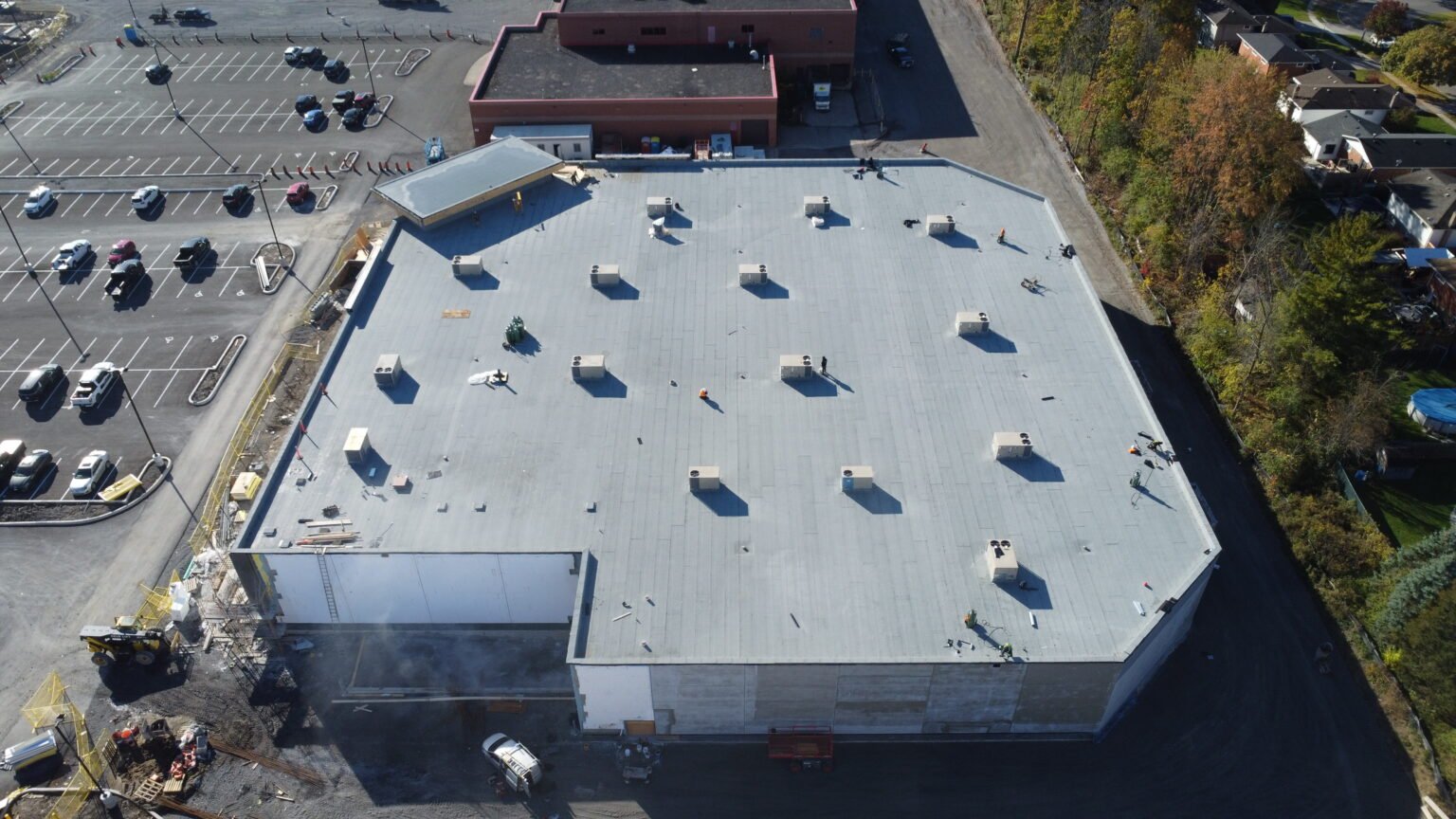
See our completed projects and roofing services. For lifespans, see how long a commercial flat roof lasts. For an active leak, see our pages on commercial roof leak repair in Toronto and in Mississauga.
Frequently asked questions
Can modified bitumen roofing be repaired?
Yes. Most problems on a modified bitumen roof are local: open laps, fishmouths, splits, punctures, bare spots and loose flashings. They are repaired with patches of the same membrane, torched, mopped with hot asphalt or set in cold adhesive, after any wet insulation below is replaced. Wide granule wear can be recoated or covered with a new cap sheet if the roof below is dry and sound.
How to patch a torch down a roof?
Sweep off loose granules, embed the granules with the torch or prime the area, then torch a base patch of like membrane at least 150 mm (6 in) past the damage, with clipped or rounded corners. A cap patch goes over it, 50 to 150 mm larger depending on the maker, and loose granules finish the edges. In Ontario, the Fire Code firewatch applies and the roofer needs propane training.
What is the best sealant for a modified bitumen roof?
A membrane patch is the repair; a sealant only seals details such as terminations, penetrations and membrane edges. For those, use an SBS-modified mastic from the same maker as the roof, such as SOPREMA's SOPRAMASTIC or IKO's AquaBarrier, both rated down to -10°C. Matching brands matters: SOPREMA does not accept other makers' sealants on its top warranties.
How to fix granule loss on roof?
On a modified bitumen roof, small bare spots are covered with bitumen melted from a scrap of membrane and fresh granules, or with a roof coating over the right primer. Wide wear is recoated and resurfaced, or covered with a new cap sheet. Fix the cause too: granule loss is worst in ponded water and along foot-traffic paths.
Does granular loss mean I need a new roof?
Usually not. A NIST field study found modified bitumen roofs with heavy granule loss that were still watertight. Granule loss speeds up aging, so it needs attention, but the real test is underneath: a moisture survey and test cuts show whether the insulation is dry. If it is, a recoat or a new cap sheet is usually a smaller job than a replacement.
Need a roof that lasts?
Tell us about your building and roof, and we will set up a roof assessment and a written quote.
Call 1-833-775-7663Request an assessment
Karol Rajkowski
Vice President · OYH Roofing
Karol Rajkowski is Vice President of OYH Roofing, an Oakville-based ICI flat-roofing contractor whose projects include the 52,300 sq ft IKO 2-ply modified bitumen roof at 777 Niagara St in Welland and the 8,500 sq ft roof for the City of Mississauga. Learn more about the OYH team.
Sources
- CRCA Canadian Roofing Reference Manual (2020): 13.1.2, potential problem areas; 13.2, repair roofing problems; 13.2.2, modified bitumen membranes; Chapter 5, modified bituminous membranes; 3.3, cold weather conditions; 1.3.6, propane handling; 1.5.3, torching.
- IKO Commercial Technical Specification Manual: Part 15, post-job and membrane repair (VER1225); Part 16, roof repair (VER1022); Part 3, decks and re-cover (VER1219); Part 5, asphalts, primers and adhesives (VER1225); Part 10, APP application (VER1219). IKO Diamond Shield Limited Warranty, Canadian sample (October 2021).
- SOPREMA Canada: General Conditions for Warranties, Roofing (March 2026); Materials Warranty sample (May 2026); Preventive Maintenance Guide; SOPRAMASTIC data sheet (January 2026). Resisto: Supreme Roof Repair and Super Roof Repair Low Temperature.
- Research: W.J. Rossiter and K.J. Denchfield (NIST), Observations from a field study of the performance of polymer-modified bitumen roofing, NISTIR 4972 (January 1993, U.S.). Tremco Brush Grade Mastic data sheet (U.S.). ASTM D4977, granule adhesion to mineral surfaced roofing. RCABC Roofing Practices Manual, roof maintenance (reprinted from RIEI).
- Ontario: Fire Code, O. Reg. 213/07, Division B, 5.11; O. Reg. 211/01, Propane Storage and Handling, s. 6; O. Reg. 215/01, Fuel Industry Certificates, ss. 47, 48 and 54; O. Reg. 213/91, Construction Projects, s. 42; Building Code, O. Reg. 163/24, Division B, 3.1.15.2 and Part 11; City of Toronto, when do I need a building permit (2026).
OYH Roofing, 2120 Speers Rd, Oakville, ON L6L 2X8 · 1-833-775-7663 · info@oyhroofing.ca