
Hotel Roof Repair in Ontario
How hotel roofs are repaired and replaced while guests sleep below: the fire safety plan, top-floor rooms, rooftop terraces and pools, and where the roof fits in the capital plan.
Call 1-833-775-7663 Oakville head office · Flat roofing for commercial and institutional buildings across the GTA
Karol Rajkowski
Vice President, OYH Roofing
Published November 17, 2026 · 12 min read
Short answer
Hotel roof repair uses the usual flat roof methods, planned around guests who are in the building day and night. Ontario treats a hotel as a residential occupancy, so before roof work with torches or other hot surface applications the Fire Code requires the hotel's fire safety plan to be revised, and sprinkler or standpipe shutdowns follow a notice schedule. Quiet, low-odour methods, work in phases and a plan for the top-floor rooms matter as much as the membrane.
What makes hotel roof repair different?
Hotel roof repair is flat roof repair over people who are asleep, working or on holiday below it, at any hour. Ontario's Building Code defines a hotel as floor areas with "four or more suites" that provide "sleeping accommodation for the travelling public or for recreational purposes", and classes it as a residential occupancy (Group C), the same group as apartments (Division A, 1.4.1.2, and Note A-3.1.2.1.(1)). Four things shape the work:
- Guests directly under the roof. The top floor is usually guest rooms. A leak takes rooms out of order, and noise or odour reaches guests who are paying to rest. In one hotel re-roof case study, leaks were "forcing the closure of several guest rooms, resulting in lost income".
- Fire rules for a sleeping building. Most hotels must have an approved fire safety plan and supervisory staff, and the Fire Code ties roof work into that plan.
- A crowded roof. Corridor make-up air units, rooftop units, kitchen and laundry exhausts, elevator penthouses and brand signs all pass through or sit on the membrane.
- Amenity roofs. Rooftop terraces, bars and pools put people and water on top of the waterproofing, and a restaurant or bar adds an assembly occupancy to the building.
Where do hotel roofs leak?
Mostly at the edges and around the equipment, not in the open field of the roof. In the Boston Marriott case study, the leaks forcing rooms out of service turned out to come from the walls: "We suspected that the problem was really with the thru-wall flashings."
| Where | Why it leaks | What the repair involves |
|---|---|---|
| Corridor make-up air units and rooftop units | Large curbs, condensate lines, gas piping and service traffic, often changed by mechanical trades after the roof went on | Curbs re-flashed to a proper height and service paths protected; see our rooftop equipment guide |
| Walls of the elevator penthouse and upper storeys | Water runs down the walls and gets behind base flashings and through-wall flashings | New base flashing and counterflashing; see our roof flashing repair guide |
| Kitchen and laundry exhausts | Grease from the restaurant's kitchen fans softens membranes; dryers vented through the roof leave lint around the outlet and in the drains | A grease-rated zone and containment at kitchen fans (see our restaurant roofing guide); lint cleared on every inspection |
| Brand signs, antennas and dishes | Sign frames and mounts added on the roof or parapet, each with its own penetrations or ballast | Mounts flashed by the roofer, not the sign installer, and recorded for the warranty holder |
| Terraces and pool decks | Membrane hidden under pavers, plus door sills and drains under constant use | Pavers lifted to reach the membrane; see terraces and pools below |
| Roof drains | Strainers blocked by debris and lint, and low spots at the drain | Clear, reset or replace the drain; see our roof drain repair guide |
Equipment changes are the classic cause. A facilities article on roof inspections notes it is "not unusual" to find "improper flashings and significant damage to the roof following a mechanical equipment upgrade project", and says new curbs and flashings should be "properly installed by the roofing contractor, not the mechanical contractor." Hotels upgrade make-up air units, add signs and replace antennas between roof replacements, so keep a record of every new penetration and who flashed it. Membrane warranties also exclude damage from later equipment added without the maker's written permission; our office guide explains how those warranty clauses read.
How do you keep guests comfortable during hotel roof work?
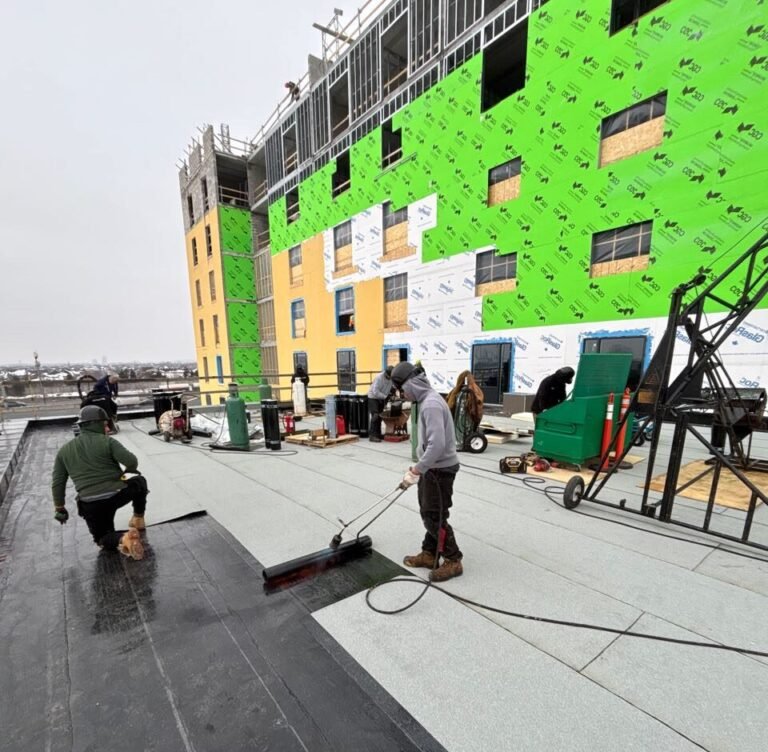
By planning the job around the guests first and the roof second. The published hotel re-roofs we found are U.S. case studies from Sika Sarnafil, and they read like the same checklist. On a 51,500 sq ft re-roof of a Marriott in Boston, the owner's "number one priority was 'don't inconvenience the guests'", and the planning "took several months before they even stepped foot on the job". What the crews did:
- Quieter tools and fewer screws. The Boston crew used "electric instead of pneumatic chipping equipment", hand tools instead of power tools in places, and "a low-rise foam adhesive for the insulation instead of mechanically attaching it". Screws driven into a steel deck are loud in the rooms below; adhered insulation avoids most of them, where the wind design allows it.
- The noisiest work at midday. On a 345-room resort, "We tried to do the noisiest work around lunch time, when most people are out and about," and the crew was ready "to stop work if guests complained about the noise."
- Work in small sections. In Boston the crew was "limited as to which roof areas we could work on each day". Each section is closed watertight before the crew leaves.
- Debris kept on the roof. A Hawaii resort job used "counter weights and debris nets" and 3,200 linear feet of screen at the roof edge, and an Oregon crew kept one worker on the ground "sweeping the walkways". In Ontario, debris must come down "by a chute, in a container or by a crane or hoist", never dropped (O. Reg. 213/91, s. 35(2)), and work on a building 4.5 m or less from a public way needs a covered way over the part next to the project unless the work is enclosed (s. 64). Plan the entrance, the drop-off lane and the patios before the bin arrives.
- Air units kept running. The same Hawaii job had "100 plus air handling fans, and those fans had to be kept working". Odour-heavy steps go where they will not be drawn into the corridor make-up air; our office guide covers keeping roofing odours out of the building.
- The front desk in the loop. "We had to coordinate our schedule with the front desk to make sure we didn't interfere with the guests."
The top floor needs its own plan. Rooms directly under a section where the deck is opened or re-fastened are usually blocked for those days, and rooms under quiet work stay on sale. The hotel knows its occupancy calendar; the roofer knows how many days each section takes. Put the two together before the schedule is signed. Loud work also has to respect the city's construction hours; our flat roof installation guide has construction noise hours for GTA municipalities. Niagara Falls, a large hotel market outside that table, bans construction equipment noise from 7:00 p.m. to 7:00 a.m., and until 9:00 a.m. on Saturdays, Sundays and statutory holidays (By-law 2024-044, Schedule 3).
What fire rules apply to roof work on a hotel?
The hotel's fire safety plan comes first. Ontario's Fire Code (O. Reg. 213/07, consolidation from January 1, 2026) requires an approved fire safety plan in buildings with a residential occupancy whose occupant load exceeds 10 (2.8.1.1.), which covers almost every hotel. Roof work changes that plan:
| Rule | What it says | What it means for the roof job |
|---|---|---|
| 2.8.2.1.(5) | "Before demolition or construction, including hot surface applications, commences in or on the building", the fire safety plan is revised to add temporary measures for occupants' safety and procedures to control the fire hazards of the work | Torch-on roofing and kettles are hot surface applications. The hotel updates its plan with the roofer's method before the first torch is lit |
| 2.8.2.2.(2) | Hotels keep enough supervisory staff to carry out the plan, and in buildings over 3 storeys or 4000 m² they are on duty whenever the building is occupied | The roofer has a named contact on every shift, including nights if work runs late |
| 6.5.2.2.(2) and 6.4.1.5 | In a hotel, sprinkler valves and standpipe systems are not shut down without notifying the Chief Fire Official on the schedule in the approved fire safety plan | If roof work needs any part of the sprinkler or standpipe system shut down, book it through the hotel and its sprinkler contractor |
| 6.3.1.3. and 6.3.1.5. | A fire alarm shut down is reported to the fire department, occupants and supervisory staff, and an alarm is not silenced until staff confirm there is no fire | Torch smoke or dust drawn into a unit can set off detectors. Plan with the hotel's engineer rather than disabling devices |
| 2.5.1.2. | Fire access routes and fire department connections are not obstructed by "vehicles, gates, fences, building materials" | Bins, lifts and material stacks stay clear of the fire route, the main entrance and the siamese connection |
The torch rules themselves are the same as on any building: combustibles protected, openings within 5 m covered, and a fire watch after the torches stop; our industrial guide covers torch safety over occupied buildings. On roofs over guest rooms, many owners avoid the question by choosing flame-free systems; our healthcare guide compares flame-free roof systems.
Carbon monoxide is the other residential rule. The Fire Code's carbon monoxide alarm section applies to buildings with a residential occupancy and a fuel-burning appliance (2.16.1.1.), and where a gas-fired unit heats a public corridor, alarms go in that corridor (2.16.2.1.(4)). If a rooftop make-up air unit is disconnected or moved for the re-roof, the licensed gas technician who reconnects it should confirm the alarms still work.
What about rooftop terraces, bars and pools?
An amenity roof is a floor that has to stay waterproof. The Building Code treats it very differently from a roof people only walk on to service equipment:
| Rule | What it says | What it means for the roof |
|---|---|---|
| Live load, 4.1.5.5.(3) and Table 4.1.5.3 | Exterior areas open to pedestrians are designed for at least the assembly-area live load, 4.8 kPa, against 1.0 kPa for an ordinary roof | Turning part of an existing roof into a terrace or bar needs an engineer's check and a building permit |
| Guards, 3.3.1.18.(1) | "a guard not less than 1 070 mm high" around a roof with access for other than maintenance | Guard posts and railing bases are penetrations; flash them like any curb or post |
| Exits, 3.3.1.3.(3) and (4) | A roof intended for occupancy needs a means of egress, and two separate ones if its occupant load is over 60 | Exit doors onto the roof need sills and flashings that stay watertight under traffic |
| Access, 3.8.2.1.(1)(b) | A barrier-free path of travel within "rooftop amenity spaces" | Low thresholds at the door make the flashing detail harder; plan it before the paving goes down |
Most terraces are built as a membrane under pavers set on pedestals, often with the insulation above the membrane, so the waterproofing is protected and the pavers can be lifted for repairs; our flat roof system guide explains when a protected membrane roof makes sense. Finding a leak under pavers is slow, which is why some owners install electronic leak detection when the terrace is built. On one U.S. resort deck over an electrical room, the test "found two leaks from some of the other trades before the roof was finished".
Pools are the hardest roofs in a hotel. The National Research Council's Canadian Building Digest 83 calls a pool "a large humidifier" and says humid air leaking into walls and roofs causes "failure of roofing systems", and can do so "at points remote from the swimming pool, especially at upper floors". Its advice still stands: continuous air and vapour barriers in the pool hall's walls and roof, continuous ventilation, and a separate air system for the pool. The building scientist Joseph Lstiburek adds that chlorine travels with the leaking air, and that roof fasteners over a pool "are both a thermal bridge and a moisture leak".
Under Ontario's Public Pools regulation, a hotel pool is a Class B pool, and if it is closed for more than four weeks, for example while the roof over it is replaced, the operator notifies public health in writing at least 14 days before reopening (R.R.O. 1990, Reg. 565, ss. 2 and 5(3)).
When should a hotel replace its roof, and how is it paid for?
On the roof's own schedule, which is not the brand's. "Should hotels be renovated every 7 years?" is a common question, and the seven years comes from franchise agreements for soft goods such as carpets and fabrics. IHG's 2025 franchise disclosure document for Crowne Plaza (U.S.) requires "replacement of Soft Goods at least every seven (7) years" and of case goods, such as furniture, at least every fourteen. Roofs are not on that clock; they fall under the franchisee's general duty to repair and maintain the hotel. Most commercial flat roofs in Ontario last about 20 to 30 years; our lifespan guide explains how long each roof system lasts.
The money is the harder part. Hotels usually set aside a reserve for replacements of about 4% to 5% of revenue, and the hotel consultant David Berins, writing in Hotel News Now (2019), argued that "Almost no one thinks the current method of capitalizing replacements of and renovations to not only FF&E, but building systems like elevators, roofs, chillers, windows and the like is working."
His fix is "a long-term (e.g. 20 years) rolling prediction of probable capital improvements", line by line. For a roof, that means a condition assessment with core samples and a moisture survey, a replacement year with a budget range, and a plan to phase the work in slow months. Our guides cover which roof assessment to order and the budget lines owners miss.
Buying a hotel is the other moment to look hard at the roof. A U.S. building forensics consultant, describing hidden moisture and mould in a hotel bought without a close look at the envelope, wrote: "None of these major issues had been uncovered by the PCA or the Phase 1 Environmental Report." He added that such failures "can drive costs up into the seven-figure range". See our guide to a roof inspection before buying a commercial building.
Has OYH Roofing worked on a hotel?
Yes. OYH Roofing installed the roof on a new-build Marriott hotel in Vaughan: 15,000 sq ft of 2-ply modified bitumen with a 20-year labour and materials warranty. Because it was new construction, the deck, insulation, curbs and parapet details were all built to the manufacturer's specification from the start.
OYH Roofing is an Oakville-based industrial, commercial and institutional flat roofing contractor working across the GTA. On an operating hotel, we can find and repair leaks over guest rooms, re-flash rooftop units, signs and terraces, plan quiet and low-odour work with your general manager and chief engineer, and phase a replacement around occupancy. See all our completed projects.
Frequently asked questions
Can a hotel stay open during a roof replacement?
Yes, and most do. The roof is replaced in sections that are closed watertight every day, the noisiest work is done at midday, adhered insulation replaces screws over occupied rooms where the design allows, and odour-heavy steps are kept away from the air intakes. Rooms directly under deck work are blocked for those days. The fire safety plan is revised before any torch work starts.
Do top-floor guest rooms have to be closed during roof work?
Not all of them, and not for the whole job. Rooms under a section where the deck is opened, re-fastened or torched are usually blocked for the days that section takes, because of noise, dust and the risk of a leak. Rooms under quiet work, or under sections already finished, stay on sale. Match the roofer's section schedule to the hotel's occupancy calendar.
Who has to be told before roof work starts on a hotel?
Inside the hotel, the general manager, the chief engineer and the supervisory staff named in the fire safety plan, which must be revised before torch or other hot work. The Chief Fire Official is notified, on the plan's schedule, if any sprinkler or standpipe system is shut down. Guests on affected floors should hear about noise ahead of time, and the city if loud work runs outside its construction hours.
How often should a hotel roof be replaced?
When its condition says so, not on the brand's renovation clock. Most commercial flat roofs in Ontario last about 20 to 30 years, and inspections, drainage and rooftop traffic decide where a particular roof lands. Plan the replacement in the hotel's long-term capital plan from a condition assessment, so it is not paid for out of a furniture reserve at the last minute.
Can we add a rooftop terrace or bar to an existing hotel roof?
Often, but it is a building project, not a roof repair. Ontario's Building Code designs areas open to pedestrians for at least 4.8 kPa, against 1.0 kPa for an ordinary roof, and requires 1,070 mm guards, exits and a barrier-free path. That means an engineer, a building permit, and a waterproofing system built for pavers and traffic.
A leak over guest rooms, or a roof replacement to plan around occupancy?
Send us photos of the ceiling and the roof, a roof plan with the units, terraces and signs marked, and your busy and quiet seasons, and we will plan the work around your guests.
Call 1-833-775-7663Request an assessment
Karol Rajkowski
Vice President · OYH Roofing
Karol Rajkowski is Vice President of OYH Roofing, an Oakville-based ICI flat-roofing contractor whose projects include the 15,000 sq ft roof of a new Marriott hotel in Vaughan and the 52,300 sq ft roof at 777 Niagara St in Welland. Learn more about the OYH team.
Sources
- Building and fire codes: Building Code, 2024 Building Code Compendium, Volume 1 (January 16, 2025 edition), Div. A 1.4.1.2 and Div. B 3.3.1.3, 3.3.1.18, 3.8.2.1, 4.1.5.5 and Table 4.1.5.3, with Note A-3.1.2.1.(1) in Volume 2; Fire Code, O. Reg. 213/07 (consolidation from January 1, 2026), Div. B 2.5.1.2, 2.8.1.1, 2.8.2.1, 2.8.2.2, 2.16, 6.3.1.3, 6.3.1.5, 6.4.1.5 and 6.5.2.2.
- Other Ontario laws: O. Reg. 213/91 (Construction Projects), ss. 35 and 64 (consolidation from April 20, 2026); R.R.O. 1990, Reg. 565 (Public Pools), ss. 2 and 5 (consolidation from January 1, 2025); City of Niagara Falls, Noise By-law 2024-044 (passed April 30, 2024), Schedule 3.
- Hotel re-roof case studies (U.S.): Sika Sarnafil, Marriott Long Wharf Hotel, Boston, Kaua'i Marriott Resort, Aston Kaanapali Shores and Hallmark Resort, Newport; Sika Sarnafil, Talking Stick Resort plaza decks.
- Roofs, pools and moisture: Facilitiesnet, Common Problems Found During Roof Inspections (U.S.); National Research Council, Canadian Building Digest 83, Indoor Swimming Pools (G.K. Garden, 1966); Building Science Corporation, BSI-055, In the Deep End (Joseph Lstiburek, November 2011).
- Hotel capital planning: David Berins, With CapEx, is it time to ditch replacements reserve?, Hotel News Now (February 26, 2019); IHG, Crowne Plaza Franchise Disclosure Document 2025 (U.S.), Item 10; Richard Scott, How to protect yourself from hidden mold problems during a purchase of a hotel, Building Design + Construction (March 1, 2019).
- OYH Roofing project records: new-build Marriott hotel, Vaughan (15,000 sq ft, 2-ply modified bitumen) and 777 Niagara St, Welland (52,300 sq ft).
OYH Roofing, 2120 Speers Rd, Oakville, ON L6L 2X8 · 1-833-775-7663 · info@oyhroofing.ca