
Office Building Roof Repair in Ontario
How office roofs get repaired while tenants work below: leaks over ceilings and server rooms, window-cleaning anchors, rooftop antennas, after-hours work and odour.
Call 1-833-775-7663 Oakville head office · Flat roofing for commercial and institutional buildings across the GTA
Karol Rajkowski
Vice President, OYH Roofing
Published November 16, 2026 · 14 min read
Short answer
Office building roof repair uses the same fixes as any commercial flat roof, planned around the people and equipment below. Most office roof leaks start where something passes through the membrane: rooftop units, window-cleaning anchors, antenna mounts and cable entries. Ontario adds steps: anchors the work disturbs are logged and checked before window cleaners use them again, antenna operators control access near their equipment, and loud work at night or on Sundays needs a city exemption in Toronto.
What makes office building roof repair different?
Office building roof repair is flat roof repair on a building that is full of people from Monday to Friday. The membranes and repair methods are the same as on any commercial roof. Four things change the plan:
- What sits under the roof. Suspended ceilings, desks, computers, server rooms and electrical rooms. Aviva Canada says roof leaks "consistently represent one of the top 3 leading causes of loss" for the insurer, and suggests starting leak sensors in "the mechanical and electrical rooms".
- A roof shared with other trades. Office roofs carry rooftop units, window-cleaning anchors and davit bases, and often cell antennas. The Infrastructure Health and Safety Association's advisory on rooftop antennas opens: "Many building owners are leasing their rooftops to telecommunication companies." Each of these goes through the membrane or sits on it, and most were installed by someone other than the roofer.
- Landlord, property manager and tenants. In a multi-tenant office, the lease decides who orders and who pays for the repair, and tenants need to know when work will be loud or smelly.
- Working hours. Tenants want quiet days, and city noise by-laws limit loud work at night and on Sundays. The repair plan has to fit between the two.
Low-rise suburban offices usually have one large roof with many rooftop units. Mid-rise and high-rise offices add a mechanical penthouse, window-cleaning anchors along the roof edge, and lower roofs over podiums and entrances that take water off the walls above. Our roofing guide for property managers covers the roof file, capital plans and tenders; this guide stays with the repair.
Where do office building roofs leak?
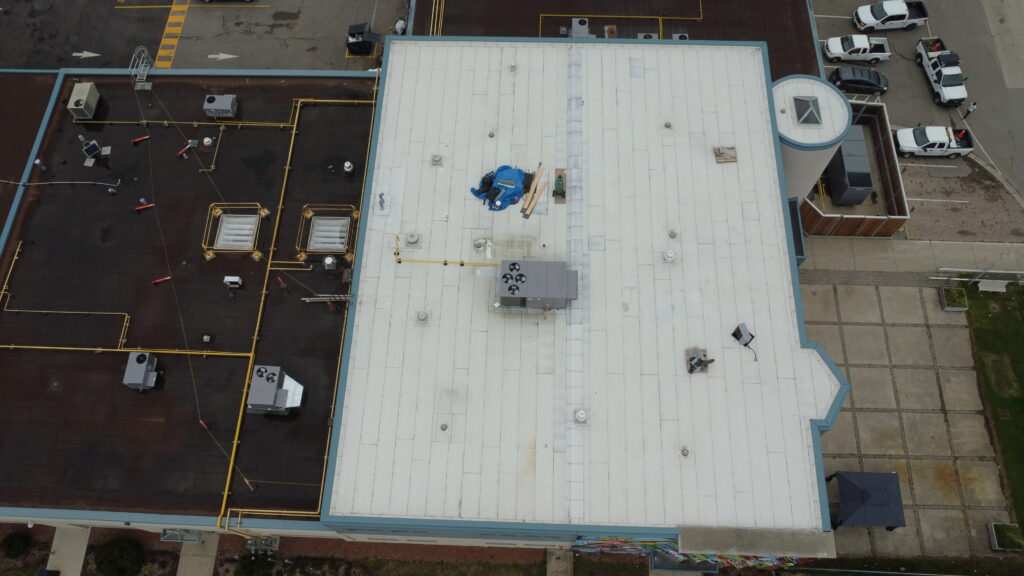
Mostly where something passes through the membrane or stands on it, and where a low roof meets a taller wall. The table lists the usual places on an office roof.
| Where | Why it leaks | What the repair involves |
|---|---|---|
| Rooftop units, curbs and ducts | Many curbs, refrigerant lines and condensate drains, and service technicians kneeling and walking around them | Re-flash the curb to the proper height and protect the service paths; see our rooftop equipment guide |
| Window-cleaning anchors and davit bases | Each post passes through the membrane, and the anchor maker leaves the seal to the roofer: one Ontario shop drawing reads "ALL FLASHING & SEALING - BY OTHERS" | A proper post or prefabricated anchor flashing. U of T's standard says "Pitch boxes, pitch pans, or plastic boxes are not acceptable" at penetrations |
| Antenna frames, cable trays and cable entries | Cables run over parapets and through flashings, and ballasted frames wear the membrane | Cables in a tray on pavers, not through the edge: "Do not secure multiple cables through perimeter metal flashings" (U of T). Single cables enter through a "spun aluminum goose neck with a rubber end cap" |
| Walls of the penthouse and upper floors | Water runs down the walls and windows onto the lower roof and gets behind the base flashing | New base flashing and counterflashing; see our roof flashing repair guide |
| Roof drains | Blocked strainers, loose clamping rings and low spots around the drain | Clear, reset or replace the drain; see our roof drain repair guide |
Equipment added after the roof was installed also puts the warranty at risk. IKO's sample commercial membrane warranty excludes damage after the roof is altered, naming equipment such as "air conditioning equipment, television antennas and skylights", unless a written request reaches IKO in advance, an approved contractor does the work, and "IKO provides written permission for such alterations". The CRCA's standard contractor warranty says the completed roof "shall not be altered in any manner" without the contractor's prior written consent. So before a tenant, a carrier or a mechanical contractor cuts into the roof, check both warranties. Our property manager guide compares the leak notice terms in two of them.
What should you do when a roof leak reaches ceilings, server rooms or electrical rooms?
Deal with electricity and people first, then the water, then the roof:
- Keep people and power apart. If water reaches a panel, a server rack or an electrical room, have a licensed electrical contractor make it safe. Ontario's Electrical Safety Code (Rule 2-032 3), as quoted by the Electrical Safety Authority) says equipment that has been exposed to water "shall be subjected to evaluation to ascertain whether or not the equipment may be placed back into service". ESA adds that allowing equipment and wiring to "dry out" and then re-energizing it "is not a recommended practice".
- Catch and contain the water. Buckets under the drips, plastic over desks and equipment, and anything movable moved away from the wet area.
- Take down wet ceiling tiles. The Canadian Construction Association's mould guideline (CCA 82, 2004 edition) asks for wet materials to be dried "within 24 hours (48 hours maximum)", and says absorbent ceiling tiles "cannot be effectively dried and should be immediately discarded and replaced." The U.S. EPA's guide for commercial buildings gives the same 24 to 48 hours.
- Record it and call the insurer. Photos of the ceiling and the roof above, the date, the time and the weather. Aviva's list for after a water emergency starts with "document damage, contact insurance company".
- Call the roofer, and the warranty holder. Our leak detection guide lists what to tell the roofer, and most membrane warranties set a notice deadline.
In office building roof repair, the first visit is usually a search and a temporary seal. Water on a flat roof often travels before it drips, so the hole is rarely right above the stain; our guide explains why a flat roof leak is rarely under the stain. Once the source is found and the roof is dry, the permanent repair can be scheduled around the tenants.
How are window-cleaning anchors handled during roof repair?
Carefully, and with paperwork. Ontario's Building Code requires anchor systems on larger buildings where window cleaning or other suspended maintenance is planned and "any portion of the roof is more than 8 m above adjacent ground level" (Division B, 4.4.5.1, in the January 16, 2025 edition of the 2024 Code; the 2012 Code had the same rule at 4.4.4.1). They are designed, installed and tested to CSA Z271, or CSA Z91 on older buildings. Two regulations under the Occupational Health and Safety Act then govern their use, and both reach roof repair:
| Rule | What it says | What it means for roof repair |
|---|---|---|
| Reg. 859, s. 39 | The owner keeps sketches of all anchor points and posts a copy "near the entrance to the roof" | The roofer gets the anchor layout before work starts, so nobody cuts, buries or damages an anchor by mistake |
| Reg. 859, s. 41 | Anchors are inspected by a competent person before first use and at least once a year; the log book records "any modifications or repairs made to an anchor point", with the date, name and signature of the person who made them | Re-flashing, raising or re-setting an anchor goes in the log, and the owner makes sure the anchor is fit for use before window cleaners hang from it again |
| O. Reg. 213/91, s. 141.4 | Fixed supports for suspended work platforms are inspected by an engineer before first use and "after every time that it is repaired or modified", and the owner keeps a permanent record | If the roof work touched a fixed support for swing stages, book the engineer's inspection before the next suspended job |
| O. Reg. 213/91, s. 26.7 | A permanent anchor system "shall be used" as the fixed support for workers' fall protection if it was installed according to the Building Code and "It is safe and practical to use the anchor system as the fixed support" | Roofers tie off to the building's anchors where they qualify, but not to an anchor the crew has loosened or that has not been checked |
Anchor makers expect the roofer to seal the anchor. The davit base drawing in a 2017 federal tender for an Ontario building says "ALL FLASHING & SEALING - BY OTHERS", and tells the installer to "NOTIFY ENGINEER OF ANY DEVIATIONS OF THE POSITION OR DETAILS" of the cast-in parts. Owners' own standards go further. The University of Toronto's roofing design standard has anchors "signed and stamped by a professional engineer licensed in Ontario", and says: "For reroofing projects, anchors are to be installed during the roof replacement project."
For an office building roof repair near the anchors, a sensible order is:
- Get the anchor plan and the log book from the property manager or the window-cleaning contractor.
- Agree which anchors the roofer will re-flash, and how. A lasting flashing goes up the post, not into a pitch pan.
- If new insulation will raise the roof surface, ask the anchor maker or the engineer whether the posts need to be extended before the roofer starts.
- Record the work in the log, and have the anchors inspected before the next window cleaning or swing stage job.
What if there are cell antennas on the office roof?
Then the roof has a second operator, with its own safety rules. Under Innovation, Science and Economic Development Canada's antenna procedures, "It is the responsibility of proponents and operators of installations to ensure that all radiocommunication and broadcasting installations comply with Safety Code 6 at all times" (CPC-2-0-03). Where exposure is too high, the operator's corrective measures include signs, locked fences or doors, "and/or changes to the station's parameters" (CPC-2-0-20), with bilingual warning signs at least 20 cm by 30 cm.
For roofers, the practical guidance comes from the Infrastructure Health and Safety Association. Its advisory W121 (October 2018) says personnel "should maintain a minimum distance of 2 metres (6.5 feet) from these devices" and not stand directly in front of them, and that some areas cannot be entered unless the equipment is "powered down to a safe level or completely shut off." It says the site owner should keep the most recent Safety Code 6 attestation, and warns: "If an attestation has not been carried out, there will be no sign and no way to verify the area is safe."
So before roof work near antennas:
- Find the carrier's site contact in the rooftop licence agreement, or through the property manager.
- Ask for the latest attestation and a roof plan showing the areas to stay out of.
- Book any power reduction early. We found no Canadian carrier that publishes a standard notice period; the rooftop licence and the carrier set it.
- Leave the carrier's equipment to the carrier. Ballasted frames, cable trays and cables belong to them; the roofer works around them, or the carrier's crew moves them.
- Check the roof warranty before any new antenna or cable entry goes in. IKO's sample warranty lists "television antennas" among the alterations it excludes without its written permission.
Can office building roof repair be done after hours or on weekends?
Quiet work, yes. Loud work at night or on Sundays usually needs a city exemption. Toronto's noise by-law treats repair as construction and bans construction sound that is clearly audible "From 7 p.m. to 7 a.m. the next day, except until 9 a.m. on Saturdays" and "All day on Sundays and statutory holidays" (Municipal Code Chapter 591, s. 591-2.3).
Mississauga bans construction equipment from 7 p.m. to 7 a.m. and all day on Sundays and statutory holidays, but its rule applies where the sound is "clearly audible at a point of reception" in a residential area or quiet zone (Noise Control By-law 0360-1979, s. 4 and Schedule 2). An office in a business park with no homes nearby may fall outside it, so check with the City before planning night work.
| Toronto | Mississauga | |
|---|---|---|
| Who decides | Executive Director, Municipal Licensing and Standards; the ward councillor is notified and can object | The City (Licensing, Permits and Regulatory Services) |
| When to apply | At least 28 calendar days before the work, with a noise mitigation plan; later costs a late fee | At least six weeks before the date |
| Fee | $114.40, $353.60 or $592.80 by level on the 2024 form | $294.42 including HST; an exemption lasts up to six months |
In practice, the loud parts of a repair, such as cutting out wet insulation, power tools and generators, are done on weekdays, and the quiet parts, such as inspections and hand-applied flashing repairs, can be done early or late.
Owners write this into their specifications. Health Canada's 2023 roof replacement specification for its Radiation Protection Bureau building in Ottawa asked bidders to "include in the bid an allowance for the performance of off-hours work should it be required", gave "minimum 48 hours notification if services are to be interrupted", and had furnishings in the work area covered "with (6 mil) polyethylene film during construction". The National Research Council's 2023 roof tender in Ottawa set normal hours of 8:00 a.m. to 4:30 p.m., Monday to Friday, with permission needed for anything outside them.
Tell the tenants what is coming and when. In commercial buildings the lease sets the notice rules; see what tenants need to be told about roof work.
How do you keep roofing odours out of the offices?
By choosing the method with the tenants in mind and planning around the air intakes. Hot asphalt, torch work and solvent-based adhesives all smell, and rooftop units pull outside air straight into the offices. The CRCA's roofing manual, in its guidelines for roofing adhesives on occupied buildings, says: "When at all possible, the air intake system should be completely shut down if the intakes are on the roof." Health Canada's Ottawa specification also asked for a "portable supply of outside air and exhaust fans to ensure fumes will not impact workmen or building occupants."
- Self-adhered membranes and flashings need no torch and no solvent adhesive. Elevate, which makes them, lists "no harmful fumes" among the advantages; that is the maker's claim, but there is no flame and no solvent to smell.
- Odour-heavy steps go early or after hours, with the nearest intakes shut down or protected by the building operator and restarted once the area is sealed.
- Torch work brings its own rules: a fire watch after the torches stop, under Ontario's Fire Code. Our industrial roof repair guide covers torch safety on occupied buildings.
Our healthcare roofing guide goes further into protecting air intakes from dust and odour, for buildings where it matters most.
Who pays for an office roof repair: the landlord or the tenant?
The lease decides. Ontario's Commercial Tenancies Act says nothing about roof repairs, so the repair, replacement and capital-cost clauses of each lease do the work, and courts read them closely.
In most multi-tenant office buildings the landlord controls the roof, orders the repairs and recovers the cost through operating costs where the lease allows it. Whether a roof replacement shows up in those costs depends on the wording: many leases exclude capital costs, and others let the landlord recover them over the roof's useful life. In 402 Mulock v. Wheelhouse (2022), the Ontario Court of Appeal treated replacing the membrane on a whole building as a capital repair or replacement; our plaza guide covers who pays for roof repair under Ontario leases, with the leading cases.
Equipment that belongs to someone else raises a second question. A tenant's supplementary air conditioning unit or a carrier's antenna frame can cause the leak, and the lease or the rooftop licence should say who repairs the roof around it. Our plaza guide explains who looks after tenants' rooftop units; the same questions apply in an office building. Before work starts, confirm in writing who orders the repair, who pays, and whether the cost goes into operating costs.
Does OYH Roofing do office building roof repair?
Yes. OYH Roofing is an Oakville-based industrial, commercial and institutional flat roofing contractor working across the GTA. Our published projects do not include an office tower, so we do not claim one. The closest is the City of Mississauga building at 3185 Mavis Rd, a municipal building where we installed 8,500 sq ft of IKO 2-ply modified bitumen with a 20-year system warranty, around rooftop units and gas lines. At 777 Niagara St in Welland, we roofed 52,300 sq ft of a commercial building, also with a 20-year warranty.
On an office building, we can find and repair leaks, re-flash rooftop units, anchors and cable entries, work with the window-cleaning contractor and the carrier, and plan loud or smelly work around your tenants. See all our completed projects.
Frequently asked questions
Is a leaking roof considered a structural issue?
Not usually at first. Most roof leaks come from the membrane or a flashing, not the structure. But water left in the roof soaks the insulation, rusts steel decks and rots wood, and wet insulation and ponding add weight. If the deck sags, rust shows through the ceiling, or the roof feels soft underfoot, have a structural engineer look at it before anyone works on that area.
Who is typically required to warranty the roof against leaks?
Usually two parties. The roofing contractor warranties its workmanship, for example on the CRCA's standard form, and the membrane maker issues a material or system warranty. Both expect to hear about leaks quickly, and both can refuse cover if the roof was altered without their written consent. Call the original roofer first while the warranties run, and check what equipment was added since.
What happens if a roof leak in an office is left untreated?
The damage spreads, inside the building and inside the roof. The Canadian Construction Association's mould guideline asks for wet materials to be dried within 24 hours, 48 at most, and says absorbent ceiling tiles should be thrown out. Electrical equipment that got wet must be evaluated before it goes back into service. On the roof, wet insulation spreads well past the leak, which can turn a repair into a replacement.
Can office roof repair be done at night or on weekends?
Quiet work, yes. In Toronto, clearly audible construction noise is banned from 7 p.m. to 7 a.m., until 9 a.m. on Saturdays, and all day on Sundays and statutory holidays, unless the City issues an exemption permit, applied for at least 28 days ahead. Mississauga's ban applies where the noise is clearly audible in a residential area or quiet zone, and its exemption needs six weeks' notice.
Can a tenant or a cell carrier put equipment on the office roof?
Only with the landlord's consent under the lease or the rooftop licence, and the roof warranty needs its own approval. IKO's sample commercial warranty excludes damage from alterations such as antennas and air conditioning units unless IKO gets a written request in advance, an approved contractor does the work, and IKO gives written permission. Have a roofer flash every new penetration.
A leak over an office, or roof work to plan around tenants?
Send us photos of the ceiling and the roof, the roof plan with the anchors and antennas marked, and your tenants' working hours, and we will plan the repair around them.
Call 1-833-775-7663Request an assessment
Karol Rajkowski
Vice President · OYH Roofing
Karol Rajkowski is Vice President of OYH Roofing, an Oakville-based ICI flat-roofing contractor whose projects include the City of Mississauga building at 3185 Mavis Rd and the 52,300 sq ft roof at 777 Niagara St in Welland. Learn more about the OYH team.
Sources
- Ontario laws: R.R.O. 1990, Reg. 859 (Window Cleaning), ss. 39, 41 and 43 (consolidation from July 1, 2022); O. Reg. 213/91 (Construction Projects), ss. 26.7 and 141.1 to 141.4 (consolidation from April 20, 2026); Building Code, 2024 Building Code Compendium, Volume 1 (January 16, 2025 edition), Div. B 4.4.5.1, and O. Reg. 332/12, 4.4.4.1.
- Electrical safety and wet materials: Electrical Safety Authority, Guideline: In the Event of Flooding, Water Ingress or Damage (revised May 1, 2025); Canadian Construction Association, CCA 82, Mould Guidelines for the Canadian Construction Industry (2004 edition, s. 6.5); U.S. EPA, Mold Remediation in Schools and Commercial Buildings, Chapter 4; Aviva Canada, Tips for protecting your commercial or residential building from water damage (February 28, 2022).
- Rooftop antennas: ISED, CPC-2-0-03, Radiocommunication and Broadcasting Antenna Systems (Issue 6, July 2022) and CPC-2-0-20, Radio Frequency (RF) Fields: Signs and Access Control (Issue 1, March 2013); IHSA, Technical Advisory W121, Exposure to Electromagnetic Radiation from Rooftop Antennas (October 2018).
- Noise rules: City of Toronto, Municipal Code Chapter 591, Noise and Noise Exemption Permit, Construction (August 2024); City of Mississauga, Noise Control By-law 0360-1979 and Apply for a noise exemption (updated April 7, 2026).
- Roofing practice and warranties: University of Toronto Facilities and Services, Roofing Design Standard 07 00 00 (November 28, 2023); CRCA, Canadian Roofing Reference Manual, 7.2.8 Installation Precautions (March 13, 2020) and standard form of warranty; IKO, limited labour and membrane warranty sample; Elevate, Is Elevate SA right for your next roof?
- Owner specifications: Public Services and Procurement Canada, roof anchors appendix (2017); Health Canada, Specifications for Roof Replacement, 775 Brookfield Road, Ottawa (March 2023); National Research Council, M-50 Roof Section 4 tender (February 2023).
- OYH Roofing project records: City of Mississauga, 3185 Mavis Rd (8,500 sq ft, IKO 2-ply modified bitumen) and 777 Niagara St, Welland (52,300 sq ft).
OYH Roofing, 2120 Speers Rd, Oakville, ON L6L 2X8 · 1-833-775-7663 · info@oyhroofing.ca