
Commercial Roof Inspection: What It Includes and When
What a flat roof inspection checks, how often to book one, what the report should show and what to check before you buy a building.
Call 1-833-775-7663 Oakville head office · Flat roof repairs, replacements and inspections for commercial, industrial and institutional buildings across Ontario
Karol Rajkowski
Vice President, OYH Roofing
Published October 9, 2026 · 10 min read
Short answer
A commercial roof inspection checks the membrane, seams, flashings, rooftop units, drains, roof edges and the ceiling below for damage, wet insulation and ponding, and records it all in a report with photos. In Ontario, book one every spring and fall, after severe storms, and before you buy a building.
What does a commercial roof inspection include?
A commercial roof inspection covers the whole roof, inside and out: the ceiling and deck underside, the membrane, every seam, flashing and penetration, the drains and the roof edges. National Research Council Canada (NRC) makes the key point: flashings and seals cover a very small part of the roof, but most leaks start when they fail.
| Area | What the inspector looks for | Why it matters |
|---|---|---|
| 1. Inside the building | Ceiling stains, rust or spalling on the deck underside, condensation | Shows where water already gets in, often far from the opening |
| 2. Membrane field | Blisters, splits, ridging, punctures, worn surfacing, debris | An opening in the field lets water into the insulation |
| 3. Seams and laps | Open laps, fishmouths, failed welds or tape | Seams move with every temperature swing |
| 4. Flashings at walls, parapets and curbs | Height, adhesion, splits, loose counterflashing, failed sealant | Most leaks start at flashings and seals |
| 5. Penetrations and rooftop units | Pipe boots, pitch pans and their filler, curbs, condensate lines, damage near equipment | Service traffic and vibration open these details |
| 6. Drains, scuppers and gutters | Debris, loose clamping rings, water still there 48 hours after rain | Blocked drains cause ponding and extra load |
| 7. Roof edges and metal | Loose edge metal, copings and fascia, popped fasteners | Wind damage starts at the perimeter |
| 8. Skylights and hatches | Cracked glazing, failed seals, curb flashings | A common leak point, and a fall hazard on the roof |
| 9. Moisture in the insulation | Soft or spongy areas; a moisture survey and core cuts where needed | Wet insulation hides under a sound-looking membrane |
Elevate's Canadian inspection brochure names three main leak factors: rooftop traffic and trades, punctures and tears, and ponding from clogged drains. Our guides cover the usual repairs: roof flashing repair, membrane roof repair and ponding water on a flat roof.
How often should a commercial roof be inspected?
At least twice a year, in spring and fall, plus after heavy rain, high winds, hail or ice storms and after any work on rooftop equipment. That is the advice of the Canadian Roofing Contractors Association (CRCA), the NRCA, and makers such as Carlisle, Sika Canada and Elevate.
| When | Why |
|---|---|
| Spring, after the snow melts | A flat roof inspection then finds winter damage from ice, ponding and snow clearing |
| Fall, before the snow | Clears drains and closes open details before freeze-thaw cycles |
| After heavy rain, high winds, hail or an ice storm | Damage is cheaper to fix, and easier to document for your insurer, when it is found early |
| After rooftop equipment is installed or serviced | Rooftop traffic and other trades are among the main causes of leaks |
| Before you buy or lease a building | Sets a baseline and shows what the price should account for |
Some warranties ask for a commercial roof inspection more often. IKO's owner's guide for its TPO system says to inspect at least quarterly, and Carlisle recommends an inspection every six months for continued warranty coverage. Our guide on how to prepare a flat roof for winter covers the fall visit in detail.
Inspections also protect the warranty. Sika Canada says warranties can be voided by a lack of regularly scheduled inspections and maintenance, and IKO's Canadian built-up roof warranty excludes damage when the owner does not follow a maintenance program recommended by the CRCA or NRCA. Leak notices have deadlines: 7 days in writing for Sika Canada, and 30 days by certified mail, with a $200 inspection cheque, for that IKO warranty. Our commercial roof warranty guide explains what else can void coverage.
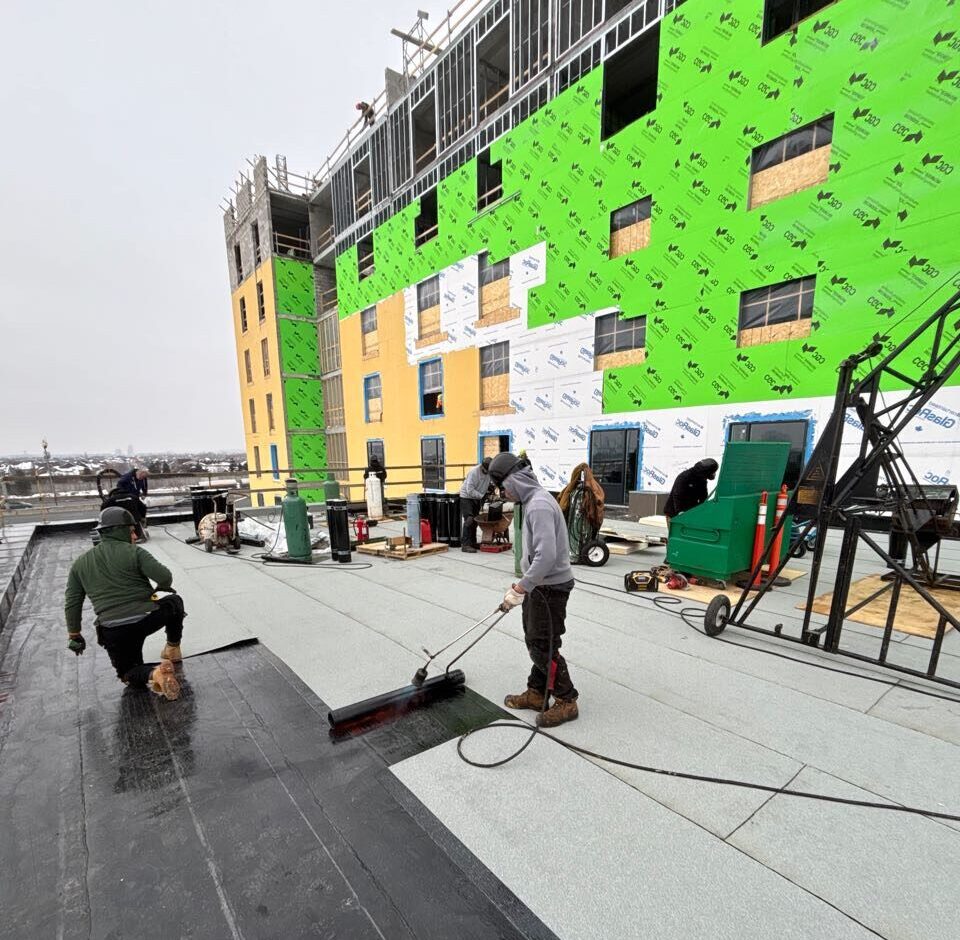
What should a commercial roof inspection report include?
A useful report shows what is wrong, where it is and what to fix first. The RCABC's Roofing Practices Manual has inspectors rate each roof area by condition, set repair priorities and mark them on a roof plan, and the NRCA says conditions should be written down, photographed and kept for comparison at the next inspection.
- A roof plan showing every drain, penetration and rooftop unit, with each problem marked on it.
- Dated photos of each finding. Carlisle asks for at least six photos for each inspection in its Continu-Care program.
- A condition rating for each item, such as OK, minor or major, as on the RCABC checklist.
- Priorities: emergency repairs, maintenance repairs, and recover or replacement planning.
- Moisture survey results, confirmed with core cuts, when a survey was done.
- Recommendations and timing, so repairs can go into the budget.
Keep every report with the warranty, the as-built drawings and repair invoices; the RCABC calls this the roof's historical file. Carlisle's owner's manual also asks owners to keep logs of inspections, rooftop traffic and service work.
Due for a roof inspection?
We will inspect the roof, photograph what we find and give you a written report with priorities, before the snow arrives.
Call 1-833-775-7663Request an assessmentWhat is the difference between an inspection, a condition assessment and a moisture survey?
A visual commercial roof inspection looks at the surface and the details. A roof condition assessment adds a full report with a roof plan, ratings and priorities. A moisture survey finds wet insulation the eye cannot see. Survey methods only point to likely wet areas, so NRC says their results should always be verified by destructive testing, such as core cuts.
| Method | How it works | Limits | Standard |
|---|---|---|---|
| Visual inspection | Walk the roof and check the interior below | Cannot see wet insulation under the membrane | NRCA, CRCA and manufacturer guides |
| Roof condition assessment | Inspection plus a roof plan, condition ratings, priorities and repair or replace advice | Only as good as the testing behind it | RCABC Roofing Practices Manual |
| Infrared survey | At night after a sunny day, wet insulation holds heat longer and shows on a thermal camera | Needs a dry roof clear of snow; does not show where water got in | ASTM C1153 |
| Electrical impedance scan | A scanner reads relative moisture across the roof | Not for metal, black EPDM or foil-faced materials | ASTM D7954 |
| Nuclear survey | A gauge counts hydrogen on a 5 to 10 ft grid | Bitumen and concrete also contain hydrogen; relative readings only | ANSI/SPRI/IIBEC NT-1 |
| Electronic leak detection | A low or high voltage current finds breaches in the membrane | Needs a conductive layer directly under the membrane | ASTM D7877, D8231 |
| Core cuts | Small cuts down to the deck show what is inside | Get the warrantor's approval first; check older roofs for asbestos | NRC guidance |
In Ontario, an infrared survey is a warm-season job. NRC's building condition assessment protocol has the roof scanned after sunset in warm weather, and Fluke's survey checklist asks for a roof clear of snow, dirt and debris. A late spring to early fall survey, timed with a regular commercial roof inspection, gives the clearest picture.
What should a roof inspection cover before you buy a commercial building?
More than a standard property condition assessment. ASTM E2018, the usual framework for those reports, describes a walk-through and document review that is not technically exhaustive and does not remove materials. Before you buy, add a moisture survey with core cuts and ask the seller for the roof's records.
- The warranty, and whether it transfers. IKO's Diamond Shield can be transferred once, with 30 days' written notice to IKO, a $750 fee and IKO's consent; IKO's labour and membrane warranty cannot be transferred at all.
- Every inspection report, leak record and repair invoice. The RCABC calls this the roof's historical file.
- As-built drawings and the roof plan. Do not count on the municipality: the Town of Oakville, for example, keeps the drawings filed for a permit, not as-built drawings.
- The age and system of the roof, and the dates of rooftop equipment added since.
- An asbestos check on older built-up roofs. NRC notes that built-up roofs installed before September 1990 often used asbestos felts.
Ask for the remaining life of the roof in the roof condition assessment as well. CMHC's capital replacement planning manual has condition surveys estimate normal life and remaining life for each component, and the answer belongs in your price. Our guides to commercial flat roof lifespan, the commercial roof warranty and tar and gravel roofs help read the findings.
Who should inspect a commercial roof, and is it safe?
A qualified roofing contractor or an independent roof consultant, never building staff. Ontario does not require roofers to be certified, since roofer is a non-compulsory trade, so ask who will do the commercial roof inspection and what training they have. Independent consultants may hold voluntary IIBEC designations such as Registered Roof Consultant, which calls for at least four years of roof consulting and 70 hours of continuing education.
A roof inspection is also work at height. Under Ontario's construction projects regulation, a worker who could fall more than 3 m must be protected, by a guardrail first and otherwise by travel restraint, fall restricting or fall arrest, and the employer needs written rescue procedures before fall arrest is used. Workers who use fall protection on a construction project need Working at Heights training from a provider approved by the Chief Prevention Officer, valid for 3 years.
Skylights deserve special care. Ontario's Ministry of Labour says every skylight must be considered a fall hazard unless a licensed professional engineer confirms its strength, and one of its alerts describes a roofer who sat on a snow-covered skylight that gave way. The Ministry's flat-roof guidance also keeps workers at least 2 m from the roof edge. Staff should check only from inside and from the ground; our winter guide lists what building staff can check without going on the roof.
OYH Roofing inspects and maintains commercial, industrial and institutional flat roofs across Ontario. Our maintenance programs cover spring and fall inspections, drain clearing, flashing and seam checks, and photo records of the roof from year to year. You can see our work on the completed projects page, including the 53,000 sq ft industrial recover in Mississauga and the Marriott Hotel in Vaughan.
Frequently asked questions
What do they look for in a roof inspection?
On a commercial flat roof, an inspector looks for damage to the membrane, open seams, failed flashings at walls and curbs, damaged pipe boots and pitch pans, blocked drains, ponding, loose edge metal and cracked skylights. Inside, they check ceilings and the deck underside for stains, rust and condensation. A moisture survey finds wet insulation the eye cannot see.
What is included in a Building Condition Assessment?
A building condition assessment reviews the main building systems, including the roof, through a walk-through, document review and interviews, and reports deficiencies with opinions of costs. ASTM E2018 describes it as not technically exhaustive, and CMHC condition surveys add normal and remaining life for each component. For the roof, add a moisture survey with core cuts.
What is a roof inspector?
A roof inspector is the person who checks a roof's condition and reports on it, usually a roofing contractor or an independent roof consultant. In Ontario, roofer is a non-compulsory trade, so certification is voluntary. Independent consultants may hold IIBEC designations such as Registered Roof Consultant or Registered Roof Observer. Ask about their experience with your roof system.
How often does a commercial roof need to be replaced?
Most commercial flat roofs in Ontario last 20 to 30 years before replacement. Makers rate TPO at 20 to 30 years and SBS modified bitumen at about 25 to 30, and well-kept PVC and EPDM roofs can pass 35. Regular inspections and timely repairs keep a roof toward the top of its range. Our commercial flat roof lifespan guide has the details.
What does a working on roof risk assessment include?
In Ontario it starts with a job hazard analysis of the roof: edges, skylights, hatches and other openings, access, weather and wet surfaces. It then sets the fall protection, such as a barrier 2 m from the edge, guardrails, covers or travel restraint, and adds fall clearance and a written rescue plan, as in IHSA's fall protection work plan.
What does commercial roofing consist of?
A commercial flat roof is a system: the structural deck, an air and vapour barrier, insulation, often a cover board, and the waterproof membrane, such as modified bitumen, TPO, PVC or EPDM, with flashings at walls, curbs, drains and edges. A commercial roof inspection checks every layer it can reach, and a moisture survey checks the insulation.
Buying a building or planning a roof budget?
Book an inspection and get a written report with photos, priorities and the next steps for the roof.
Call 1-833-775-7663Request an assessment
Karol Rajkowski
Vice President · OYH Roofing
Karol Rajkowski is Vice President of OYH Roofing, an Oakville-based ICI flat-roofing contractor whose projects include the City of Mississauga building at 3185 Mavis Rd and the Marriott Hotel in Vaughan. Learn more about the OYH team.
Sources
- Inspection and Maintenance of Flat Roofs, Canadian Building Digest 179, NRC, 1976 (historical series).
- Reroofing considerations, Smith, NRC, 2005, and Protocols for Building Condition Assessment, NRC, 1993.
- Roofing Preventative Maintenance, Canadian Roofing Contractors Association advisory, June 2014.
- Tech Today, Professional Roofing (NRCA), April 2012; Surveying roof moisture, Professional Roofing, December 2025; Collaborating with consultants, Professional Roofing, July 2013; and the NRCA glossary: ponding.
- Roof Maintenance, RCABC Roofing Practices Manual.
- Technical Bulletin 005: Roof Maintenance Guide, Sika Canada, 2020.
- Innovi TPO Building Owner's Guide, BUR Limited Labour and Material Warranty (Canada), Diamond Shield warranty sample and Limited Labour and Membrane warranty sample, IKO.
- Owner's Manual (2025) and Continu-Care program brochure, Carlisle.
- Roof inspection brochure, Elevate Canada, 2024.
- ASTM International: C1153-23 (infrared imaging), D7954-22a (electrical impedance), D7877-25 and D8231-24a (electronic leak detection), E2018-24 (property condition assessments).
- ANSI/SPRI/IIBEC NT-1, SPRI standards list.
- Infrared roof inspection, Fluke.
- Capital Replacement Planning Manual, CMHC.
- Building records, Town of Oakville.
- Roofer, trade information, Skilled Trades Ontario.
- O. Reg. 213/91: Construction Projects, sections 26 to 26.2, and O. Reg. 297/13: Occupational Health and Safety Awareness and Training, Ontario e-Laws.
- Construction projects on flat roofs and Workers falling through skylights, Ministry of Labour, Immigration, Training and Skills Development.
- Fall Protection Work Plan, Infrastructure Health and Safety Association, 2020.
- OYH Roofing project records: Mississauga industrial recover; Marriott Hotel, Vaughan (October 2026).
OYH Roofing, 2120 Speers Rd, Oakville, ON L6L 2X8 · 1-833-775-7663 · info@oyhroofing.ca