
Grocery Store Roof Repair and Replacement in Ontario
Why supermarket roofs leak, what to do when water reaches the sales floor, and how a store stays open while the roof is replaced.
Call 1-833-775-7663 Oakville head office · Flat roofing for commercial and institutional buildings across the GTA
Karol Rajkowski
Vice President, OYH Roofing
Published November 24, 2026 · 11 min read
Short answer
Grocery store roof repair starts at the rooftop equipment: refrigeration condensers, rooftop units, pipe supports and skylights cause most supermarket roof leaks. When water reaches the sales floor, protect the food and the floor first, because Ontario's food premises rules require ceilings in good repair and food protected from contamination. A full replacement can usually be done with the store open, in sections that are closed up every day.
What makes grocery store roof repair different from other flat roofs?
More equipment, more foot traffic and more at stake underneath. A supermarket roof carries the rooftop units that cool the sales floor, condensers for the display cases and walk-in coolers, exhaust fans for the bakery and deli, and often rows of skylights. Each one is a hole in the roof and a reason for someone to walk on it. The Canadian Roofing Contractors Association (CRCA) found that roof penetrations, openings and terminations "account for the majority of roofing problems reported".
| On the roof | What goes wrong | More detail |
|---|---|---|
| Rooftop units over the sales floor | Curb flashings, condensate overflow, and leaks through the unit's own casing | Rooftop equipment |
| Refrigeration condensers and lines | Wood blocking, pitch pans, pipes that move with temperature, oil | Below |
| Skylights | Curb flashings, condensation, and a fall hazard for every trade | Skylight leaks |
| Service traffic | Dropped tools and panels, worn paths to the equipment | Walkway pads |
| A long, wide roof | Water held behind curbs, drifts at roof steps | Drainage repair |
Service traffic is the part owners underestimate. In one Ontario food processing plant, a TPO roof only six years old had "thousands of leaks" that the membrane maker's case study put down to rooftop equipment, long snowy winters and "foot traffic from maintenance crews"; it was replaced. A grocery store's refrigeration and HVAC contractors are on the roof every month.
What should a grocery store do when the roof leaks over the sales floor?
Protect the food and the customers first, then find the source. An insurer-funded guide from the Insurance Institute for Business & Home Safety (U.S.) lists the basics: "Move equipment, furniture, and inventory away from leaks. Use buckets or tarps to catch dripping water. Mark leak locations clearly for contractors." For a food store:
- Get food out from under the drip. Ontario's food premises regulation says "All food shall be protected from contamination and adulteration" (O. Reg. 493/17, s. 26). Set aside anything the water reached and deal with it under your food safety procedures.
- Close the spot, not the store. Cones, signs and a mat or catch bucket around the drip, and a staff member checking it (see liability below).
- Check the rooftop unit first. The CRCA notes that leaks near units are "often erroneously identified" as roof leaks "when the real culprit is a breach in the unit enclosure itself". If the drip sits under a unit and shows up only in wind-driven rain, call the HVAC contractor as well as the roofer.
- Write it down. Time, location, photos, who was called and when they arrived. That record answers the inspector, the insurer and the landlord.
Public health inspectors look at the ceiling too. The regulation requires the ceilings of every room where food is sold or displayed to be "kept clean and in good repair" (s. 7(1)(g)); an Eastern Ontario Health Unit report on a Cornwall supermarket in January 2026, for example, marked that item non-compliant and set a follow-up date.
Where an inspector finds a health hazard, an order under the Health Protection and Promotion Act can require the owner or occupier "to close the premises or a specific part of the premises", require "the doing of work specified in the order", and require food to be destroyed (s. 13(4)). If the order goes to the grocer as tenant, a copy goes to the landlord (s. 13(5)).
Who is liable when a shopper slips on water from a roof leak?
The occupier, and a grocery store can have more than one. Ontario's Occupiers' Liability Act requires an occupier to take reasonable care that people "are reasonably safe while on the premises" (s. 3(1)), whether the danger comes from "the condition of the premises" or from an activity (s. 3(2)). The Act allows for "more than one occupier", so in a plaza both the grocer running the store and the landlord responsible for the roof may be answerable for the same puddle.
The standard is reasonable care, not perfection. In Martin v. AGO (2022 ONSC 1923), a slip on water in a courthouse lobby, the claim was dismissed because the occupier could show its system: mats, wet floor signs and regular floor checks. For a known roof leak, that means a written routine: report the leak to the roofer the same day, guard the spot, check it on every round, and keep the log. Ontario's 60-day notice rule covers injuries "caused by snow or ice" (s. 6.1), which on its wording does not reach rainwater from a roof; ask a lawyer about any claim.
How do refrigeration units and lines damage a grocery store roof?
Mostly through the way they are supported, flashed and serviced:
- Wood blocking. U.S. roof consultants writing in IIBEC Interface list "deterioration and warping of the wood" under condensers and pipes, and note that blocking will not allow "adequate movement and/or load distribution". Manufactured supports or curbed steel stands last longer.
- Pipes that move. The CRCA warns that a pipe's expansion and contraction "has sufficient force to dislocate the supports, abrade the roof surface, and cause significant damage to the membrane". Ontario's Building Code requires air-conditioning piping to "allow for expansion and contraction due to temperature changes" (6.7.1.1.).
- Pitch pans. The CRCA calls them "a constant source of roofing problems", and the NRCA "discourages the use of pitch pans". Refrigerant lines should pass through a flashed curb or a pipe portal instead.
- Condensate. Drain pans that are not level overflow into the building; the CRCA says they "must be routinely inspected and cleaned".
- Oil. The CRCA notes a roof "can be ruined by the careless spilling of lubricating oils". Tremco rates both TPO and PVC "C" for oils ("Extensive Absorption and/or Rapid Degradation possible"), and its warranties "do not cover damages resulting from chemical attack on the membrane".
Refrigeration also limits what the roofer may touch. Under O. Reg. 463/10, "No person shall service or test refrigeration equipment that contains a refrigerant unless the person is certified" (s. 22(1)), and no one may let refrigerant escape "into the natural environment or within a building" (s. 19(1)). So the refrigeration contractor disconnects, lifts and reconnects; the roofer flashes around the work. Who looks after tenant equipment in a plaza is covered in our plaza roof guide.
A re-roof can move every pipe stand. When a U.S. grocery chain's distribution centre in San Antonio got thicker insulation, "all of the metal stands which supported the ammonia lines, electrical conduit, and control wiring had to be cut, rewelded, and galvanized". Count the stands and lines before pricing the job.
How are skylights handled on a grocery store roof?
As a fall hazard first and a leak point second. Ontario's Ministry of Labour says "Every skylight must be considered to be a fall hazard when workers are on a roof", because a plastic dome's strength "may deteriorate over time due to the effects of sunlight and atmospheric contaminants". Its bulletin lists a worker who died after falling through a dome while "walking backwards while doing roof repairs", and a roofing worker who "sat on a snow covered skylight" that gave way.
During roof work, every skylight needs a guardrail or a cover that is secured, marked and able to carry 2.4 kN/m² (O. Reg. 213/91, s. 26.3(2)), and no material may be stored within 1.8 m of a roof opening (s. 40). On a store with dozens of skylights that is a line item in the price. The Building Code requires permanent skylight guards only on roofs "intended to be occupied", so most grocery roofs have none; permanent screens protect every service visit after the roofers leave. Leaks around skylight curbs are covered in our skylight leak guide.
Can a grocery store stay open during a roof replacement?
Usually, yes. Maker case studies describe a 175,000 sq ft SuperTarget in Kansas re-roofed in single-ply, where "The store remained open during this process", and an Asda store in England re-roofed with a cold-applied liquid system, "zero flame, zero heat", that let it remain operational throughout. A case study of a U.S. grocery chain's distribution centre states the rule for any food building: "When you have food grade products below, you can't have debris falling inside the building or any leaks."
- Open only what can be closed the same day. CRCA: "No roofing materials should be removed unless it is possible to maintain the premises beneath the roof in a watertight condition."
- Keep debris off the food. Where old roofing comes off over open aisles or cases, plan the sequence with the store: protection under the deck, or that section emptied while the deck is open.
- Control smell and flame. Heat-welded single-ply and cold-applied systems avoid kettle fumes and torches over an open store; our office roof guide covers odour and air intakes, and our industrial guide the firewatch after torching.
- Use the closed days. Ontario's Retail Business Holidays Act keeps large stores closed on New Year's Day, Good Friday, Easter Sunday, Canada Day, Labour Day, Thanksgiving and Christmas, the only days the sales floor is reliably empty for crane lifts. Municipal noise by-laws can still limit holiday work; our plaza roof guide covers noise hours and keeping stores open.
Can an older grocery roof carry new equipment, insulation or solar?
Only an engineer can confirm it, and big roofs start with less margin than owners expect. Ontario's Building Code raises the basic snow load factor on large roofs once their characteristic length passes 70 m (4.1.6.2.): by our arithmetic about 2.5% more snow for a 60 m by 90 m roof and about 11% more for 100 m by 150 m. It also adds drifts beside a higher roof within 5 m (4.1.6.5. and 4.1.6.6.), beside rooftop equipment 3 m or longer (4.1.6.7.) and in inside corners at parapets (4.1.6.8.).
Every change on the roof adds to that: bigger condensers, thicker insulation, ballast or a solar array. Our snow load guide explains drifts, and our guide to solar panels on a commercial flat roof covers arrays.
Which roof system suits a grocery store?
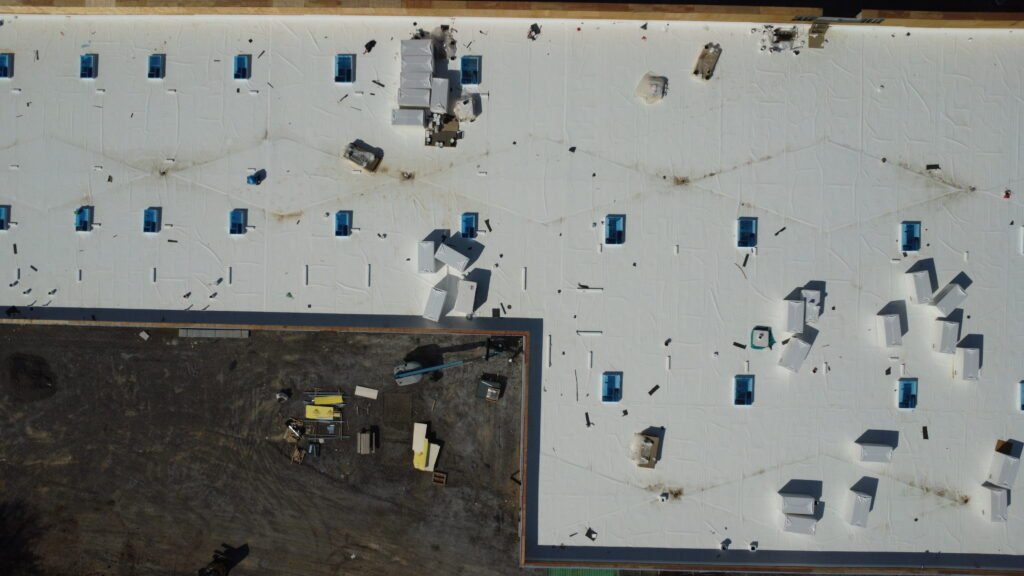
A roof that shrugs off service traffic and whatever lands on it. Many new supermarkets get a white single-ply membrane over a large, open deck, as the Longo's store in our photo did. Three choices matter more on a grocery roof than elsewhere:
| Choice | Why it matters |
|---|---|
| Membrane near oil and grease | Tremco rates grease "B" for TPO, "C" for PVC and "A" for its KEE membrane, and oils "C", "C" and "B". Keep bakery and deli exhaust grease and compressor oil off any membrane, and ask the maker about the zones near them |
| Walkway pads | The CRCA recommends "walkway pads, pavers, or other forms of protection to the membrane be provided around units and along access paths" |
| White surface | In Toronto, the Eco-Roof program pays "$5 / m² for a cool roof with a new membrane", up to $50,000, for a low-slope roof with a Solar Reflectance Index of 78 or more; apply before work starts |
Our best flat roof system guide compares systems by building type, and our cool roof guide covers white roofs in Ontario's climate.
Has OYH Roofing roofed a grocery store?
Yes. At Longo's Plaza in Welland, 968 Niagara Street, we installed about 64,000 sq ft of GAF TPO across four new commercial buildings, including the Longo's grocery store, with a 20-year warranty. The photo at the top of this page shows the store building during construction; the one below shows its skylights and rooftop equipment.
That was new construction, so this guide's advice on leaks and live re-roofs relies on the codes and sources below. OYH Roofing is an Oakville-based industrial, commercial and institutional flat roofing contractor working across the GTA. For grocery store roof repair, we trace leaks from the sales floor up, repair membranes and flashings around refrigeration and HVAC equipment, and plan replacements around store hours. See all our completed projects.
Frequently asked questions
Who pays for roof repairs at a grocery store in a plaza?
The lease decides. Plaza leases differ on whether the landlord or the tenant repairs the roof, and on who pays for damage caused by the grocer's own rooftop units and refrigeration equipment. Read the repair, replacement and capital expenditure clauses before calling the roofer, and send the landlord written notice of any leak the same day.
Can public health close a grocery store because of a roof leak?
It can if an inspector finds a health hazard. An order under Ontario's Health Protection and Promotion Act can close the store or just part of it, require repair work and require food to be destroyed. The food premises regulation requires ceilings over food areas to be kept clean and in good repair, and food protected from contamination.
Can a grocery store roof be replaced while the store is open?
Usually, yes. The roof is replaced in sections that are made watertight at the end of every day, debris is kept away from food areas, and low-odour, flame-free systems such as heat-welded single-ply or cold-applied membranes are chosen. Crane lifts of rooftop units can be planned for days the store is closed.
What is the best roof for a grocery store?
Many new stores get a white single-ply membrane such as TPO or PVC, with walkway pads to and around every unit. Where grease or oil may reach the roof, ask the maker which membrane resists it; Tremco, for example, rates its KEE membrane better than TPO or PVC for grease. In Toronto, a white roof can earn an Eco-Roof incentive.
How often should a grocery store roof be inspected?
At least once a year and after major storms, plus a walk after any big equipment job. The Insurance Institute for Business & Home Safety advises a professional inspection "at least once annually and before storm season", and the CRCA says condensate pans on rooftop units "must be routinely inspected and cleaned".
Water dripping onto the sales floor?
Send us the store address, photos of the ceiling and of the roof above the drip if it is safe to reach, and the equipment nearby. We will tell you whether it looks like the roof, a rooftop unit or a line, and how quickly we can make it watertight.
Call 1-833-775-7663Request an assessment
Karol Rajkowski
Vice President · OYH Roofing
Karol Rajkowski is Vice President of OYH Roofing, an Oakville-based ICI flat-roofing contractor whose projects include the 53,000 sq ft roof of an industrial building in Mississauga, the 50,000 sq ft TPO roof at Millomat Stampings and the 52,300 sq ft roof at 777 Niagara St in Welland. Learn more about the OYH team.
Sources
- Food safety and liability: O. Reg. 493/17 (Food Premises), ss. 7 and 26; Health Protection and Promotion Act, s. 13; Occupiers' Liability Act, ss. 1, 3 and 6.1; Eastern Ontario Health Unit, supermarket inspection report, Cornwall (January 23, 2026); BLG, Court emphasizes systems of maintenance in occupiers' liability claims (Martin v. AGO, 2022 ONSC 1923).
- Other Ontario rules: O. Reg. 463/10 (Ozone Depleting Substances and Other Halocarbons), ss. 19 and 22; O. Reg. 213/91 (Construction Projects), ss. 26.3 and 40; Ministry of Labour, Workers falling through skylights (February 12, 2013); Retail Business Holidays Act; 2024 Building Code Compendium, Volume 1 (January 16, 2025 edition), Division B, 3.3.1.18., 4.1.6.2., 4.1.6.5. to 4.1.6.8. and 6.7.1.1.; City of Toronto, Eco-Roof Incentive Program.
- Roofing practice: CRCA, Technical Bulletin Vol. 44, Roof Top Equipment, and Canadian Roofing Reference Manual, 3.2.3 Keeping Roof Watertight; IIBEC Interface, rooftop equipment supports (October 2009) and pitch pans (September 2001); Tremco Roofing, Chemical Resistance of Thermoplastic Membranes; Insurance Institute for Business & Home Safety, Commercial Roof Inspection and Maintenance Guide (2025).
- Case studies: Sika Sarnafil, SuperTarget, Olathe, Kansas and H-E-B Retail Service Center, San Antonio (2017); Specifier Review, Asda store remains open during roof refurbishment; RoofersCoffeeShop, Ontario food processing facility re-roof (FiberTite, February 2020).
- OYH Roofing project record: Longo's Plaza, Welland (about 64,000 sq ft, GAF TPO, including a Longo's grocery store).
OYH Roofing, 2120 Speers Rd, Oakville, ON L6L 2X8 · 1-833-775-7663 · info@oyhroofing.ca