
Cool Roof Guide: Benefits, Limits and Toronto Grants
What a reflective roof does on a commercial building in Ontario, where it pays off, where it does not, and how Toronto's Eco-Roof grant works.
Call 1-833-775-7663 Oakville head office · Flat roofs for commercial, industrial and institutional buildings across Ontario
Karol Rajkowski
Vice President, OYH Roofing
Published October 2, 2026 · 7 min read
Short answer
A cool roof is a roof surface that reflects most of the sun's heat instead of absorbing it, usually a white membrane such as TPO or a reflective coating. On commercial buildings in Ontario it mainly cuts summer cooling costs, and Toronto pays $5 per square metre for a new reflective membrane.
What is a cool roof?
A cool roof is a roof that stays cooler in the sun because it reflects sunlight and gives off the heat it does absorb. Two numbers measure it: solar reflectance, the share of sunlight reflected, and thermal emittance, how well the surface sheds heat. Both run from 0 to 1, and higher is cooler.
Many products combine the two into a Solar Reflectance Index (SRI). On low-slope commercial roofs, the usual choice is a white single-ply membrane such as TPO or PVC, or a reflective coating over an existing roof.

What are the benefits of a cool roof?
A reflective roof keeps heat out of the building in summer. The U.S. Department of Energy's guide to cool roofs lists these benefits, which are largest in hot weather:
- Lower air-conditioning costs. In warm or hot climates, a reflective roof can cut a single-storey building's yearly air-conditioning energy by up to 15 per cent. Savings in Ontario are smaller, but large, flat, air-conditioned buildings still gain the most.
- Cooler space without air conditioning. Warehouses and plants with no cooling stay more comfortable under a reflective roof.
- Lower peak demand. Less cooling on hot afternoons means lower peak electricity demand.
- Cooler neighbourhoods. Reflective roofs can help lower city air temperatures and the emissions from power used for cooling.
- A grant in Toronto. The City of Toronto pays part of the cost of a qualifying project, as explained below.
| Building | Benefit | Why |
|---|---|---|
| Single-storey retail store or plaza with air conditioning | More | A large roof sits right over cooled space |
| Warehouse or plant without air conditioning | Comfort more than savings | The space under the roof stays cooler in summer |
| Multi-storey office building | Less | The roof covers only the top floor |
| Roof with high insulation levels | Less | The insulation already slows the heat |
| Roof that is due for replacement | Best timing | White is the standard colour for TPO and PVC, so the switch costs little |
Does a cool roof make sense in Ontario's climate?
Yes, on the right building, but it is not a fix for every roof. Ontario has hot summers and cold winters, so a white roof saves on cooling in summer and can add a little to heating in winter, when it reflects sun that would have warmed the building.
The Department of Energy notes that even in mixed climates, the winter penalty can be smaller than the summer savings. Snow also covers many flat roofs for part of the winter, and insulation does most of the work in the cold months.
| Limit | What it means | How to handle it |
|---|---|---|
| Winter heating penalty | The roof reflects some winter sun | Insulate well; the penalty is often smaller than the summer savings |
| Dirt and ageing | Reflectance drops as the surface gets dirty | Compare aged ratings, not just new ones, and keep the roof clean |
| Replacing a sound roof | Rarely pays off for reflectance alone | Switch to a white roof when the roof is due anyway |
| Coating a failing roof | A coating does not fix wet insulation or open seams | Repair or replace first, then coat |

Is your roof due for replacement?
Tell us about the building and we will set up a free roof assessment and a written quote.
Call 1-833-775-7663Request an assessmentShould you choose a cool roof membrane or a coating?
Choose a new white membrane when the roof is due for replacement, and a reflective coating when the existing roof is still sound but dark. A coating does not fix wet insulation, open seams or a worn-out membrane.
| Option | Best for | Toronto incentive |
|---|---|---|
| New white TPO or PVC membrane | Roofs that are due for replacement | $5 per m² (new membrane) |
| Reflective coating over the existing roof | Sound roofs with years of life left | $2 per m² (coating) |
| Green roof | Owners who also want stormwater control and can carry the weight | $100 per m² of plants (separate green roof stream) |
Whichever you choose, ask for the product's SRI and emittance ratings, including the aged values. Toronto's program needs an SRI of 78 or more on a low-slope roof. OYH Roofing installs white TPO and PVC membranes as well as roof coatings, and our warehouse roof replacement guide explains how a roof is replaced while the building stays open.
How does Toronto's cool roof grant work?
The City of Toronto's Eco-Roof Incentive Program pays $5 per square metre for a cool roof with a new membrane and $2 per square metre for a cool roof coating over an existing roof, up to $50,000 per project. The application must be approved before any work on the roof starts.
| Item | Requirement |
|---|---|
| Eligible buildings | Existing residential, industrial, commercial and institutional buildings; new low-rise residential buildings under 5 units |
| Incentive | $5 per m² for a new membrane; $2 per m² for a coating over an existing roof |
| Maximum | $50,000 per project |
| Low-slope roofs | SRI of 78 or more and emissivity of 0.9 or more (slope under 16.7 per cent, or 9.5 degrees) |
| Timing | Approval before any work starts; projects already started may not qualify |
For example, a 2,000 square metre plaza roof with a new reflective membrane could qualify for up to $10,000, if the project meets the program's rules and is approved first. Programs change, so check the City of Toronto Eco-Roof Incentive Program page before you set the budget. Outside Toronto, ask your municipality and your utility whether a similar program exists.
Which white roofs has OYH Roofing installed?
OYH Roofing has installed white single-ply roofs on industrial, institutional and residential buildings in Ontario:
| Project | System | Size | Warranty |
|---|---|---|---|
| Millomat Stampings, Mississauga | 60 mil TPO; new addition plus re-roof | 50,000 sq ft | 20 years on labour and materials |
| Devi Mandir, Pickering | 60 mil TPO; two old layers and a coating removed | 6,500 sq ft | 20 years on labour and materials |
| Residential building, Sault Ste. Marie | PVC single-ply; new build | 17,500 sq ft | 30 years on labour and materials |


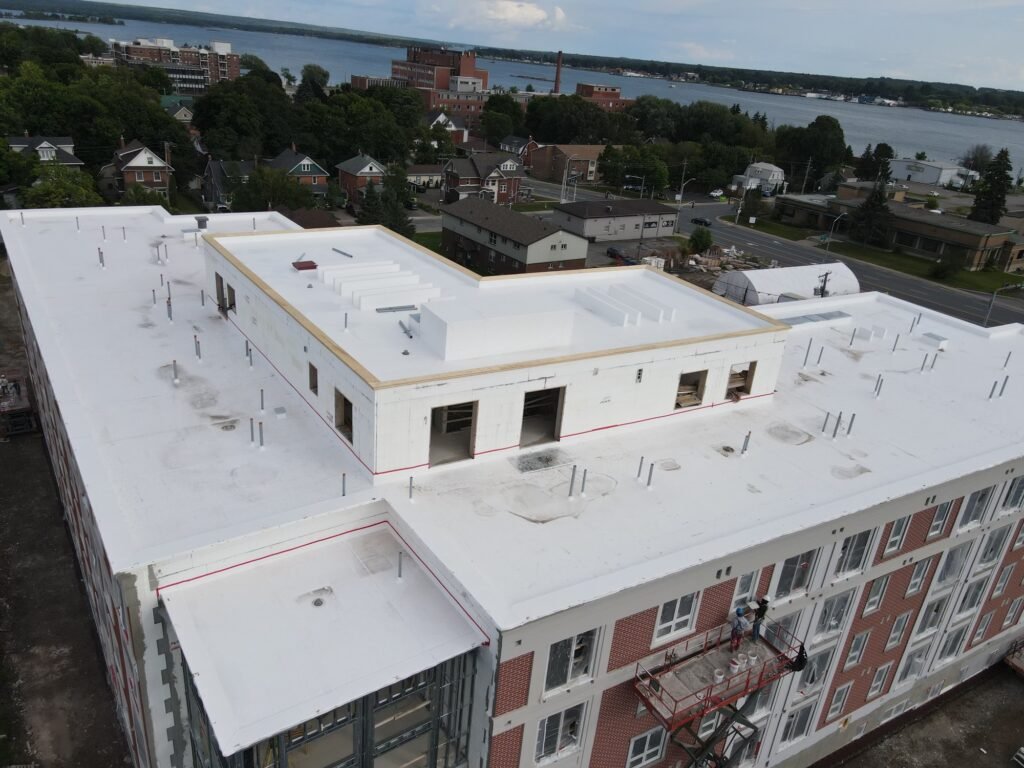
See the rest on the completed projects page, or read about our roofing services.
Frequently asked questions
What are the pros and cons of cool roofs?
The pros are lower air-conditioning costs, cooler space in buildings without air conditioning, lower peak electricity demand and, in Toronto, a grant. The cons are a small winter heating penalty, reflectance that drops as the roof gets dirty, and little payback if you replace a sound roof only to make it reflective.
What is the purpose of a cool roof?
A cool roof is meant to keep the sun's heat out of the building. It reflects more sunlight and sheds the heat it absorbs, so the roof surface and the space below stay cooler, air conditioners work less, and the building adds less heat to the neighbourhood on hot days.
What are the disadvantages of using cool roof paint?
Cool roof paint, or coating, only works on a roof that is still sound. It does not fix wet insulation or open seams, it loses reflectance as dirt builds up, and it needs recoating over time. To qualify for Toronto's grant, the coating must also meet the program's reflectance rating.
Does cool roof coating work?
Yes, when it goes on a sound roof that suits it. A reflective coating lowers the roof surface temperature and the heat reaching the space below, with the biggest effect on single-storey, air-conditioned buildings. It works less well on dirty roofs, roofs with wet insulation and buildings that mostly need heating.
What type of roof is most energy-efficient?
For a low-slope commercial roof, the most energy-efficient choice is usually a well-insulated roof with a reflective white surface, such as white TPO or PVC. Insulation cuts heat loss in winter and heat gain in summer, while the white surface cuts summer heat gain further. A green roof is another option.
Is there a grant for a cool roof in Toronto?
Yes. The City of Toronto's Eco-Roof Incentive Program pays $5 per square metre for a new reflective membrane and $2 per square metre for a reflective coating, up to $50,000 per project. The roof must meet the program's reflectance rules, and the application must be approved before work starts.
Karol Rajkowski
Vice President · OYH Roofing
Karol Rajkowski is Vice President of OYH Roofing, an Oakville-based ICI flat-roofing contractor whose projects include the City of Mississauga building at 3185 Mavis Rd and the Marriott Hotel in Vaughan. Learn more about the OYH team.
Sources
- Eco-Roof Incentive Program, City of Toronto (page updated January 14, 2026).
- Guide to Cool Roofs, U.S. Department of Energy, DOE/EE-0384.
- Cool Roof Rating Council, product ratings for solar reflectance and thermal emittance.
- OYH Roofing project records: Millomat Stampings, Mississauga; Devi Mandir, Pickering; residential building, Sault Ste. Marie (October 2026).
OYH Roofing, 2120 Speers Rd, Oakville, ON L6L 2X8 · 1-833-775-7663 · info@oyhroofing.ca