
Skylight and Roof Hatch Leak Repair in Ontario
Why skylights and roof hatches leak on flat roofs, how to tell a leak from condensation, how they are fixed, and the safety rules around roof openings.
Call 1-833-775-7663 Oakville head office · Flat roofing for commercial and institutional buildings across the GTA
Karol Rajkowski
Vice President, OYH Roofing
Published November 19, 2026 · 15 min read
Short answer
Skylight leak repair usually starts at the curb, not the glass. Most leaks come through the membrane flashing around the curb, the metal counterflashing or the seal between the frame and the curb. Plastic domes also crack with age, and roof hatch gaskets wear out. In winter, much of the water under a skylight is condensation. The lasting fix is new curb flashing at least 200 mm high, a new dome or hatch when the unit is worn out, and fall protection at every opening.
Why do skylights and roof hatches leak on a flat roof?
Because each one is a hole in the roof with a box built around it, and that box is where four materials meet: the roof membrane, the wood or metal curb, the metal frame and the plastic or glass on top. The Canadian Roofing Contractors Association (CRCA) puts it simply: "Roof curbs are raised members that are used to support roof penetrations, mechanical equipment, skylights and roof hatches." Every joint in that stack can let water in.
| Where | What fails | What you usually see inside |
|---|---|---|
| Membrane flashing up the curb | Splits, open seams, wrinkles, or flashing left too low after a re-cover added insulation | Drips at the corners of the opening during heavy rain or snowmelt |
| Metal counterflashing and the frame-to-curb joint | A frame that does not lap far enough over the flashing, loose metal, dried-out sealant | Water at one edge of the frame in wind-driven rain |
| Dome or glazing | Cracked, crazed or brittle plastic, hail damage, failed glazing seals | Drips from the middle of the opening, visible cracks, a cloudy or yellowed dome |
| Weep holes and condensation gutters | Holes plugged with dirt or sealed shut with caulk | Water running out of the frame on cold days |
| Roof hatch cover | A hardened or torn gasket, a bent cover, a latch that no longer pulls the lid tight | Drips around the lid, daylight at the gasket |
| The roof nearby | A leak somewhere else that runs along the deck and drops at the opening | A stain at the skylight with nothing wrong at the curb |
The last row matters more than it looks. Building scientists from Simpson Gumpertz & Heger and 4EA, writing in The Construction Specifier, recommend tracing the water first "to avoid the potential pitfall of replacing a skylight when leakage is originating elsewhere". Our leak detection guide covers how roofers trace water under a membrane.
Large glazed skylights fail at their seals just as small units do. At the TTC's Yorkdale station in Toronto, a 2013 evaluation of the 183 m long barrel-vault skylight found that degraded seals between the skylight and its precast concrete shelter were "accounting for nearly 75% of leaks", according to WSP's account of the repair, which ran overnight from May 2021 to August 2024.
Is the water under a skylight a leak or condensation?
Check before anyone cuts into the roof, because in an Ontario winter it is often condensation. A skylight is usually the coldest surface in the room, right where the warmest, most humid air collects. The National Research Council's Canadian Building Digest 4 explains that "Condensation occurs on inside window surfaces whenever surface temperature falls below the dew-point temperature of the room". NRCA, the U.S. roofing contractors' association, warns that condensation on a skylight's inside face "may be misinterpreted as a leak".
| Clue | Points to a leak | Points to condensation |
|---|---|---|
| When it drips | During or right after rain or snowmelt | On cold nights and mornings, or on a mild, dry day after a cold spell, when frost melts |
| Where it drips | At one side or corner of the opening, often the side facing the wind | Along the bottom edge of the dome or frame, or all around it |
| The room below | Any room | Humid or tall rooms: kitchens, pools, gyms, labs, crowded spaces, high ceilings with little air movement |
| A water test | Spraying the curb or frame brings the drip back | Spraying does not; the drip follows indoor humidity and outdoor cold |
The CRCA's troubleshooting chapter adds that in freezing weather condensation can "build-up and turn into ice until the outside temperature is warm enough to melt it", so a sudden drip on a mild, dry day can be last week's frost. Roof hatches sweat too: an uninsulated steel lid is a cold plate over a warm stairwell, and Bilco, a hatch maker, says thermally broken hatches are designed to "minimize heat transfer and the effects of condensation".
Many skylights are built for some condensation. NRCA notes that "Skylight frames can include condensation gutters and weep holes" that drain it outside; if those holes are plugged or caulked shut, the frame overflows and it looks like a leak. The fixes for real condensation are inside: lower the humidity, keep air moving across the glazing, and choose double-glazed skylights and insulated hatch covers when units are replaced. One skylight maker's warranty states that condensation "is not a defect and is not covered".
How is skylight leak repair done on a flat roof?
By fixing the part that failed, which is most often the flashing around the curb rather than the skylight itself. The same steps apply to roof hatches:
- Find the entry point. Water-test one part at a time, starting with the curb flashing and moving up to the frame and the glazing, so the test shows which joint is open.
- Re-flash the curb. The old flashing comes off, and new membrane flashing goes up the curb, sealed to the roof and covered at the top by metal counterflashing. IKO's current TPO curb detail says: "MINIMUM VERTICAL FLASHING HEIGHT OF 8" (200 MM) ABOVE THE FIELD MEMBRANE MUST BE ACHIEVED." Our rooftop equipment guide lists the curb and flashing heights that roofing standards ask for.
- Raise a low curb. Skylights with built-in curbs come in heights such as "4 inches, 9 inches and 12 inches" (NRCA), and a 100 mm curb cannot carry 200 mm of flashing. A site-built wood curb can be extended, and a factory curb can be lifted on wood blocking.
- Close the top joint. NRCA shows a skylight frame that "does not adequately overlap the base flashing by 3 inches (75 mm)" and calls for separate counterflashing in that case.
- Fix the hatch itself. A torn gasket can be replaced, and the latch and springs adjusted so the lid pulls down tight. A rusted or bent cover can be swapped on the old curb: Bilco says its replacement hatch "allows you to replace a damaged roof hatch without re-roofing".
- Clear the weep holes. Clean them out and leave them open.
What about caulk? Sealant has a place at the top edge of counterflashing, but it is not a repair for a leaking curb. The standard of the Roofing Contractors Association of British Columbia (RCABC) says penetrations "may not be flashed with an open-topped flashing filled with sealant", and caulk smeared over a skylight frame can block the weep holes and trap water inside. Treat a tube of sealant as a way to get to the next dry day, not as the repair.
Two more checks come before the work starts. Most skylight domes are plastic, and Ontario's Fire Code says an open flame torch shall not directly expose "voids, holes and skylights in the roof or roof deck" (O. Reg. 213/07, 5.11.2.2), so curbs next to domes are usually flashed with self-adhered, cold-applied or heat-welded materials; our industrial roofing guide covers the firewatch rules for torch work. And if the roof is under a membrane warranty, call the warranty holder first, for the reasons in the warranty section below.
When should a skylight or roof hatch be replaced instead of repaired?
When the unit itself is worn out, and ideally at the same time as the roof. Plastic domes age however well they are flashed: one commercial skylight maker's warranty says acrylic and polycarbonate are not warranted against "yellowing, crazing, or cracking", which "may naturally occur over time due to normal aging". The same maker warrants its polycarbonate units leak-free for 15 years, so a dome put in with the last roof may be near the end of its life when that roof is replaced.
| Option | When it fits | Points to watch |
|---|---|---|
| Re-flash the curb | The unit is sound but the flashing has failed | The most common repair; raise the curb if the flashing cannot reach 200 mm |
| New dome or glazing on the old frame or curb | Cracked, crazed or yellowed dome; frame and curb sound | Same size and type; screens and guards go back on afterwards |
| New skylight on a raised curb | The unit is near the end of its life, or the roof is being replaced | Check the label for the Canadian rating (see the code section below); plan it with the roof |
| New hatch on the old curb | Rusted, bent or leaking hatch cover; curb sound | Keep the opening size and ladder the Building Code requires |
| Remove the skylight and fill in the opening | Daylight no longer needed, or leaks that keep coming back | New deck and framing, usually a design and a permit, and a darker room |
A roof replacement is the natural time to deal with skylights and hatches. The RCABC standard says "All penetration flashings must be replaced in a roof replacement project", and the Construction Specifier authors call it "advisable to complete both (roofing and skylight) projects concurrently", because a new skylight may need a taller curb or a local re-roof anyway. Adding insulation also makes the roof thicker, and NRCA notes that this "may necessitate raising a skylight". Ontario public owners often buy the two together: in 2025 the City of Hamilton tendered a "Flat Roof and Skylight Replacement" at its Traffic Operations building as one job.
Sometimes the answer is a different opening. In 2025 the Grey Sauble Conservation Authority in Grey County found "rotting, cracks, moisture/water damage, missing insulation" under a leaking skylight at its administration centre. Of five options, from caulking to full replacement, its board backed a cupola-style roof with side windows, priced between new skylights and "filling in the skylight with a solid roof". The estimate was $275,000, including a new roof membrane.
What do Ontario's codes require for skylights and roof hatches?
For a repair, mainly that the roof ends up no worse; for a new or bigger opening, much more. Part 11 of the Building Code, which covers existing buildings, says that when a building system is "materially altered or repaired", its performance afterwards "shall be at least equal to the performance level of the building prior to the material alteration or repair" (11.3.1.1).
| Rule | What it says |
|---|---|
| Skylight standards (5.9.2.2 and 9.7.6.1) | Skylights must meet the North American Fenestration Standard (NAFS, AAMA/WDMA/CSA 101/I.S.2/A440-17) and its Canadian Supplement, CSA A440S1:19, and be installed to CSA A440.4. A Code note says skylights are tested "at 200% of design pressure for snow" |
| Thermal break (5.9.2.4.(2)) | Metal-framed glazed assemblies between heated space and the outside "shall incorporate a thermal break to minimize condensation" |
| Roof access hatch (3.2.5.3.(1)) | Buildings over 3 storeys with roofs flatter than 1 in 4 need access from the floor below by a stairway or "a hatch not less than 550 mm by 900 mm with a fixed ladder"; the ladder's anchorage follows Supplementary Standard SB-8 (3.6.1.6) |
| Skylights near windows (3.2.3.15.(1)) | Where windows in a wall overlook a lower roof of a separate, unsprinklered fire compartment, "the roof shall contain no skylights within 5 m of the exposed wall" |
| Plastic skylights (3.1.5.4.(1)) | In buildings that must be noncombustible, plastic skylights with a flame-spread rating of 150 or less may be up to 9 m² each and 25% of the ceiling area, spaced at least 2.5 m apart and 1 200 mm from fire separations |
| Building permits (Building Code Act, ss. 1 and 8) | A permit is needed to "construct", which includes "material alteration or repair". Toronto exempts a new skylight only in a house or small building of 3 storeys or less, where no more than one rafter or joist is removed |
In practice, a new dome, hatch cover or curb flashing on the existing opening is a repair, while a new or larger opening means cutting the deck and often the joists, which needs a structural design and usually a permit. Mississauga, for example, lists adding skylights as permit work, as our roof permit guide shows.
When a skylight is replaced, check the label. RDH Building Science explains that in Canada "water penetration resistance is specified separately from Performance Grade, and is reported in the Secondary Designator on product labels". And should a roof hatch be locked? We found no Fire Code or Building Code article either way; if the hatch is the roof access the Building Code requires, ask your fire department before adding a padlock.
What fall protection do skylights and roof hatches need?
More than most owners think, because a skylight dome is not a floor. Ontario's Ministry of Labour says every skylight must be considered a fall hazard unless a professional engineer confirms its strength, as our roof inspection guide explains. Two regulations set the rules:
- Roofers and other contractors (O. Reg. 213/91, Construction Projects). The fall protection rules apply where a worker could fall "through an opening on a work surface", at any height (s. 26). The opening needs a guardrail or a protective covering that "completely covers the opening", "is securely fastened", "is adequately identified as covering an opening" and carries at least 2.4 kN per square metre (s. 26.3(2)). The guard or cover may come off only while workers are otherwise protected and signs are posted (s. 26.3(3)).
- The building's own staff (R.R.O. 1990, Reg. 851, Industrial Establishments). An uncovered opening in a roof needs a guardrail (s. 13(1)). A roof "to which access is required only for maintenance purposes" is exempt, but the employer must then "develop and implement other measures and procedures to protect workers from the hazard of falling" (s. 13(3)). A cover must be "secured in place" and built for roof loads (s. 15).
| Employer, place, conviction | What happened | Fine |
|---|---|---|
| North West Lumber Co. Ltd., Chelmsford (Greater Sudbury), December 1, 2020 | A worker clearing snow from a shed roof stepped on a skylight and fell more than 17 feet. The plastic skylights were "mounted flush to the shingled roof surface", and "No identification markers were placed to demarcate the skylight" | $55,000 plus a 25% victim fine surcharge |
| H&N Roofing & Sheet Metal Ltd., London, February 6, 2024 | A roofer fell 15 feet through a 4 by 8 foot HVAC opening on a fifth-storey roof. "The only item covering the opening at the time of the incident was Styrofoam insulation" | $75,000 plus 25% |
| Ontario Clean Water Agency, Mississauga, September 28, 2026 | A worker at a wastewater plant was critically injured after "The workers left the building with the floor hatches remaining open", with no guardrail and no warning signs | $100,000 plus 25% |
For owners, the lessons are simple: mark skylights before snow hides them (see our ice dam guide), keep screens or guardrails on them, and close hatches behind you. NRCA notes that "metal bars and screens that cover skylights' lenses to provide fall protection" are available. For a hatch railing, choose one that clamps to the hatch; Bilco warns that a railing that goes through the roof "might result in a potential leak path".
Who pays for a leaking skylight: the warranty, insurance or the lease?
It depends on why it leaks, and for an old skylight the honest answer is often the owner. Here is where each one stands:
- The roof warranty covers the membrane and the maker's own flashing parts, not the skylight. IKO's sample warranty excludes damage when the roof is altered by installations including "television or cell phone antennas and skylights" without IKO's written approval, and it does not pay for metal flashings made by others. Sika Canada's sample warranty may be void if "Metal work or other accessories or equipment is used in the Roofing and causes leaks". Our roof warranty guide lists the other things that can void a warranty.
- The skylight maker's warranty covers the unit for a set term, but not normal ageing of the plastic or condensation.
- Property insurance generally excludes rain that comes through an existing opening. A Canadian commercial broad form excludes damage "by the entrance of rain, sleet or snow through doors, windows, skylights or other similar wall or roof openings unless through an opening concurrently and directly caused by a peril not otherwise excluded". A worn seal is therefore not covered, while a dome broken by hail, with rain coming through the hole in the same storm, is the case the exception describes. Your policy wording decides; our roof leak insurance guide covers claims.
- The lease decides between landlord and tenant. A 2019 Toronto industrial lease filed publicly makes the landlord responsible for "structural repairs to the building, including roof" and recovers the cost as additional rent. Whether a skylight counts as roof depends on the wording; our plaza roofing guide covers the Ontario court cases.
Has OYH Roofing worked on roofs with skylights and hatches?
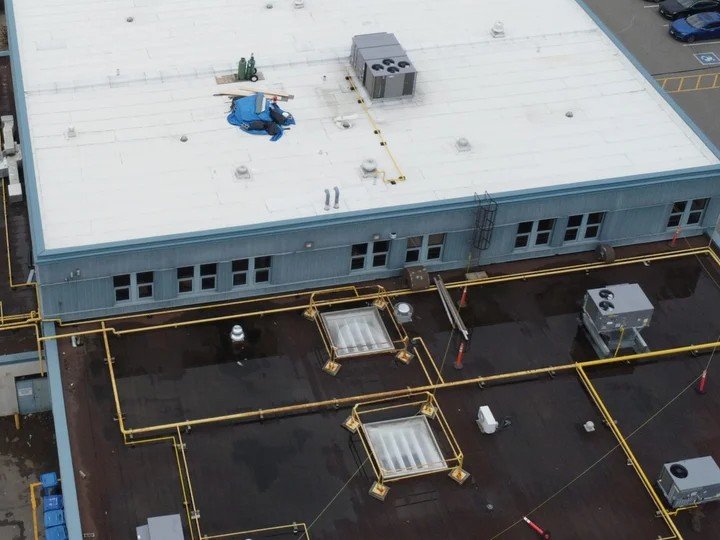
We flash curbs on every roof we install, but we have not published a skylight or hatch replacement project, so this guide relies on the codes, standards and sources below. The photo at the top of this page shows the roof hatch on the 17,500 sq ft PVC roof we installed on a new residential building in Sault Ste. Marie, which carries 30 years on labour and materials. The photo below shows two pyramid skylights with guardrails on a lower roof of the City of Mississauga building at 3185 Mavis Rd, beside the roof we installed on the upper level.
OYH Roofing is an Oakville-based industrial, commercial and institutional flat roofing contractor working across the GTA. We can trace skylight and hatch leaks, re-flash and raise curbs, coordinate new domes and hatch covers with the supplier, and plan skylight work with a roof replacement. See all our completed projects.
Frequently asked questions
Why would my skylight be leaking water?
On a flat roof, the usual causes are failed membrane flashing around the curb, a loose counterflashing or frame seal, and a cracked or aged dome. Water from a leak elsewhere can also run along the deck and drip at the opening. In winter, check for condensation first: drips on cold nights or on mild, dry days with no rain usually come from moisture inside the building, not from the roof.
What is the best way to seal around a leaking skylight?
Replace the flashing rather than adding sealant. On a flat roof, the lasting fix is new membrane flashing at least 200 mm up the curb, with metal counterflashing over its top edge. Sealant is a short-term stopgap, and caulk spread over the frame can block the weep holes that drain condensation. If the dome or frame itself is worn out, replace the unit.
How long do commercial skylights last?
It depends on the type. Plastic domes yellow, craze and crack with age; one commercial maker warrants its polycarbonate units leak-free for 15 years and does not warrant any plastic against ageing. Glazed units can last longer, but their seals wear out. The flashing around the curb often fails first, so look at every skylight when the roof is replaced.
Is a leaking skylight covered by insurance?
Usually not when it leaks from age or wear. Canadian commercial property forms commonly exclude rain or snow that enters through skylights and other roof openings, unless a covered peril such as hail or wind makes the opening at the same time. A dome broken by hail is the typical covered case. Read your own policy and report damage quickly.
Why does a roof hatch leak?
Most often the gasket under the lid has hardened or torn, the latch no longer pulls the lid down tight, or the membrane flashing around the curb has failed. Uninsulated steel lids also drip condensation in winter. A worn gasket can be replaced, and a rusted or bent hatch can be replaced on the existing curb without re-roofing.
Water under a skylight, or a roof hatch that drips every spring?
Send us photos of the stain inside and of the skylight or hatch on the roof, with the dates it leaked and the weather on those days, and we will tell you whether it looks like a leak or condensation and what the repair involves.
Call 1-833-775-7663Request an assessment
Karol Rajkowski
Vice President · OYH Roofing
Karol Rajkowski is Vice President of OYH Roofing, an Oakville-based ICI flat-roofing contractor whose projects include the 53,000 sq ft roof of an industrial building in Mississauga, the 50,000 sq ft TPO roof at Millomat Stampings and the 52,300 sq ft roof at 777 Niagara St in Welland. Learn more about the OYH team.
Sources
- Building Code and Fire Code: Building Code, 2024 Building Code Compendium, Volume 1 (January 16, 2025 edition), Div. B 3.1.5.4, 3.2.3.15, 3.2.5.3, 3.6.1.6, 5.9.2.2, 5.9.2.4, 9.7.6.1 and 11.3.1.1, with Note A-9.7.4.2.(1) in Volume 2; Fire Code, O. Reg. 213/07 (consolidation from January 1, 2026), Div. B 5.11.2.2; Building Code Act, 1992, ss. 1 and 8; City of Toronto, When do I need a building permit (July 21, 2026).
- Workplace safety: O. Reg. 213/91 (Construction Projects), ss. 26 and 26.3 (consolidation from April 20, 2026); R.R.O. 1990, Reg. 851 (Industrial Establishments), ss. 13 and 15; Ontario Newsroom court bulletins: North West Lumber (December 1, 2020), H&N Roofing & Sheet Metal (March 6, 2024), Ontario Clean Water Agency (November 17, 2026).
- Curbs and flashing: CRCA, Canadian Roofing Reference Manual, 3.1.4 Curbs and 13.1.2 Potential Problem Areas (2020); RCABC, Standard for PVC Membrane Systems (2021); IKO, T-CB-1 New Curb Flashing (August 1, 2025); James R. Kirby, Shedding some light on skylights, Professional Roofing (NRCA, August 2002, U.S.).
- Skylights, hatches and condensation: Sarah Rentfro and Kayla Salmon, Rooftop skylight replacement considerations, The Construction Specifier (March 5, 2022, U.S.); A.G. Wilson, Condensation on Inside Window Surfaces, Canadian Building Digest 4 (NRC, April 1960); RDH Building Science, What You Need to Know About NAFS in Canada (2014); Acuity Brands, Sunoptics Statement of Limited Warranty (September 1, 2020, U.S.); Bilco, VersaMount Replacement Hatch data sheet (U.S.); Kathy Price-Robinson, Roof Hatches Simplified (BNP Media, sponsored by Bilco, 2024, U.S.).
- Ontario projects: WSP, Saving a stunning skylight (TTC Yorkdale Station, March 19, 2026); CollingwoodToday, Leaky skylight adds costs to Grey Sauble Conservation Authority reno project (August 28, 2025); City of Hamilton, Traffic Operations, Flat Roof and Skylight Replacement (2025).
- Warranties, insurance and leases: IKO, Diamond Shield Limited Warranty (sample); Sika Canada, Sikaplan Standard Warranty (sample); Premier, Commercial Building, Equipment and Stock Broad Form BF801 (rev. August 29, 2012); Industrial Lease, 1057041 Ontario Inc. (Toronto) (October 15, 2019).
- OYH Roofing project records: residential building, Sault Ste. Marie (17,500 sq ft, PVC) and City of Mississauga, 3185 Mavis Rd (8,500 sq ft, IKO 2-ply modified bitumen).
OYH Roofing, 2120 Speers Rd, Oakville, ON L6L 2X8 · 1-833-775-7663 · info@oyhroofing.ca