
Condo Roof Replacement in Ontario
What a condo board decides, what the Condominium Act requires, how the reserve fund pays for it, and how the roof gets replaced while owners live underneath it.
Call 1-833-775-7663 Oakville head office · Flat roofing for condominium and multi-residential buildings across the GTA
Karol Rajkowski
Vice President, OYH Roofing
Published November 9, 2026 · 14 min read
Short answer
In most Ontario condominiums the roof is a common element, so the corporation must maintain, repair and replace it, unless the declaration says otherwise. A like-for-like condo roof replacement needs no owners' vote under section 97 of the Condominium Act, and the board can pay for it from the reserve fund without owner consent. An upgrade to a different roof can need notice to owners or a vote.
Who is responsible for a condo roof in Ontario?
The condominium corporation, in most buildings. The roof is normally part of the common elements, and under section 90 of the Condominium Act, 1998, the corporation maintains the common elements while each owner maintains their own unit. Section 89 adds that the corporation repairs the units and common elements after damage, which includes the obligation "to repair and replace after damage or failure". The declaration can move some of these duties, so it is the first document to read.
| Situation | General rule | Section |
|---|---|---|
| Normal wear on the roof (maintenance) | The corporation maintains the common elements; maintenance includes repair after normal wear and tear | s. 90 |
| Roof damaged or failed (a storm, a leak, the end of its life) | The corporation repairs, and replaces after damage or failure | s. 89 |
| A terrace or roof area one owner uses alone (exclusive-use common element) | Still a common element; the declaration may make that owner maintain and repair it | ss. 7(2)(f), 91(c) |
| An owner does not do work the declaration gives them | The corporation may (or, after damage, must) do it, and the cost is added to that owner's common expenses | s. 92 |
| Warranties on roof work and materials | Warranties for work on the common elements are for the benefit of the corporation | s. 96(3) |
So the board and its property manager run a condo roof replacement; owners do not hire their own roofer for the roof over their unit. Where a rooftop terrace belongs to one unit for its exclusive use, read the declaration closely: under section 91 it may make that owner responsible for the terrace surface, while the roof membrane under it stays the corporation's job. Who owns a rental apartment roof is a simpler question; our apartment building roof replacement guide covers buildings with a single owner and tenants.
Does a condo board need an owners' vote to replace the roof?
Not for a like-for-like replacement. Section 97(1) of the Condominium Act says that when the corporation repairs or maintains the common elements "using materials that are as reasonably close in quality to the original as is appropriate in accordance with current construction standards", the work is deemed not to be an addition, alteration or improvement. A new roof built to today's standards, with today's insulation and code requirements, is still a replacement, not a change.
The vote question comes up when the board wants something the old roof never had, such as a green roof, an amenity terrace or solar panels. Then section 97 sorts the work by cost.
| Type of roof work | What the board needs | Section |
|---|---|---|
| Repair or replacement with materials reasonably close in quality to the original, to current standards | Nothing extra: it is not a change | s. 97(1) |
| A change needed to comply with a law or by-law, for safety, or to prevent imminent damage | A board resolution; no notice to owners | s. 97(2)(a), (b) |
| A change costing no more in any month than the greater of $1,000 and 1 per cent of the annual budgeted common expenses | A board resolution; no notice to owners | s. 97(2)(c) |
| A larger change that is not substantial | Notice to owners with the cost and how it will be paid; owners have 30 days to requisition a meeting | s. 97(3) |
| A substantial change: total cost over 10 per cent of the annual budgeted common expenses, or the board chooses to treat it as substantial | Approval by owners of at least 66 2/3 per cent of the units, at a meeting called for that purpose | s. 97(4) to (6) |
A full roof can easily cost more than 10 per cent of a year's budget, so the first row is the one that matters most. Ask the consultant to describe the new roof in the specification as a replacement to current standards, and to list separately any part that is an upgrade, so the board can apply section 97 to that part alone. Upgrades on the roof also carry their own technical questions; our guides to green roofs and rooftop equipment cover them.
How is a condo roof replacement paid for?
From the reserve fund. Section 93 of the Condominium Act says a reserve fund "shall be used solely for the purpose of major repair and replacement of the common elements and assets of the corporation", and section 95 says the board does not need the owners' consent to spend it. The roof is one of the largest items in most condo reserve fund studies, so the timing of the replacement is usually set years in advance.
What the reserve fund study says about the roof
Ontario Regulation 48/01 sets the rules. A new corporation's first study must be a comprehensive one, and after that a study is due within every three years. An update without a site inspection may only follow a study that had one, so the roof is looked at on site at least every second study. The study lists each component with its "normal expected life", its remaining life and its cost, and projects the fund for at least 30 years. The person preparing it must review the existing warranties and the repair and maintenance records.
There is no single Ontario table of roof lives. As an example, one Toronto reserve fund study (Pinchin, 2021) carried a near-flat modified bitumen roof and the podium deck waterproofing at 30 years each, while a 2026 article for the Canadian Condominium Institute (CCI) gives 15 to 30 years for low-slope roofs. Check the expected-life column in your own study, and the condition notes beside it. Our flat roof lifespan guide explains what moves a roof's life up or down.
When the fund is short
| Step | Deadline | Rule |
|---|---|---|
| Board reviews the study and proposes a funding plan | Within 120 days of receiving the study | s. 94(8) |
| Notice to owners: summary of the study, the plan and where they differ ("Notice of Future Funding of the Reserve Fund") | Within 15 days of proposing the plan | s. 94(9); O. Reg. 48/01, s. 33 |
| Board implements the plan | After 30 days from the notice | s. 94(10) |
| Fund must be adequate | By the fiscal year after the year the study is completed | O. Reg. 48/01, s. 33(1) |
The Condominium Act itself never uses the words "special assessment". When the fund cannot cover the roof, the board's funding plan raises owners' contributions, and the regulation's notice form has a line for "special assessment contributions" as one way of collecting them. Planning the replacement through the study, rather than waiting for leaks, is what keeps that line empty.
What about a roof leak in a new condo?
In a condo's first years, the builder's warranty and the performance audit come first. Under the Ontario New Home Warranties Plan Act, the common elements warranty starts on the date the condominium is registered, not when owners move in. The two-year warranty covers water getting through the building envelope, which Regulation 892 defines as "the wall and roof assemblies that contain the building space". Major structural defects, including serious distortion of the roof structure, are covered to the seventh anniversary of registration.
| Item | When | What it covers for the roof |
|---|---|---|
| Performance audit by a licensed engineer or architect | No earlier than 6 and no later than 10 months after registration | "Roofing" is one of the listed items to inspect |
| Audit report to the board and filed with Tarion | Before the end of the 11th month after registration (Act) | Filing counts as a notice of claim |
| First-year warranty | Registration to the first anniversary | Work and materials, defects in general |
| Two-year warranty | Registration to the second anniversary | Water penetration through the wall and roof assemblies |
| Major structural defects | To the seventh anniversary of registration | Includes collapse or serious distortion of the roof structure |
Tarion's own page gives the 12th month for filing; the Act says before the end of the 11th, so plan to the earlier date, and check again because Ontario is consulting on changing the audit window. Keep a leak log from day one: a leak that is written down, dated and reported inside the first two years is a warranty claim, and the same leak found in year three is a reserve fund cost.
How does a condo roof replacement project run?
Most Ontario condo roofs are replaced the same way: an engineer or building science consultant assesses the roof, writes the specification, tenders the work to prequalified roofers, and then reviews the work for the board. The Condominium Authority of Ontario (CAO) guide on procuring goods and services calls this design-bid-build "one of the most common project delivery methods in the condominium sector".
- Condition assessment. The consultant confirms whether the roof needs replacing or can be repaired for a few more years; our repair or replace guide covers that call.
- Specification and drawings. The consultant designs the new roof and lists anything cheaper to do while the roof is open, such as guards, anchors or drains.
- Tender. The CAO guide says "the standard in the condominium industry is to use a private bid call" to prequalified contractors, with three or more bids, and advises planning a year ahead and calling bids in "late fall or winter".
- Award and contract. The board alone awards the contract; the CAO guide says this decision cannot be delegated. CCDC 2, the stipulated price contract, is the usual form for a defined roof scope, amended by the corporation's supplementary conditions.
- Construction and site review. The consultant reviews the work, certifies payments and handles change orders. Payment follows Ontario's Construction Act, including the 10 per cent holdback explained in our new construction guide.
- Close-out. A deficiency review, the warranties, the as-built drawings and the consultant's final report (see records below).
A tender price is rarely the final price on a re-roof, because the deck and insulation are only fully seen once the old roof is off. Ask for unit prices in the tender, for example per square metre of deck repair or wet insulation, so hidden conditions are priced before the job starts. For what to check in each bidder, see our guide to choosing a commercial roofing contractor.
What is different about condo roofs?
Many GTA condo towers have inverted roofs, many have terraces that owners use every day, and almost every high-rise has roof anchors for window cleaning. Each one changes how a condo roof replacement is assessed, priced and built.
| Feature | What it is | What it means for the replacement |
|---|---|---|
| Inverted (protected membrane) roof | The membrane sits directly on the concrete deck, under the insulation, with gravel ballast or pavers on top | The membrane cannot be seen without lifting the ballast and insulation; leaks travel, so tracing them takes test openings |
| Amenity terrace | A shared roof area with pavers, planters, furniture or a barbecue area | Everything on the membrane comes off and goes back; often a separate phase |
| Private terrace (exclusive-use common element) | A roof area only one unit can use, often with the owner's planters, decking or a hot tub | The owner's items have to be removed; who pays depends on the declaration and any section 98 agreement |
| Podium or garage roof | Waterproofing over the parking garage, under paving or landscaping | Often replaced with the landscaping and irrigation above it |
| Window-cleaning roof anchors | Permanent anchors for suspended equipment, each one a roof penetration | Each anchor is flashed into the new membrane, and the work is recorded in the anchor log book |
Inverted roofs and leaks that travel
CCI Toronto calls the inverted roof "popular in the GTA", and the Canadian Roofing Contractors Association (CRCA) explains why: under the insulation, the membrane "remains at a relatively constant temperature year-round". The trade-off is that nobody can see it. The CRCA manual says concrete decks "will definitely cause moisture to travel", and a 2025 CCI article puts the travel at "10 to 100 feet".
The Professional Engineers Ontario (PEO) reserve fund guideline adds that an inverted roof's condition cannot be judged much from site observation, so the forecast rests on its age and leak history. A dated leak log helps both the study and the roofer; our flat roof leak detection guide explains the testing methods.
Terraces and owner items
Under section 98 of the Condominium Act, an owner may change an exclusive-use area only with a board resolution and a registered agreement that sets who pays for repair, maintenance and insurance. Find those agreements before the tender, so the specification can say what is removed, by whom, and at whose cost. Hot tubs and large planters also need the consultant's look at the load and the anchoring, and the roof manufacturer's approval before they go back on.
Roof anchors
Ontario's window cleaning regulation (Reg. 859) requires the building owner to keep a sketch of all anchor points posted near the roof entrance, to have the anchors inspected by a competent person before first use and at least once a year, and to keep a log book of inspections and "any modifications or repairs made to an anchor point". A re-roof touches every anchor, so plan the anchor inspection for the end of the job, before the window cleaners return.
How is a condo roof replacement done with residents at home?
With planning on three fronts: notices, the building's systems and the route to the roof. Section 19 of the Condominium Act lets the corporation, or a person it authorizes, enter a unit or an exclusive-use area "on giving reasonable notice" and "at any reasonable time", which covers private terraces that sit on the roof.
- Notices. A kick-off notice when the dates are set, then reminders a week and 48 hours before noisy work or access changes, with a short brief for the concierge (practice set out in a 2025 REMI article for condo managers). Top-floor residents and terrace owners need their own notices, because the work happens right above them.
- Air intakes. The CRCA manual says to place equipment where fumes "will not be drawn into the building through fresh air intakes" and to shut down air intake and exhaust fans in the area while torching. Cold-applied membranes avoid open flame and kettle odour where the intakes are hard to manage.
- Fire safety. The CRCA manual asks the roofer to know the building's fire safety plan, alarm and sprinkler systems, and to notify the local fire department when hot work is used. Ontario's Fire Code then sets a fire watch after torching stops; our industrial roof repair guide gives the hours.
- Weather. The CRCA manual says to remove no more roof than can be made watertight by the end of the day.
- Access and hoisting. Book the service elevator, protect the floors and walls on the route to the roof, and plan crane or hoist lifts with the City; a lift over a public street needs a street occupation permit in Toronto.
For the building-wide side of keeping a property open during a re-roof, our commercial roof replacement guide has a table of what changes in occupied buildings.
Which warranties and records should a condo keep?
At the close-out of a condo roof replacement, collect the manufacturer's warranty in the corporation's name, the roofer's own workmanship warranty, the as-built drawings, the consultant's final report and the maintenance requirements. Under section 55 of the Condominium Act, owners may examine the corporation's records, including all reserve fund studies and agreements, and Regulation 48/01 says existing warranties must be kept for as long as they are in force and engineers' reports for seven years.
Read the warranty's conditions before the first owner puts something on the new roof. Sika Canada's sample system warranty is void for "objects ... placed on or attached to the completed roof without first obtaining written authorization", and IKO's sample excludes use as a "recreational surface". Both leave the cost of lifting pavers or ballast for a warranty repair with the owner, and both require prompt written notice of a leak.
On a condo, that makes terrace rules part of the warranty: new planters, hot tubs, satellite dishes or fastened decking should go through management and, where the warranty requires it, the manufacturer. Our commercial roof warranty guide covers the general terms, and our roof maintenance guide covers the yearly program that keeps them valid.
Does OYH Roofing work on residential buildings?
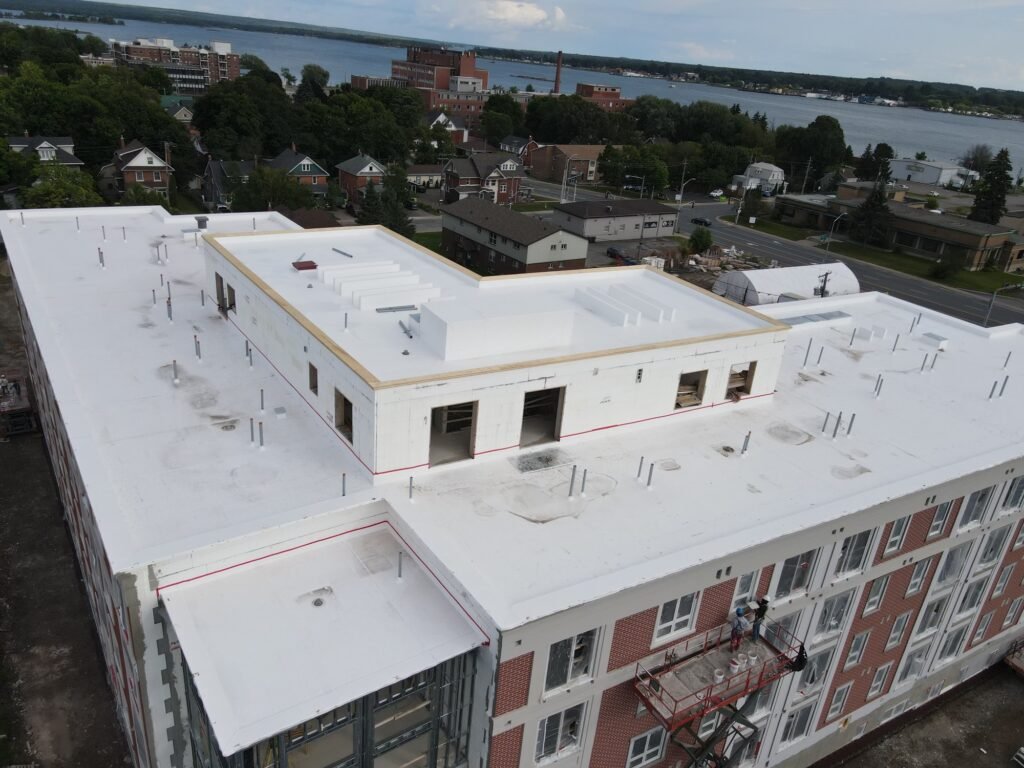
Yes. Our published residential work includes a 17,500 sq ft PVC roof on a new residential building in Sault Ste. Marie, with a 30-year warranty on labour and materials. It is the roof in the photo at the top of this page. We install modified bitumen, TPO, PVC and EPDM roofs on multi-residential and commercial buildings across the GTA.
See all our completed projects and the systems we install on our services page.
Frequently asked questions
Who is responsible for a leak in a condo in Ontario?
It depends on where the water comes from and on the declaration. Under the Condominium Act, the corporation maintains the common elements, usually including the roof, and repairs units and common elements after damage, while owners maintain their units. The declaration can shift some duties to owners, and the corporation's insurance and deductible rules then decide who pays for the damage inside a unit. A roof leak is normally the corporation's to fix.
What is section 89 of the condo Act in Ontario?
Section 89 of the Condominium Act, 1998 makes the condominium corporation repair the units and common elements after damage, subject to sections 91 and 123. The obligation to repair after damage includes the obligation to repair and replace after damage or failure. Section 91 lets the declaration move some of that duty to owners, for example for the parts of the common elements they use alone.
What are condo special assessments in Ontario?
A special assessment is an extra charge to owners on top of their monthly common expenses, usually to cover a reserve fund shortfall for a major repair such as a roof. The Condominium Act does not use the term; the board raises contributions through its reserve fund funding plan, which owners must be notified of within 15 days of the board proposing it. A current reserve fund study is the best way to avoid one.
Are roof leaks covered under warranty?
Often, for a while. In a new Ontario condo, Tarion's two-year warranty covers water penetration through the wall and roof assemblies, counted from the date the condominium is registered. On a replaced roof, the roofer's workmanship warranty and the membrane maker's warranty apply instead, provided the corporation reports leaks promptly in writing, keeps up the required maintenance and has not altered the roof without approval.
What is section 134 of the condo Act of Ontario?
Section 134 of the Condominium Act, 1998 lets an owner, the corporation and certain others apply to the Superior Court of Justice for an order enforcing compliance with the Act, the declaration, the by-laws or the rules. Where mediation and arbitration are required first, the court route opens only after they fail. For a roof, it is the route an owner may use if the corporation does not carry out its repair duty.
Planning a roof replacement for your condo building?
Send us the building address, the roof type and any reserve fund study, consultant report or tender documents you already have, and we will review the roof and the scope with your board or property manager.
Call 1-833-775-7663Request an assessment
Karol Rajkowski
Vice President · OYH Roofing
Karol Rajkowski is Vice President of OYH Roofing, an Oakville-based ICI flat-roofing contractor whose projects include the 17,500 sq ft PVC roof on a new residential building in Sault Ste. Marie and the 52,300 sq ft IKO 2-ply modified bitumen roof at 777 Niagara St in Welland. Learn more about the OYH team.
Sources
- Ontario laws (e-Laws): Condominium Act, 1998, S.O. 1998, c. 19, ss. 7, 19, 44, 55, 89 to 98 and 134 (current consolidation; the 2015 amendments to ss. 89 to 99 were never brought into force and were repealed on December 31, 2025); O. Reg. 48/01, General, ss. 13.1, 27 to 33; Ontario New Home Warranties Plan Act, s. 15; R.R.O. 1990, Reg. 892, ss. 1, 5.2 and 15; R.R.O. 1990, Reg. 859, Window Cleaning, ss. 39 and 41.
- Tarion: Common elements coverage and Performance audit. Condominium Authority of Ontario: Guide on Procuring Goods and Services (2021), Guide on Condo Reserve Funds and proposed changes to the Condo Act (2026).
- Professional Engineers Ontario: Guideline for Engineers Conducting Performance Audits and Reserve Fund Studies (2021). Pinchin, Reserve fund study update, YCC 75, 40 Homewood Ave, Toronto (November 30, 2021).
- Canadian Condominium Institute: Built to Last? What Really Determines the Life of Your Roof (2026); The Dos and Don'ts of Addressing Roof Leaks (2025); Minor Repairs Stretch Roof Life and Save Reserve Funds (2022); The Consultant's Role and What to Expect During a Project (2022); Customizing the CCDC Contract for Condominium Corporations (2022). REMI, How to keep residents safe during refurbishments (December 2025).
- CRCA, Canadian Roofing Reference Manual: 1.1.4 Worksite safety, 1.5.3 Torching, 3.2 Re-roofing operations, 4.1.5 Protected membrane roofs, 8 Vegetative roofing, 13.1.1 Locate the problem area. Warranty samples: Sika Canada Sarnafil System Warranty (March 2022); IKO Limited Labour and Membrane Warranty. Ontario Ministry of Labour, Access and fall protection in window cleaning (2022).
OYH Roofing, 2120 Speers Rd, Oakville, ON L6L 2X8 · 1-833-775-7663 · info@oyhroofing.ca