
Flat Roof Leak Detection: How to Find the Source
Why the drip is rarely under the hole, how roofers trace a leak, and why a flat roof leaks after heavy rain in Ontario.
Call 1-833-775-7663 Oakville head office · Leak tracing, repairs, inspections and maintenance for commercial, industrial and institutional flat roofs across Ontario
Karol Rajkowski
Vice President, OYH Roofing
Published October 13, 2026 · 10 min read
Short answer
Flat roof leak detection starts indoors and works uphill. Water runs along the deck before it drips, so the stain is rarely under the hole. A roofer maps the stains, checks the flashings, drains and rooftop units above them, then confirms with a moisture scan, electronic test or core cut before repairing.
Why is a flat roof leak rarely under the stain?
Because water travels inside the roof before it shows. Flat roof leak detection is hard for that reason: the hole and the drip can be in different parts of the building.
The Canadian Roofing Contractors Association (CRCA) reference manual says the cause of a leak is not always directly above it. On a steel deck the flutes act as gutters and carry water a long distance before it finds an opening, and the entry point may be further up the slope. A vapour barrier over the deck hides it further: a paper in IIBEC's journal notes that where the water finally comes through then has little to do with where it got in.
Concrete decks add a delay. The Roofing Contractors Association of British Columbia (RCABC) notes that water needs a crack to pass through concrete and may not appear for several days.
Where do flat roof leaks start?
At the details, not in the open membrane. CRCA reports that penetrations, openings and terminations account for the majority of reported roofing problems, and a National Research Council Canada survey of about 600 public buildings logged 3,679 visible defects at the flashings of built-up roofs alone.
| Place | What goes wrong | Clue indoors |
|---|---|---|
| Flashings at walls and parapets | Open laps, flashing that stops too low, cracked sealant | Stains near an outside wall |
| Rooftop units and curbs | Wind-driven rain gets through the unit casing; low curbs; pitch pans | Drips under or beside a unit |
| Pipes, vents and anchors | Failed flashing or sealant around the penetration | Drips in line with a stack or vent |
| Drains and scuppers | Blocked strainers, water backing up over the flashing | Leaks during the heaviest rain |
| Seams and open membrane | Open laps, punctures from foot traffic and dropped tools | Drips far from any detail |
| Not the roof at all | Condensate pans, plumbing, walls, windows and skylights | Water with no rain, or only on one side of the building |
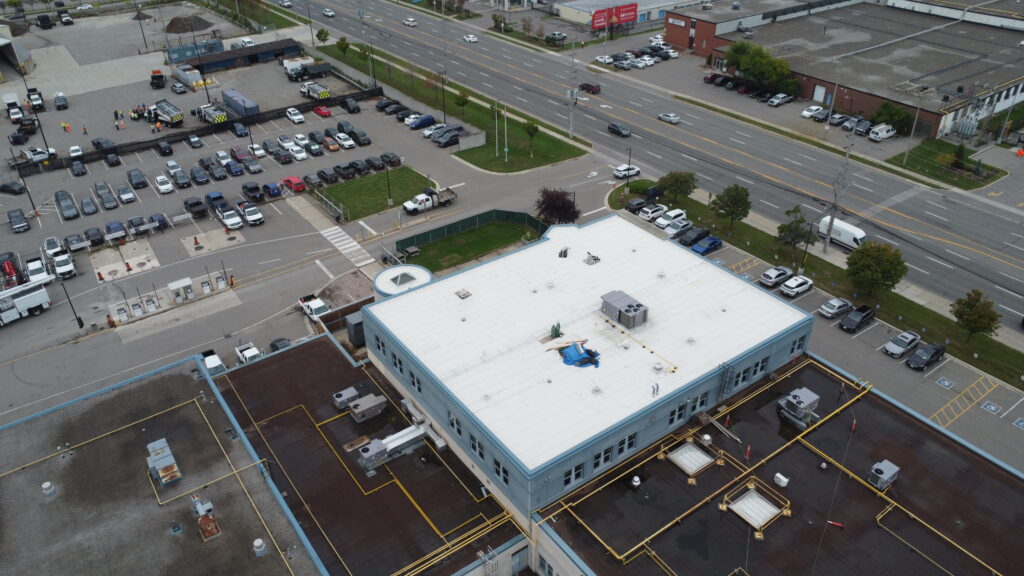
Two of our guides cover the most common repairs: roof flashing repair and membrane roof repair.
Why is my flat roof leaking after heavy rain?
Because heavy rain raises the water level on the roof and drives rain sideways. A detail that stays dry in a shower can leak when water backs up at a drain and rises over a flashing, or when wind pushes rain into a rooftop unit or a wall.
| Cause | What happens | Who says so |
|---|---|---|
| Blocked drain or scupper | The roof cannot drain freely, and water backs up into flashings and wall surfaces | RCABC, Sika Canada |
| Ponding beside a flashing | Water often ponds near flashings and can rise above them. CRCA's manual calls for membrane flashings at least 200 mm up a wall | IKO, CRCA |
| Weak seams under standing water | The chance of water getting through a split, crack or poor weld rises sharply once water ponds | IKO |
| Wind-driven rain at rooftop units | Few units are built to be fully watertight in severe wind-driven rain, and the water drops straight through the deck opening | CRCA |
| Walls, windows and vents above the roof | Water enters above the flashing and shows up as a roof leak | NRCA |
Drainage is the first thing to rule out. Ontario's Building Code sizes roof drains for the local 15-minute rainfall, 25 mm in Toronto and Mississauga, so a drain half blocked by leaves is undersized on the day it matters. Our guide to ponding water on a flat roof covers slope and drain fixes.
Heavy rain is also rare, which is one reason these leaks can go unfixed for seasons. Environment Canada's 1991 to 2020 normals show only four to six days a year with 25 mm of rain or more at Ontario's main stations.
| Station | Rain per year | Days with 10 mm or more | Days with 25 mm or more | Wettest day on record |
|---|---|---|---|---|
| Toronto Pearson | 697 mm | 23.3 | 4.6 | 126.0 mm, July 8, 2013 |
| Hamilton | 765 mm | 26.3 | 5.2 | 107.0 mm, July 26, 1989 |
| Oshawa | 805 mm | 27.1 | 5.7 | 144.8 mm, June 27, 1971 |
| Windsor | 845 mm | 28.1 | 6.4 | 94.6 mm, April 20, 2000 |
| Ottawa | 757 mm | 25.2 | 4.6 | 135.4 mm, September 9, 2004 |
| Sault Ste. Marie | 678 mm | 22.5 | 3.8 | 116.6 mm, May 31, 1970 |
The records are moving. Environment Canada's daily data show 128.3 mm at Toronto Pearson on August 17, 2024, more than the 2013 storm, and 97.8 mm on July 16, 2024. The Insurance Bureau of Canada put insured damage from the July 2024 floods at $990 million. Our roof leak insurance guide explains how insurers treat storm damage and worn roofs differently.
How do roofers find a leak in a flat roof?
With six methods, used in order from simple to specialized: interior mapping, a close look at the details, controlled water testing, an infrared scan, an impedance scan and electronic leak detection. Core cuts confirm what the scans show. No single test finds every leak.
| Method | What it finds | Where it falls short |
|---|---|---|
| 1. Interior mapping | Where and when water shows, matched to the roof using doors, windows, drains and vents as reference points | Shows the exit, not the entry |
| 2. Inspection of the details | Open laps, failed flashings, blocked drains, damage near rooftop units, up the slope from the stain | Misses hidden paths under the membrane |
| 3. Controlled water test | Confirms a suspected entry point by wetting walls, parapets and details one at a time | Slow, and flooding a whole roof is not the same thing: ASTM's flood test guide says it is not intended for building roofing systems |
| 4. Infrared scan (ASTM C1153) | Wet insulation, imaged at night | Needs a dry surface and cannot see through ballast or standing water. The standard says it does not find the point of entry |
| 5. Impedance scan (ASTM D7954) | Wet insulation under a non-conductive membrane | Not for black EPDM, foil facers, metal surfaces or protected roofs with the cover still in place. Sensitivity falls with depth |
| 6. Electronic leak detection (ASTM D7877, D8231) | The breach itself: pinholes, cuts and open seams | Needs a conductive layer under the membrane. Traditional black EPDM is conductive, which rules out some methods, and no method finds a leak that is not a membrane breach |
The scans answer different questions. Infrared and impedance scans find wet insulation; NRCA points out that an infrared camera sees temperature differences, not moisture. Electronic leak detection finds the hole, with a low-voltage test on a wet surface or a high-voltage test on a dry one. Both ASTM scan standards require the readings to be verified by opening the roof, usually with core cuts.
CRCA's technical committee does not support flood testing a roof as a quality check, and its manual says scanning tools belong with people trained on the equipment. Our commercial roof inspection guide explains when a moisture survey is worth ordering.
Chasing the same leak again?
We trace the leak before we patch it, and give you a written report with photos of what we found.
Call 1-833-775-7663Request an assessmentWhat should you tell the roofer about a flat roof leak?
When it leaks, how hard it was raining, which way the wind blew, and whether the drip stops with the rain. CRCA's manual and IKO's owner's guide ask for the same details, because the pattern often points to the source.
| What you notice | What it often points to |
|---|---|
| Leaks only with wind from one direction, and stops when the rain stops | A rooftop unit casing, or a wall or window above the roof |
| Leaks only in the heaviest rain | A drain backing up, or ponding that reaches a low flashing |
| Starts well after the rain begins, or drips after it ends | Water travelling inside the roof, or a concrete deck |
| Leaks with no rain at all | Condensate from a rooftop unit, or plumbing above the ceiling |
| Started after someone worked on the roof | A puncture, an open unit panel or a new penetration |
A roof access log makes the last row easy to check. IKO's guide recommends recording everyone who goes on the roof, with the date and the work done, because it helps establish when and how a leak began.
What should you do before the roofer arrives?
Keep people off the roof and away from wet electrical equipment, contain the water, and record what you see. The repair itself belongs to a roofer the membrane maker accepts.
- Stay off the roof. Ontario's Ministry of Labour treats every skylight as a fall hazard and a fall of more than 3 metres as one that needs protection. A wet roof is worse.
- Treat wet electrical equipment as unsafe. The Electrical Safety Authority says equipment exposed to water must be evaluated by qualified people before it is switched back on, and that drying it out and re-energizing it is not recommended.
- Contain and photograph. Move stock and equipment, catch the drips, and take dated photos for your insurer.
- Dry or discard wet materials. CMHC's guidance for housing is to dispose of wet materials that cannot dry within 48 hours.
- Do not patch a roof under warranty. Sika Canada asks for written notice within seven days and repairs by an authorized contractor. IKO's owner's guide says not to attempt temporary repairs, unless its applicator cannot respond within 48 hours.
Our commercial roof warranty guide lists the notice periods by maker.
Can a leaking flat roof be repaired, or does it need replacing?
It can be repaired when the leak is traced to a detail and the insulation around it is dry. Replacement comes into the picture when scans and core cuts show wet insulation across large areas, or when leaks keep appearing in new places.
That is the real value of flat roof leak detection: it tells you which of the two roofs you have. See membrane roof repair for how wet insulation is cut out and replaced, and our commercial flat roof lifespan guide for when repair stops paying.
How does OYH Roofing handle flat roof leak detection?
We map the stains inside, inspect every seam, flashing, penetration and drain up the slope from them, water test the suspected points, and use infrared or moisture scanning on chronic leaks. Each visit ends with a written report and photos.
OYH Roofing traces and repairs leaks on commercial, industrial and institutional flat roofs across Ontario. For local service, see commercial roof leak repair in Toronto and in Mississauga. The roofs we install, such as the 52,300 sq ft roof at 777 Niagara St in Welland, are on the completed projects page, and a maintenance program helps catch leaks before they reach the ceiling.
Frequently asked questions
Where do flat roofs leak most?
At the details: flashings at walls and parapets, rooftop units and their curbs, pipes and vents, and drains. The Canadian Roofing Contractors Association reports that penetrations, openings and terminations account for most reported roofing problems. Leaks in the open membrane are less common and usually come from punctures or open seams.
How do I find a water leak that is not visible?
With a scan. An infrared camera or an impedance scanner maps wet insulation under the membrane without opening the roof, and electronic leak detection can locate the breach itself. Core cuts then confirm the readings. Scans find where the roof is wet, so a roofer still has to trace the path back to the point of entry.
Is it normal for a roof to leak in heavy rain?
No. A sound flat roof should stay dry in heavy rain, and Ontario's Building Code sizes roof drains for the local 15-minute rainfall. A roof that leaks only in a downpour has a weak point that needs more water or wind to reach it, such as a slow drain or a low flashing. It should be traced and repaired.
Why does my roof leak even after the rain stops?
Because the water is still on its way. It can travel along a steel deck or a vapour barrier before it finds an opening, and on a concrete deck it may take days to appear. Ponded water also keeps feeding a leak after the rain ends. Tell your roofer how long the delay is; it is a useful clue.
Can you have a roof leak and not know it?
Yes. A vapour barrier or a concrete deck can keep water inside the roof, so the insulation gets wet before anything shows on the ceiling. That is why moisture scans exist, and why inspections every spring and fall, and after major storms, catch leaks that nobody has reported yet.
How to fix a roof leak you can't find?
Do not patch by guesswork. Have the leak traced step by step: map where and when it shows, check details up the slope, water test one area at a time, and scan for wet insulation. Rule out other sources too. NRCA describes a reported roof leak that a water test traced to a vent more than 30 feet away.
Need a leak traced?
Call with the details from the table above and we will take it from there.
Call 1-833-775-7663Request an assessment
Karol Rajkowski
Vice President · OYH Roofing
Karol Rajkowski is Vice President of OYH Roofing, an Oakville-based ICI flat-roofing contractor whose projects include the City of Mississauga building at 3185 Mavis Rd and the Marriott Hotel in Vaughan. Learn more about the OYH team.
Sources
- CRCA Canadian Roofing Reference Manual: 13.1.1 Locate the Problem Area and 7.2.7 Membrane Flashings.
- CRCA bulletins: Roof Top Equipment, Vol. 44, October 1995; Non-Destructive Testing for Moisture in BUR Systems, Vol. 25, October 1979; Flood Testing, November 2009.
- RCABC Roofing Practices Manual: Roof Maintenance and Notes to the SBS Standard (British Columbia).
- ASTM International: C1153-23, D7954/D7954M-22a, D7877-25, D8231-24a and D5957-98(2021).
- NRCA, Professional Roofing: The art and science of electronic leak detection, November 2012; Diagnosing persistent leaks, October 2021; Surveying roof moisture, December 2025.
- IIBEC (RCI) Interface: Sheahan, February 2001, and Tait, August 2005.
- IKO: Roofing System Building Owner's Guide, February 2026, and Roof Drainage bulletin, revised May 2025. Sika Canada: Technical Bulletin 005, March 2020.
- Environment and Climate Change Canada: Canadian Climate Normals 1991 to 2020 and historical daily data (Toronto Pearson).
- Insurance Bureau of Canada: 2024 severe weather losses, January 13, 2025.
- 2024 Building Code Compendium, Volume 1 and Volume 2 (Supplementary Standard SB-1), January 16, 2025 edition, Publications Ontario.
- Ontario Ministry of Labour, Immigration, Training and Skills Development: Workers falling through skylights and Fall prevention on construction sites.
- Electrical Safety Authority: Guideline in the Event of Flooding, Water Ingress or Damage, revised May 1, 2025. CMHC: Mould in Housing.
- National Research Council Canada: Kyle and Vanier, BELCAM roofing survey, 2001.
- OYH Roofing project records: 777 Niagara St, Welland; City of Mississauga, 3185 Mavis Rd (October 2026).
OYH Roofing, 2120 Speers Rd, Oakville, ON L6L 2X8 · 1-833-775-7663 · info@oyhroofing.ca