
Best Flat Roofing Material for Ontario Winters
How SBS, TPO, PVC, EPDM and built-up roofs handle cold, snow and foot traffic on commercial buildings.
Call 1-833-775-7663 Oakville head office · Flat roof repairs, replacements and inspections for commercial, industrial and institutional buildings across Ontario
Karol Rajkowski
Vice President, OYH Roofing
Published October 9, 2026 · 11 min read
Short answer
For most commercial roofs in Ontario, the best flat roofing material for winter is two-ply SBS modified bitumen. It stays flexible in deep cold and takes snow clearing and foot traffic best. EPDM carries the lowest cold rating, TPO and PVC suit large open roofs, and APP and aging tar and gravel roofs are the weakest in the cold.
What does an Ontario winter do to a flat roof?
It chills the membrane far below freezing, buries it under snow and ice, and thaws it again many times a season. How hard that is depends on where the building stands: Sault Ste. Marie averages more than seven times as many nights below -20°C as Toronto.
| Station | Coldest recorded, 1991 to 2020 | Nights below -20°C a year | Average January low |
|---|---|---|---|
| Toronto Pearson | -31.0°C (January 1994) | 2.7 | -8.9°C |
| Oshawa | -28.0°C (January 1994) | 3.0 | -8.9°C |
| Welland-Pelham | -31.9°C (February 2015) | 3.4 | -8.0°C |
| Ottawa (Airport) | -33.1°C (January 1996) | 15.6 | -14.3°C |
| Sault Ste. Marie | -37.3°C (January 1997) | 20.5 | -14.5°C |
The coldest night is only part of the story. Cold stiffens every flat roofing material, and the stiffness shows at the weak points: seams, flashings and anything that moves, and on the days a crew walks, shovels or repairs the roof. Freeze-thaw cycles do the rest. Our commercial flat roof lifespan guide counts 78 to 93 freeze-thaw days a year at these stations, and our flat roof snow load guide covers the weight of the snow.
Which flat roofing material handles the cold best?
On published cold tests, EPDM rates lowest at -45°C, followed by TPO and PVC at -40°C. SBS modified bitumen must pass a bend test at -18°C, and APP at only 0°C. Research by the National Research Council of Canada (NRC) found SBS much better suited to the cold than APP.
| Material | Cold test on the data sheet | Rated figure | What the research found |
|---|---|---|---|
| SBS modified bitumen | Low-temperature flexibility (bend), CSA A123.23 | -18°C new, -12°C after weathering (IKO Torchflex cap sheet) | Nine Canadian SBS sheets stayed flexible at the polymer level to -37 to -48°C; most new samples passed a bend test below -30°C |
| APP modified bitumen | Low-temperature flexibility, ASTM D6222 | 0°C (Polyglass APP cap sheet) | Stiffened at about -25°C, against -33 to -39°C for SBS |
| TPO | Brittleness point, ASTM D6878 | -40°C (IKO InnoviTPO, 60 mil) | No plasticizers to lose; contractors reported cold welds as a frequent fault |
| PVC | Low-temperature bend, ASTM D4434 | Pass at -40°C (Sika Sarnafil G 410) | Old unreinforced PVC could shatter in the cold; 25 of 40 aged samples still met the -20°C flexibility test for new sheets |
| EPDM | Brittleness point, ASTM D4637 | -45°C | Field-aged sheets stayed flexible to about -48 to -58°C |
| Built-up (tar and gravel) | No cold rating on the system | None | Shrinks in the cold and can split where it is unevenly bonded |
Read those figures with care. Each standard uses its own test, so the numbers do not rank the membranes on their own, and ASTM notes that a brittleness result does not necessarily show the lowest temperature at which a material can be used. A 2005 study of PVC roofs, written with NRC researchers, made the practical point: flexibility matters mainly during installation and maintenance, when the sheet is bent, walked on or patched.
Quality matters as much as type. In NRC tests, heat aging made SBS sheets stiffer in the cold by 3 to 19°C, depending on the product. Two older materials stand out for the wrong reasons. About 255 cases of shattered unreinforced PVC were reported to the NRCA, and an NRC paper advised keeping people off such roofs below about 10°C. Built-up roofs shrink as they cool: an NRC digest worked out that a 30 m wide asphalt membrane, free to move, would contract 46 mm between -1 and -34°C.
Which roof holds up best under snow, ice and foot traffic?
Two-ply SBS modified bitumen is the toughest flat roofing material underfoot. It is about four times thicker than a 60 mil single-ply sheet, and it has two layers, so a cut in the cap sheet still leaves a second ply underneath. In NRC tests that copied repeated boot traffic, it cut the crushing of the insulation below by 70 to 80 per cent.
A 1.2 mm PVC sheet on its own cut that damage by only 15 to 40 per cent, but the same PVC over a fibreboard cover board matched the SBS result. So a single-ply flat roofing material can take traffic well if a cover board goes under it. The tests also showed why inspections matter: the SBS surface recovered while the insulation below it stayed crushed, so the damage was hard to see.
| Material | Typical thickness | Layers and seams | Winter watch point |
|---|---|---|---|
| SBS modified bitumen | About 5.5 to 7 mm (two plies) | Base and cap sheet, torched or adhered laps | Damage to the insulation can hide under a sound-looking surface |
| TPO | 1.5 mm (60 mil) | One ply, hot-air welded seams | A puncture goes straight through; a cover board and walkway pads help |
| PVC | 1.5 mm (60 mil) | One ply, hot-air welded seams | Sika tells owners to keep metal shovels and chopping tools off the roof |
| EPDM | 1.5 mm (60 mil); thicker sheets made | One ply, taped or glued seams | Laps were the cause on 45 per cent of EPDM problem jobs in NRCA data from the 1990s |
| Built-up (tar and gravel) | Several felt plies under gravel | Mopped asphalt between plies | Gravel hides the membrane; cold shrinkage can split it |
Snow clearing is where many roofs get hurt. The NRCA lists shovels, axes and picks among the hazards to roofing and advises leaving part of the snow in place to protect the membrane. The Canadian Roofing Contractors Association (CRCA) advises staying off an icy roof unless the load, leaks or drainage are a problem, and leaving removal to qualified contractors working under a design professional. It also warns against road salt and calcium chloride, which corrode metal. Walkway pads to rooftop units take most of the winter traffic, and our snow load guide explains safe snow removal.
Choosing a roof before winter?
We will look at the roof, the traffic it gets and how it drains, and recommend the system that suits the building.
Call 1-833-775-7663Request an assessmentShould a flat roof be white or dark for winter?
In Toronto and the rest of southern Ontario, white works. NRC modelled white and black modified bitumen roofs in seven North American cities and found that in Toronto and Montreal a white roof had a low risk of moisture damage and saved energy over the year compared with a black one.
The same study found that in colder St. John's and Saskatoon, white roofs could lead to moisture problems over the long term. So a white flat roofing material, such as a reflective cap sheet, white TPO or white PVC, suits most GTA buildings, while on a colder northern site the roof designer should check the assembly for moisture before choosing a white surface. Our cool roof guide covers the summer side.
Can each flat roofing material be installed in winter?
Yes, within limits that differ by product. Welded and torched sheets can go on in colder weather than glued ones: Sika Canada allows its Sarnafil PVC membrane to be installed down to -20°C air temperature, and Johns Manville notes that torch-applied SBS performs well in cooler weather. Water-based adhesives are the exception. Sika Canada does not allow its water-based adhesive from October 1 to April 15.
Cold also changes how each flat roofing material goes on. NRC heard from contractors that cold welds, seams not welded hot enough, were a frequent TPO fault, and Elevate's cold-weather guidelines have crews make test welds whenever conditions change. Bituminous work slows down too. SOPREMA's self-adhered base sheet goes down at 10°C in its summer grade but -10°C in its winter grade, and the CRCA notes that torching is slower in cold, humid weather. The temperature limits for TPO adhesives and modified bitumen are in our modified bitumen vs TPO guide.
What matters more than the membrane in winter?
The layers under it and the way water leaves the roof. A well-chosen flat roofing material still fails early if warm indoor air condenses in the insulation, or if meltwater has nowhere to go.
Condensation is the winter risk inside the roof. NRC research notes that condensation in roofs is essentially prevented by air and vapour barriers, normally placed at or near the deck. On one 8-year-old roof in the Toronto area, the section without an air-vapour barrier had water-damaged materials and a rusted deck, while the section with one was pristine. Polyiso makers such as Hunter Panels also recommend laying insulation in more than one layer with staggered joints.
Drainage matters even more in winter. The Asphalt Roofing Manufacturers Association (ARMA) warns that ice on a roof moves with every temperature change and can scrub a membrane hard enough to damage it, and it recommends a slope of at least 1/4 in per foot. Blocked drains under snow turn melt into ponds that freeze; see our guides to ponding water and roof flashing repair, and how to prepare a flat roof for winter.
Which flat roofing material fits your building?
Match the material to how the roof is used in winter, not only to the temperature. NRC's advice on choosing a roof system starts with what will most likely end the roof's life, such as constant foot traffic to rooftop units.
| Your roof | Best fit for winter | Why |
|---|---|---|
| Busy roof with rooftop units and regular service visits | Two-ply SBS modified bitumen | Two plies and the best protection under boots and shovels in NRC tests |
| Large open warehouse roof with little traffic | TPO with walkway pads, over a cover board | Wide welded sheets rated to -40°C and a white surface |
| Kitchens, food plants, grease or chemical exhaust | PVC | Resists grease; reinforced sheets pass the -40°C bend test |
| Very cold northern site with little traffic | EPDM or SBS | EPDM has the lowest brittleness rating, -45°C; SBS where traffic is heavier |
| Existing tar and gravel roof | Repair or recover if dry; otherwise a new membrane | Built-up roofs shrink in the cold and hide damage under gravel |
| A quote for APP | Ask about SBS instead | APP stiffens at warmer temperatures than SBS |
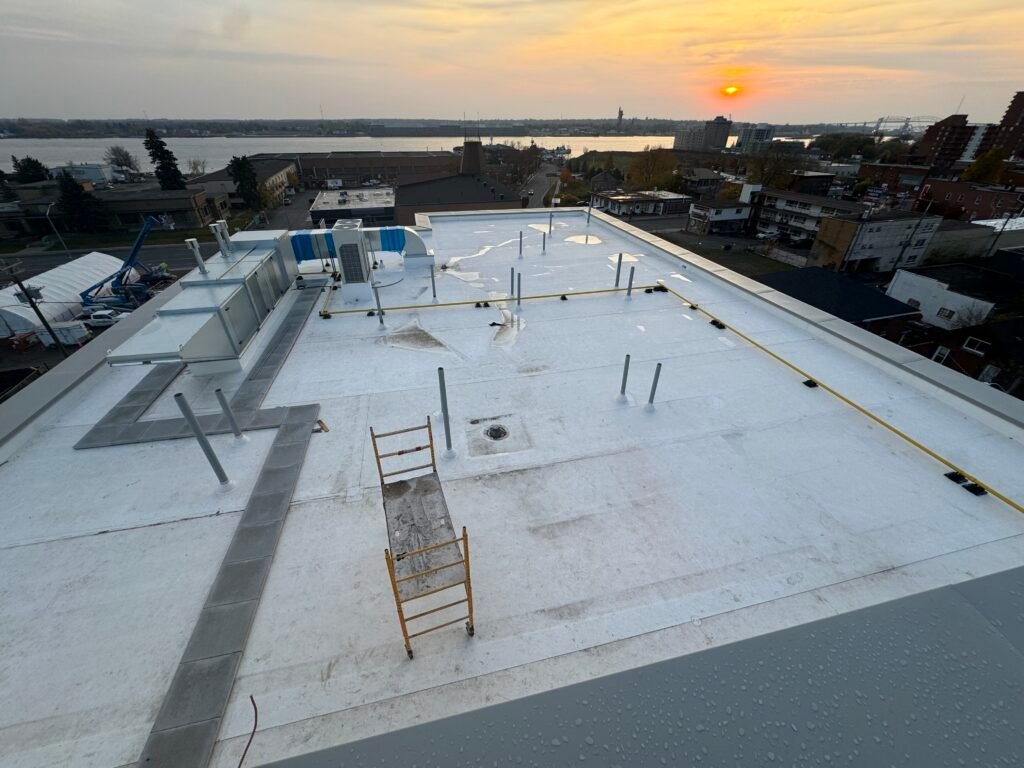
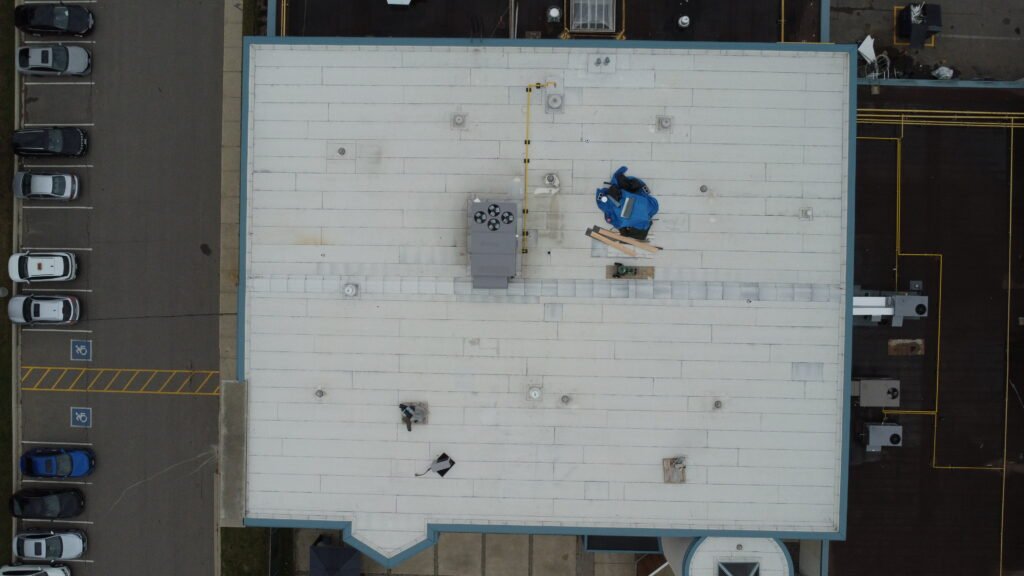
You can see all four main systems on our own projects. At 777 Niagara St in Welland, which sees 88 freeze-thaw days a year, we installed 52,300 sq ft of IKO 2-ply modified bitumen with a 20-year system warranty, and the City of Mississauga building at 3185 Mavis Rd has the same system on 8,500 sq ft. Millomat Stampings in Mississauga is 50,000 sq ft of 60 mil TPO, and our coldest site, a new residential building in Sault Ste. Marie, is PVC. For grease, see our restaurant roofing guide, and for an old gravel roof, our tar and gravel roof guide.
Frequently asked questions
What is the best roofing material for cold climates?
For a commercial flat roof in a cold climate like Ontario's, two-ply SBS modified bitumen is the strongest all-round choice: it stays flexible in deep cold and best resists foot traffic and snow clearing. EPDM has the lowest brittleness rating, -45°C, and TPO and PVC pass tests at -40°C and suit large, low-traffic roofs. SBS is a better cold-weather choice than APP.
What type of insulation is best for a cold flat roof?
On commercial flat roofs the usual boards are polyiso, XPS and EPS. Polyiso gives the most R-value per inch of the three at room temperature, where it is rated, but loses some in deep cold, so the NRCA advises designing at R-5.0 per inch. XPS and EPS hold or gain R-value as it gets colder. Building Science Corporation suggests thicker polyiso or a cold-tolerant layer over it, laid over an air-vapour barrier.
Is EPDM or TPO better?
Neither wins everywhere. EPDM carries a lower brittleness rating, -45°C against -40°C for TPO, and is usually black. TPO is white and its seams are heat-welded, while EPDM seams are taped or glued, and seams are the most common source of EPDM problems. On large open Ontario roofs, TPO is often the better fit. Our TPO vs EPDM guide compares them in detail.
What is the longest lasting flat roof material?
By makers' own figures, well-kept PVC and EPDM roofs can pass 35 years, SBS modified bitumen lasts about 25 to 30 and TPO 20 to 30. In Ontario, installation, drainage, rooftop traffic and inspections decide where a real roof lands, and freeze-thaw cycles find the weak spots first. Our commercial flat roof lifespan guide has the details.
What are the best roofing materials for flat roofs?
On commercial flat roofs, the main choices are SBS modified bitumen, TPO, PVC and EPDM, with built-up tar and gravel still on many older buildings. Modified bitumen is toughest under traffic, TPO and PVC have welded seams and white surfaces, PVC resists grease, and EPDM carries the lowest cold rating. The best flat roofing material is the one that suits how the building and its roof are used.
Should a commercial flat roof be white or black in Ontario?
In southern Ontario, white usually works. National Research Council Canada modelled white and black modified bitumen roofs and found that in Toronto a white roof had a low risk of moisture damage and saved energy over the year. In colder St. John's and Saskatoon, white roofs could lead to moisture problems, so a northern roof should be checked first.
Planning a new roof for your building?
Talk to us about the system, the warranty and the best time to install it in Ontario's weather.
Call 1-833-775-7663Request an assessment
Karol Rajkowski
Vice President · OYH Roofing
Karol Rajkowski is Vice President of OYH Roofing, an Oakville-based ICI flat-roofing contractor whose projects include the City of Mississauga building at 3185 Mavis Rd and the Marriott Hotel in Vaughan. Learn more about the OYH team.
Sources
- Canadian Climate Normals 1991 to 2020, Environment and Climate Change Canada: Toronto Pearson, Oshawa, Welland-Pelham, Ottawa (Airport) and Sault Ste. Marie.
- Effect of heat-ageing on the thermal and mechanical properties of APP- and SBS-modified bituminous roofing membranes, Rodriguez, Dutt, Paroli and Mailvaganam, NRC, 1993.
- Durability and cold temperature performance of SBS-modified bituminous roofing membranes, Liu, Xu and Voyer, NRC, 2003.
- Simulation of repeated foot traffic over low-slope roof surfaces, Liu, Booth, Lei and Irwin, NRC report IRC-IR-800, 1999.
- Shattering of unreinforced PVC roof membranes, Paroli, Smith and Whelan, NRC, 1996.
- Durability of PVC Roofing Membranes: Proof by Testing After Long Term Field Exposure, Beer, Delgado, Paroli and Graveline, 10DBMC conference, 2005.
- Thermoplastic polyolefin roofing membranes, Construction Technology Update No. 30, NRC, 1999.
- Shrinkage of EPDM roof membranes, Paroli and others, NRC, 1996.
- Shrinkage of Bituminous Roofing Membranes, Canadian Building Digest 181, NRC, 1976 (historical series).
- Long-term hygrothermal performance of white and black roofs in North American climates, Saber, Swinton, Kalinger and Paroli, NRC, Building and Environment, 2012.
- Roofing system selection criteria, Smith, NRC, 2005.
- ASTM D2137, Standard Test Methods for Rubber Property: Brittleness Point of Flexible Polymers and Coated Fabrics, ASTM International.
- Torchflex TP-250-Cap and Torchflex TP-180-FF-Base product data sheets, IKO, 2025 to 2026.
- IKO InnoviTPO 60 mil product data sheet, IKO.
- Polybond G APP cap sheet product data sheet, Polyglass, 2021.
- Sarnafil G 410-60 product data sheet, Sika Canada, May 2024, and Technical Bulletin 005: Roof Maintenance Guide, Sika Canada, 2020.
- Are temperature limitations associated with the installation of EPDM roofing system?, EPDM Roofing Association.
- SBS membranes, RCABC Roofing Practices Manual.
- Advisory Bulletin: Ice on Roofs, Canadian Roofing Contractors Association, 1998, and Application guidelines for torch welding of modified bitumen roll roofing, CRCA.
- Technical Bulletin 003: Sarnacol 2121 water-based adhesive, Sika Canada, 2020.
- What to consider in cold weather, Johns Manville, 2019.
- Sopraply Flam Stick technical data sheet, SOPREMA Canada, 2024.
- Snow Remediation in Roofing, National Roofing Contractors Association.
- Cold Weather Application Guidelines, Elevate, 2025.
- Ponding Water Basics, Asphalt Roofing Manufacturers Association, 2017.
- Protection of foam plastic thermal insulation in low sloped roofing systems, Booth, DeRushie and Liu, NRC.
- H-Shield polyiso roof insulation technical data sheet, Hunter Panels, 2024.
- Info-502: Temperature Dependence of R-values in Polyisocyanurate Roof Insulation, Building Science Corporation, 2013.
- Tech Today: polyiso in-service R-value, Professional Roofing (NRCA), June 2016, and R-value tests for polystyrene insulation, Professional Roofing (NRCA), May 2011.
- Manufacturer lifespan figures (Holcim Elevate, GAF, Sika, SOPREMA), compiled and linked in our commercial flat roof lifespan guide.
- OYH Roofing project records: 777 Niagara St, Welland; City of Mississauga, 3185 Mavis Rd; Millomat Stampings, Mississauga; residential building, Sault Ste. Marie (October 2026).
OYH Roofing, 2120 Speers Rd, Oakville, ON L6L 2X8 · 1-833-775-7663 · info@oyhroofing.ca