
Tar and Gravel Roof: Repair or Replace With a Membrane?
When a built-up roof can still be patched, the checks Ontario owners need before a tear-off, and which membranes replace it.
Call 1-833-775-7663 Oakville head office · Flat roof repairs, replacements and inspections for commercial, industrial and institutional buildings across Ontario
Karol Rajkowski
Vice President, OYH Roofing
Published October 8, 2026 · 9 min read
Short answer
A tar and gravel roof is a built-up roof: plies of felt and hot bitumen under a flood coat with gravel set into it. In Ontario it can be repaired while the damage is local and the insulation is dry. Once leaks keep moving or wet insulation spreads, plan a replacement, usually with a modern membrane.
What is a tar and gravel roof?
A tar and gravel roof is a built-up roof (BUR): layers of roofing felt mopped together with hot asphalt or coal-tar pitch, finished with a thick flood coat that holds a layer of gravel. IKO describes the system as alternating felts and hot-applied asphalt and notes it is also called a tar-and-gravel roof.
The gravel does real work. According to IKO, it shields the bitumen from UV and hail, helps give the roof its fire rating and gives crews better footing. The Canadian Roofing Contractors Association's reference manual says the gravel goes straight into the hot flood coat so that no bitumen shows, and that bare spots have to be swept back and re-gravelled.
| Part of the roof | Requirement | Article |
|---|---|---|
| Felt layers | At least 3 mopped-down layers of felt, flood coated with bitumen | 9.26.11.6 |
| Felt | At least No. 15 felt | 9.26.11.3 |
| Flood coat | 3 kg of asphalt or 3.6 kg of coal tar per m² | Table 9.26.11.1 |
| Gravel | Clean, dry stone 6 to 15 mm; at least 15 kg per m² of gravel or crushed stone, or 10 kg of crushed slag | 9.26.11.4 |
| Asphalt and coal tar | Must not be used together in built-up roof construction | 9.26.11.2 |
| Slope | Gravelled asphalt roofs 1 in 50 to 1 in 4; gravelled coal-tar roofs 1 in 50 to 1 in 25; flatter where drains sit at the low points | 9.26.3.1 |
Those numbers explain the weight. On a roof surfaced with gravel or crushed stone, the stone and flood coat alone come to at least 18 kg per m², about 3.7 lb per sq ft, before the felts and the insulation underneath.
Can a tar and gravel roof be repaired?
Yes, while the damage is local and the insulation under it is dry. The roofer scrapes the gravel back, cuts out the damaged felts, patches with new plies of the same bitumen as the roof, then floods the area and sets new gravel into it.
Matching the bitumen is not optional. Older roofs may be coal-tar pitch rather than asphalt, and Ontario's Building Code says the two shall not be used together in built-up roof construction. The National Research Council's notes on the matching national code explain why: the products are chemically incompatible, and contact can lead to the premature failure of the roof. A roofer confirms which one is on the roof before choosing repair materials.
| What the roofer finds | Why it matters | Usual repair |
|---|---|---|
| Bare spots where gravel has washed or blown off | Exposed bitumen weathers in the sun | Sweep back, re-flood and re-gravel; small eroded spots can take a cold-process asphalt coating and gravel (NRC) |
| Small blisters, under about 0.6 m (2 ft) | Usually harmless while intact | Leave them and check at each inspection (NRC) |
| Larger blisters, or blisters the gravel has slumped off | They can split and let water in | Repair promptly: cut out, or cut an X, fill with asphalt and press the corners back (NRC) |
| Splits and cracks in the felts | Water reaches the insulation | Cut out and patch with new plies of matching bitumen, then flood and gravel |
| Failed base flashing at walls, curbs and drains | Many leaks start at these details | Rebuild the flashing to suit the roof system |
| Wet insulation under the damaged area | A patch on top seals the water in | Map it with a moisture survey, then replace the wet boards before patching |
Flashings and drains often need more attention than the field of the roof; our roof flashing repair guide covers walls and curbs, and our ponding water guide covers water that will not drain. For modified bitumen and single-ply roofs, see our membrane roof repair guide.

When should a tar and gravel roof be replaced?
Plan a tar and gravel roof replacement when leaks keep returning in new places, wet insulation spreads across large areas, or repairs are needed every season on a roof that is already past 20 years. GAF puts built-up roof life at 15 to 20 years, and well-kept roofs can last longer.
SOPREMA's case study on a shopping centre roof in Dieppe, New Brunswick, shows what a long-lived one looks like: the asphalt and gravel roof built in 1974 was 25 years old when it was replaced with an SBS modified bitumen system in 1999. Age alone is not a reason to replace a roof, but these signs usually are:
- Leaks that move. Each repair holds, and the next leak shows up somewhere else.
- Wet insulation across the roof. A moisture survey shows large wet areas, not one or two spots.
- Damage across the field. Blisters, splits and bare felts spread over the roof rather than at one detail.
- Extra layers already on the roof. A second roof or a coating over the first one usually means a full tear-off next time.
Our commercial flat roof lifespan guide compares how long each system lasts and when to repair, restore, recover or replace.
What should you check before tar and gravel roof replacement?
Six things: whether the old roof contains asbestos, whether it is asphalt or coal tar, how much of the insulation is wet, what the structure can carry, how the roof drains, and how the edges and flashings will be rebuilt. All six change the scope and the price, so they belong before the quote.
| Check | Why it matters | Source |
|---|---|---|
| 1. Asbestos | Ontario's sample list of suspect materials includes roofing felt and base flashing; the owner must have suspect material examined before tendering or arranging the work | O. Reg. 278/05, s. 10 |
| 2. Asphalt or coal tar | Decides what can touch the old roof; the two must not be used together | Building Code 9.26.11.2 |
| 3. Wet insulation | Wet boards have to come out; CRCA warns that a few test cuts alone are not enough to judge it | CRCA No. 48; ASTM C1153 |
| 4. Structure and gravel weight | The gravel alone is at least 15 kg per m²; CRCA warns that brooming gravel into piles can overload the structure | Building Code 9.26.11.4; CRCA No. 48 |
| 5. Slope and drains | Gravel roofs can be built very flat; the new membrane needs its own slope and drains, or tapered insulation | Building Code 9.26.3.1 |
| 6. Edges and flashings | Gravel stops and old base flashings come off with the roof and are rebuilt for the new system | Building Code 9.26.11.10 |
The asbestos step comes first
Ontario's asbestos regulation, O. Reg. 278/05, treats material with 0.5 per cent or more asbestos by dry weight as asbestos-containing. Before requesting tenders or arranging the work, the owner must have any material likely to be disturbed examined, unless it is already known or the job is planned as though it were asbestos. The owner then prepares a report on the material, its condition and its location, and gives a copy to every prospective constructor. If unreported suspect material turns up during the work, the constructor must notify a Ministry of Labour inspector and the owner. The government's own sample list of suspect materials names roofing felt and base flashing, both parts of a typical tar and gravel roof.
Wet insulation is the other check that moves the price most. CRCA's technical bulletin on re-covering says a series of simple test cuts should never be relied on to find trapped moisture, and that infrared and nuclear moisture scans have limits too, so a survey is confirmed with core cuts. Any wet board found is replaced as part of the new roof.
Is your tar and gravel roof worth repairing?
We will look at the roof, tell you whether repairs still make sense, and give you a written quote either way.
Call 1-833-775-7663Request an assessmentShould a tar and gravel roof be recovered or torn off?
Tear-off is the safer default for an old tar and gravel roof. A recover leaves the old roof in place under a new one, so it only works when the old roof is dry and well attached and the structure can carry the extra weight.
| Question | Recover | Tear-off |
|---|---|---|
| What happens to the old roof | Stays under the new membrane | Removed down to the deck |
| Deck, nailers and air/vapour seals | Hidden and hard to assess | Exposed, inspected and repaired |
| Wet insulation | Has to be found and removed first | Comes off with the roof |
| Weight on the structure | Adds a new layer over the old felts | Old gravel and bitumen come off |
| Track record | CRCA cites NRCA data: problems at about twice the rate of new roofs | The baseline |
| Cost and disruption | Lower up front, less disruption | Higher up front |
CRCA's advice is to find out why the roof failed before deciding. A recover will not fix poor drainage, a leaking air seal or condensation; those problems get built into the new roof. Recover boards also need the loose gravel cleared first: Polyglass's data sheet for its asphalt cover board says to remove loose gravel from existing roofs and to make sure the substrate is free of trapped moisture.
What should replace a tar and gravel roof?
The usual choices are 2-ply SBS modified bitumen, TPO, PVC or EPDM, and a new built-up roof is still an option. Two-ply modified bitumen is the closest relative of a tar and gravel roof: it keeps two plies of asphalt-based membrane, without the loose gravel.
| New roof | Where it wins | Where it gives ground |
|---|---|---|
| 2-ply SBS modified bitumen | Two plies, tough under foot traffic, granulated cap sheet instead of gravel | Torch application needs fire precautions; cold adhesive avoids an open flame |
| TPO | White and reflective, heat-welded seams, light | A single ply, so service routes need walkway pads |
| PVC | Heat-welded seams and resistance to grease and chemicals | A single ply, like TPO |
| EPDM | Flexible in the cold, long track record | Taped or adhered seams; usually black |
| New built-up roof | Several plies of protection, as before | Heaviest option, a hot kettle on site, and gravel cover to maintain |
Our comparisons go deeper: modified bitumen vs TPO, TPO vs EPDM and PVC vs TPO. Our commercial roof warranty guide explains what to ask for on the new roof, and our warehouse roof replacement guide covers large buildings.
Our own projects show the range. At 777 Niagara St in Welland we installed 52,300 sq ft of IKO 2-ply modified bitumen with a 20-year system warranty, and the 53,000 sq ft industrial roof in Mississauga also went to 2-ply modified bitumen. Millomat Stampings in Mississauga and Devi Mandir in Pickering got 60 mil TPO; at Devi Mandir, two old modified bitumen layers and a coating came off first. A new residential building in Sault Ste. Marie got PVC with 30 years on labour and materials.
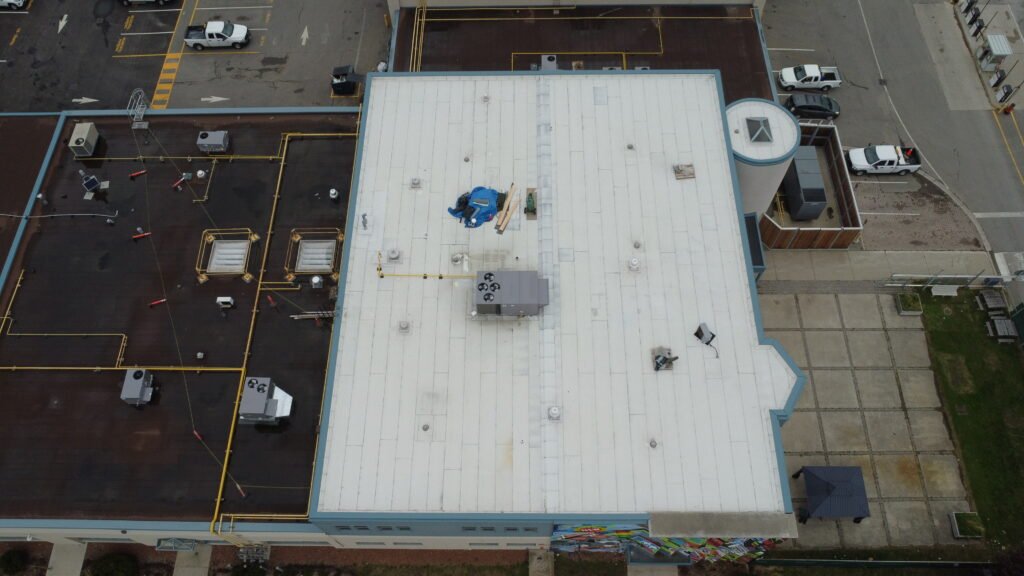
Building staff should stay off the roof, whatever its condition. A flat roof is a work area that needs fall protection, and when a built-up roof is being built, repaired or resurfaced, Ontario's construction regulation requires a barrier at least 2 metres from the roof edge. If water is coming in, contain it inside, photograph it and call a roofer; our guides to commercial roof leak repair in Toronto and Mississauga cover the first steps. You can also see our roofing services and completed projects.
Frequently asked questions
What is a tar and gravel roof called?
A built-up roof, often shortened to BUR. It is made of several plies of roofing felt mopped together with hot asphalt or coal-tar pitch, finished with a flood coat and a layer of gravel. Ontario's Building Code calls for at least three mopped-down felt layers on the built-up roofs covered by Part 9.
What is the life expectancy of a tar and gravel roof?
GAF puts built-up roofing at 15 to 20 years, and well-kept roofs can last longer: in a SOPREMA case study, an asphalt and gravel shopping centre roof in New Brunswick was replaced after 25 years. Drainage, flashings and keeping the gravel cover complete decide where a roof lands.
Can a tar and gravel roof be repaired?
Yes, while the damage is local and the insulation is dry. The roofer scrapes the gravel back, cuts out damaged felts, patches with new plies of the same bitumen as the roof, then floods the area and sets new gravel. Asphalt and coal tar must not be mixed, so the roofer confirms which one is on the roof first.
Is membrane roofing a better choice than tar and gravel roofing?
Often, once the old roof is worn out. Modern membranes such as 2-ply modified bitumen, TPO, PVC and EPDM drop the loose gravel, which makes the roof lighter and easier to inspect and repair. A built-up roof is still tough and has several plies of protection, so the right choice depends on the building, the traffic and the budget.
Do roofers use tar anymore?
Yes. Built-up roofs are still installed with hot asphalt, and IKO describes them as alternating layers of felt and hot-applied asphalt. Built-up roofing still has its own chapter in the Canadian Roofing Reference Manual, and Ontario's Building Code still sets rules for both asphalt and coal-tar roofs.
Can you walk on a tar and gravel roof?
Roofers can: the gravel protects the membrane and, according to IKO, gives crews better footing. That does not make it safe for building staff. A flat roof is a work area that needs fall protection, and Ontario requires a barrier 2 metres from the edge while a built-up roof is being repaired. Leave roof walks to a roofing crew.
Karol Rajkowski
Vice President · OYH Roofing
Karol Rajkowski is Vice President of OYH Roofing, an Oakville-based ICI flat-roofing contractor whose projects include the City of Mississauga building at 3185 Mavis Rd and the Marriott Hotel in Vaughan. Learn more about the OYH team.
Sources
- 2024 Building Code Compendium, Volume 1 (updated to January 16, 2025), Division B, Part 9: Article 9.26.3.1 and Table 9.26.3.1, Articles 9.26.11.1 to 9.26.11.10 and Table 9.26.11.1. Publications Ontario.
- Intent statement for Sentence 9.26.11.2.(1), National Building Code of Canada 2015, National Research Council Canada.
- O. Reg. 278/05: Designated Substance, Asbestos on Construction Projects and in Buildings and Repair Operations, sections 1 and 10, Ontario e-Laws.
- Appendix 2: Sample list of suspect asbestos-containing building material, A guide to the Regulation respecting Asbestos on Construction Projects and in Buildings and Repair Operations, Government of Ontario, May 3, 2022.
- O. Reg. 213/91: Construction Projects, section 207, Ontario e-Laws.
- 4.1.4 Install Surfacing, Conventional Roof System, Canadian Roofing Reference Manual, Canadian Roofing Contractors Association, updated March 26, 2020.
- Roof Re-Covering: An Alternative?, Technical Bulletin No. 48, Canadian Roofing Contractors Association, June 1999.
- Polyboard W Asphalt Coverboard, product data, Polyglass U.S.A. (2021), hosted by the RCABC Roofing Practices Manual.
- Why Do They Put Gravel on Flat Roofs?, IKO Commercial.
- Ways to Reduce Blistering in Built-up Roofs, R.M. Paroli and R.J. Booth, Construction Technology Update No. 4, National Research Council of Canada, May 1997.
- What Is the Lifespan of a Commercial Roof?, GAF RoofViews blog, January 20, 2026.
- Increasing the Durability of a Roofing System Through Resurfacing, SOPREMA, August 24, 2020.
- ASTM C1153-23: Standard Practice for Location of Wet Insulation in Roofing Systems Using Infrared Imaging, ASTM International.
- OYH Roofing project records: 777 Niagara St, Welland; Mississauga industrial recover; City of Mississauga, 3185 Mavis Rd; Millomat Stampings, Mississauga; Devi Mandir, Pickering; residential new build, Sault Ste. Marie (October 2026).
OYH Roofing, 2120 Speers Rd, Oakville, ON L6L 2X8 · 1-833-775-7663 · info@oyhroofing.ca