
Warehouse Roof Replacement: Planning Guide for Owners
How re-roofing a warehouse works in Ontario: when it is time, how the work runs while trucks keep moving, and which flat roof system fits.
Call 1-833-775-7663 Oakville head office · Flat roofs for industrial, commercial and institutional buildings across Ontario
Karol Rajkowski
Vice President, OYH Roofing
Published October 2, 2026 · 8 min read
Short answer
A warehouse roof replacement in Ontario means removing the worn-out low-slope roof one section at a time and installing a new membrane system, usually while the building stays open. Plan it when leaks keep moving or a moisture survey finds wet insulation, and choose a roofer who protects stock, docks and staff during the work.
When does a warehouse need a new roof?
A warehouse needs a new roof when the membrane is worn out across the whole roof, not when one seam or one drain fails. The usual signs are leaks that move after every repair, wet insulation found in a moisture survey, and seams opening in many places.
Age alone does not decide a warehouse roof replacement. Two roofs of the same age can be in very different shape, depending on drainage, rooftop traffic and how often the roof was inspected. The table shows what owners and facility managers usually notice first.
| What you notice | What it usually means | Usual next step |
|---|---|---|
| Drips on racking or stock after heavy rain | Water is getting past the membrane at a seam, flashing or drain | Trace the leak and repair it if the rest of the roof is sound |
| Leaks come back in new places after each repair | The membrane is wearing out across the roof | Plan a warehouse roof replacement |
| Rust or stains on the underside of the steel deck | Moisture has been sitting under the membrane for a long time | Moisture survey, then decide between repair and replacement |
| Soft spots the roofer finds during an inspection | Wet insulation or a damaged deck under the membrane | Replace the wet areas, or the whole roof if they are widespread |
| Water still sitting on the roof two days after rain | Blocked drains, poor slope or sagging insulation | Fix the drainage; a new roof can add tapered insulation |
| Blisters, cracks or open seams in many places | The system is near the end of its service life | Budget for a replacement |
If the problem is one leak rather than a worn-out roof, start with a repair. Our guide to commercial roof leak repair in Mississauga explains how leaks are traced and when repair stops making sense. To judge how much life a roof has left, see how long each flat roof system lasts in Ontario.

Which flat roof system suits a warehouse?
Modified bitumen, TPO, PVC, EPDM and built-up roofing (BUR) all work on warehouse roofs, and each one wins somewhere different. The right choice for a warehouse roof replacement depends on rooftop traffic, grease or chemicals from exhaust fans, summer heat inside and the budget.
| System | Where it wins on a warehouse | Where another system wins |
|---|---|---|
| Built-up roofing (BUR) | Several plies of felt and hot asphalt under gravel; very tough, with a long track record | Heavy; hot-asphalt kettles bring odour and need fire safety planning; slower to install |
| 2-ply modified bitumen | Two layers of protection; tough under foot traffic from service crews | Torch-applied versions need strict fire safety; a dark cap sheet takes in more summer heat |
| TPO | Hot-air welded seams and a white surface that reflects summer heat | A single layer; a thicker 60 mil sheet suits busy roofs better |
| PVC | Welded seams; holds up well to grease and many chemicals | Usually costs more than TPO |
| EPDM | Stays flexible in cold weather; long track record | Seams are taped or glued, not welded; standard black sheets absorb heat |
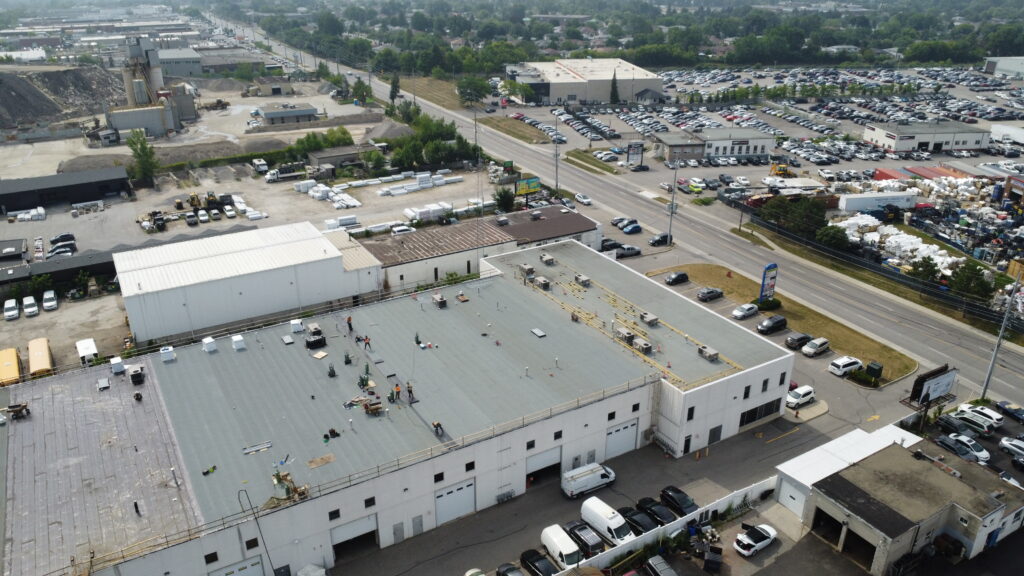
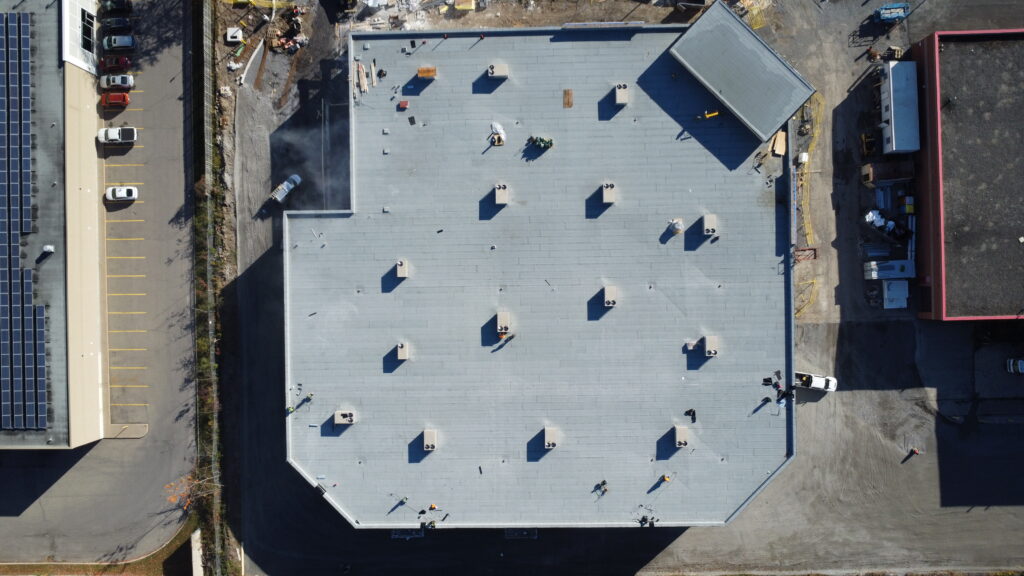
On industrial roofs, OYH Roofing installed 2-ply modified bitumen on a 53,000 square foot industrial roof in Mississauga and 60 mil TPO on the 50,000 square foot Millomat Stampings building. Both carry 20 years on labour and materials.

Should you replace or recover a warehouse roof?
A recover puts a new roof over the old one, while a full replacement strips the roof down to the deck first. A recover only makes sense when the existing roof is dry and sound and the structure can carry the extra weight, so the moisture survey decides it.
Covering wet insulation is the costly mistake. The trapped water keeps working on the deck and shortens the life of the new roof, so a warehouse roof replacement on a worn-out roof usually means a full tear-off.
| Situation | Usual choice | Why |
|---|---|---|
| Old roof is dry, one layer, sound deck | A recover can work | Less tear-off, less disposal, less noise inside |
| Wet insulation in many areas | Full tear-off | Trapped moisture damages the deck and the new roof |
| Two or more old roofs already in place | Full tear-off | Extra layers add weight and hide problems |
| Rusted or damaged steel deck | Tear-off and deck repair | The deck has to be sound before anything goes on top |
| Ponding water and slow drains | Either, with drain work | Tapered insulation and new drains fix the slope as part of the new roof |
How does a warehouse roof replacement work with the building open?
Most buildings stay open during a warehouse roof replacement. The crew works in sections, so most of the roof stays covered, and every section is sealed watertight before the crew leaves for the day.
Here is the usual order of work, in 8 steps:
- Inspect and test. The roofer checks the membrane, drains and flashings, looks at the deck from inside, and runs a moisture survey or core cuts to find wet insulation.
- Choose the system and scope. The owner decides on the membrane, the insulation and any drainage fixes, based on what the inspection found.
- Check permits. The owner or roofer asks the municipal building department whether the job needs a permit; our roof replacement permit guide lists what Toronto, Mississauga and Brampton say.
- Plan around operations. The schedule is mapped against shipping days, dock use and shifts, and staff get a written plan.
- Protect what is inside. Stock, racking and equipment under each work zone are covered, because tear-off can shake dust and debris loose through a steel deck.
- Set up safely. The crew sets up hoisting, a fenced ground zone, protected entrances and fall protection that meets Ontario's construction safety regulation.
- Tear off and install, one section at a time. Old layers and wet insulation come off one area at a time, then new insulation, the membrane and flashings at parapets, curbs, units, skylights and drains go on.
- Inspect and hand over. A final walk-through with photos, a clean site, and the warranty documents for the owner's records.
| Concern | Why it happens | How it is usually handled |
|---|---|---|
| Dust or debris inside | Tear-off shakes material loose through the deck | Cover stock and racking under each day's work zone |
| Docks and truck traffic | Hoists, bins and material need ground space | Book deliveries around shipping and keep at least one dock clear |
| Odour | Hot asphalt, torch-applied sheets and some adhesives smell | Plan around rooftop air intakes and ask about low-odour systems |
| Rooftop units and exhaust fans | Units sit on the roof and may need lifting | Plan shutdowns with the owner and the HVAC contractor |
| Skylights and roof hatches | Openings are a fall hazard | Guard or cover them as part of the safety plan |
| Rain during the job | Open roof areas can let water in | Open only what can be sealed again the same day |
During a warehouse roof replacement, staff should never go up to check on the work. Roof access belongs to the crew, with proper fall protection.

Planning a warehouse roof replacement?
Tell us about the building and we will set up a free roof assessment and a written quote.
Call 1-833-775-7663Request an assessmentWhat drives the cost of a warehouse roof replacement?
The price of a warehouse roof replacement is set after an inspection, because what sits under the membrane decides most of the cost. Get the moisture survey done before you ask for quotes, so every roofer prices the same scope.
| Factor | Why it changes the price |
|---|---|
| Roof area and shape | Large open areas go quickly; levels, corners and parapets add detail work |
| Wet insulation | Every wet board found during tear-off has to be replaced |
| Layers to remove | More old roofs mean more tear-off, weight and disposal |
| Deck condition | Rusted steel deck sections are repaired or replaced first |
| Drains and slope | New drains or tapered insulation add material and labour |
| Rooftop units and skylights | Each one needs lifting, new curbs or new flashing |
| Access and staging | Crane or hoist time, and working around docks and traffic |
| System and warranty | Membrane type, thickness and the manufacturer's warranty terms |
Spring to fall is the usual season for a warehouse roof replacement in Ontario, when membranes and adhesives install best. Emergency repairs still happen in winter, with methods adjusted for the cold.
What warehouse and industrial roofs has OYH Roofing done?
OYH Roofing has completed large low-slope roofs on industrial and commercial buildings across Ontario. Three of them are similar in size to a large warehouse roof replacement:
| Project | Size | System | Warranty |
|---|---|---|---|
| Industrial building, Mississauga | 53,000 sq ft | 2-ply modified bitumen; existing system removed | 20 years on labour and materials |
| Millomat Stampings, Mississauga | 50,000 sq ft | 60 mil TPO; new addition plus re-roof | 20 years on labour and materials |
| 777 Niagara St, Welland | 52,300 sq ft | IKO 2-ply modified bitumen | 20-year system warranty |

See the rest on the completed projects page, or read about our roofing services.
Frequently asked questions
What type of roof is best for a warehouse?
There is no single best roof for every warehouse. TPO suits buildings that need a cool white surface, 2-ply modified bitumen suits roofs with heavy foot traffic from service crews, PVC suits roofs exposed to grease or chemicals, and BUR suits owners who want a thick multi-ply system. An inspection of the deck, drainage and rooftop equipment decides it.
What kind of roof does a warehouse have?
Most warehouses in Ontario have a low-slope roof, often called a flat roof, over a steel deck. It is covered with a membrane such as modified bitumen, TPO, PVC, EPDM or built-up roofing, with insulation underneath. Some older warehouses have metal roofs instead, which are repaired and replaced in a different way.
What is included in a roof replacement?
A full roof replacement usually includes removing the old roof down to the deck, repairing damaged deck sections, new insulation, the new membrane, flashings at walls, curbs and drains, and a final inspection with warranty documents. For a warehouse, the quote should also list protection inside the building, hoisting, disposal and work around rooftop units.
How much does it cost to replace a roof in Canada?
It depends on the size of the roof, the system, how many old layers come off, how much insulation is wet and how hard the roof is to reach. Commercial flat roofs are priced per job after an inspection, not from one set rate. For an accurate number, get a moisture survey and a written quote that lists the scope line by line.
Can a warehouse stay open during a roof replacement?
Usually, yes. A warehouse roof replacement is done one section at a time and sealed at the end of each day, so the building stays dry. Expect noise during tear-off, some limits on docks or parking near the hoist, and covers over stock under each day's work zone. Plan the schedule with the roofer around your shipping days.
Do you need a permit to replace a warehouse roof in Ontario?
It depends on the job and the municipality. The municipal building department decides whether a permit is needed under the Ontario Building Code, and changes to the structure, insulation or drainage can affect the answer. Ask your city before work starts, and make sure the roofer follows the province's construction safety rules for working at heights.
Karol Rajkowski
Vice President · OYH Roofing
Karol Rajkowski is Vice President of OYH Roofing, an Oakville-based ICI flat-roofing contractor whose projects include the City of Mississauga building at 3185 Mavis Rd and the Marriott Hotel in Vaughan. Learn more about the OYH team.
Sources
- Ontario's Building Code, Government of Ontario.
- O. Reg. 213/91, Construction Projects, under the Occupational Health and Safety Act.
- National Roofing Contractors Association (NRCA), guidance on low-slope roof inspection and maintenance.
- OYH Roofing project records: industrial building, Mississauga; Millomat Stampings, Mississauga; 777 Niagara St, Welland (October 2026).
OYH Roofing, 2120 Speers Rd, Oakville, ON L6L 2X8 · 1-833-775-7663 · info@oyhroofing.ca