
Membrane Roof Repair: Blisters, Seams and Punctures
How roofers repair modified bitumen, built-up, TPO, PVC and EPDM membranes, which defects can wait, and when repairs stop making sense.
Call 1-833-775-7663 Oakville head office · Flat roof repairs, replacements and inspections for commercial, industrial and institutional buildings across Ontario
Karol Rajkowski
Vice President, OYH Roofing
Published October 7, 2026 · 8 min read
Short answer
Membrane roof repair fixes damage in the field of a flat roof: blisters, open seams, splits and punctures. The repair has to match the membrane: torched, mopped or adhered plies for modified bitumen, welded patches for TPO and PVC, primed patches for EPDM. Wet insulation underneath has to be found and replaced first.
How is membrane roof repair done on each type of flat roof?
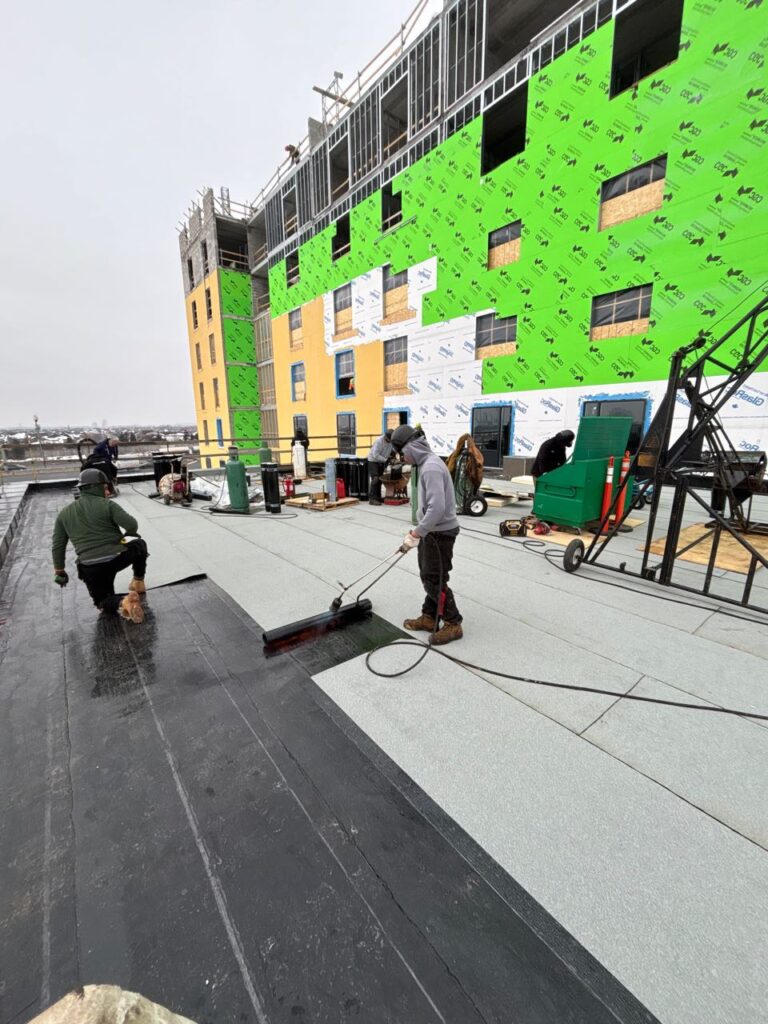
Every repair uses the same material and the same joining method as the roof: new plies on modified bitumen and built-up roofs, a welded patch on TPO and PVC, a primed patch on EPDM. What changes most is the preparation, because aged membranes have to be cleaned before anything new will bond to them.
| Membrane | How it is joined | Typical repair | Preparation that matters |
|---|---|---|---|
| 2-ply modified bitumen (SBS) | Plies torched, mopped with hot asphalt, set in cold adhesive or self-adhered | Patch with compatible modified bitumen, set the same way | Cold adhesive avoids an open flame on occupied buildings (ARMA) |
| Built-up roofing (tar and gravel) | Layers of felt and asphalt | Cut out the damage and patch with felts and asphalt | Bare, eroded spots can take a cold-process coating and gravel (NRC) |
| TPO | Seams welded with hot air | Weld a TPO patch; cover tape where aged TPO will not weld | Scrub with an abrasive pad and the maker's solvent to restore weldability (NRCA) |
| PVC | Seams welded with hot air | Weld a PVC patch | Sika: clean the patch area with MEK in one direction and let it flash off, typically 20 minutes; asphalt needs mineral spirits or an all-purpose cleaner first |
| EPDM | Seams taped or adhered | Primed, laminated patch | Broom, wash with low-sudsing soap, rinse, then prime (EPDM Roofing Association) |
Matching matters for the warranty too. IKO, for example, approves its InnoviFlash TPO cover tape for use with an appropriate IKO Diamond Shield warranty, and its warranty guide says substitutions need IKO's approval. Our commercial roof warranty guide explains why, and our comparisons of modified bitumen vs TPO, TPO vs EPDM and PVC vs TPO show how the systems differ.
Which roof blisters need repair?
Small, intact blisters can usually be left alone and watched. Repair a blister when it breaks, grows to about 1.5 m (5 ft), sits where people walk, or starts pulling a seam apart, according to the National Research Council of Canada.
Blisters form over voids built into the roof: skips in the asphalt, trapped debris, uneven substrates or moisture in the materials. In the heat of the day the trapped air and moisture expand and push the warm membrane up; at night the membrane stiffens and air is drawn back in, so the blister can grow a little each day. NRC research on modified bitumen roofs found that an intact blister did not weaken the membrane, while in one sample a ruptured blister cut the strength of the cap sheet by more than 50 per cent.
- Leave small blisters alone. On built-up roofs, NRC says blisters under about 0.6 m (2 ft) are better left unattended while they stay watertight.
- Keep feet off. NRC advises against stepping on blisters, especially when the membrane is cold.
- Repair the big or broken ones. The usual repair for a broken blister is to remove the entire raised portion and patch the area.
- Watch the seams. On modified bitumen, NRC recommends repair once a blister has separated a third or more of a seam's width.
What are the most common membrane roof repairs?
Most membrane roof repair work falls into six jobs: watching small blisters, cutting out large ones, re-sealing open seams, patching punctures and splits, sealing aged TPO that will not weld, and replacing wet insulation before patching.
| Repair | When it fits | What to know |
|---|---|---|
| 1. Mark and monitor small blisters | Intact blisters under about 0.6 m (2 ft) | Check them at every inspection; keep traffic off |
| 2. Cut out and patch large or broken blisters | Broken, about 1.5 m (5 ft) across, or in a traffic area | Remove the whole raised portion, then patch with matching material |
| 3. Re-seal open seams and laps | A lap lifting, or a blister separating a third or more of a seam | Re-weld TPO and PVC, re-tape EPDM, re-bond modified bitumen plies |
| 4. Patch punctures, cuts and splits | Local damage from foot traffic, tools or debris | Patch with the same membrane; add walkway pads on service routes |
| 5. Seal aged TPO that will not weld | Weathered TPO that a new patch will not weld to | NRCA: scrub to restore weldability, or patch from underneath and weld the reverse side; IKO makes cover tape for this |
| 6. Replace wet insulation, then patch | Water has reached the insulation below the membrane | Map the wet area first; a patch over wet insulation does not dry it out |
Punctures usually come from people. Trades crossing the roof to rooftop units, dropped tools and wind-blown debris are common causes, which is why walkway pads along service routes help. Leaks around walls, curbs and pipes are usually flashing problems rather than membrane problems; our roof flashing repair guide covers those.
Blisters, open seams or a leak you cannot trace?
Tell us what you are seeing, and we will set up a free roof assessment and a written quote for the repair.
Call 1-833-775-7663Request an assessmentHow do roofers find wet insulation under a membrane?
With a moisture survey. ASTM C1153 describes infrared scans done at night, when wet insulation holds heat longer than dry insulation and shows up warmer on the camera; suspect areas are then checked with core cuts.
A survey shows where the roof is wet, not where the water got in, and ASTM C1153 says so plainly. That is why a roofer pairs the scan with an inspection of seams, flashings and drains. Wet areas have to be cut out and replaced before any membrane roof repair goes on top; otherwise the new patch seals the water in. Keep the survey report: it helps with planning and with an insurance claim, as our roof leak insurance guide explains.
When should a membrane roof be replaced instead of repaired?
Repair while the damage is local and the insulation is mostly dry. Plan a replacement when wet insulation is spread across the roof, leaks keep coming back in new places, or the roof already carries extra layers or coatings.
| What the roofer finds | Usual direction |
|---|---|
| One leak or one damaged area, dry insulation around it | Repair |
| A few small, intact blisters | Monitor at each inspection |
| Wet insulation in a few spots | Replace those boards and repair |
| Wet insulation across large areas, or leaks that keep moving | Plan a replacement |
| Two or more old roof layers or a coating already on the roof | Tear-off and replacement |
Most commercial flat roofs in Ontario last 20 to 30 years, and our commercial flat roof lifespan guide explains the repair, restore, recover or replace decision in more detail. For large buildings, see our warehouse roof replacement guide.

Whatever the repair, building staff should stay off the roof: a flat roof is a work area that needs fall protection, and blisters and soft spots are easy to damage. If water is coming in, contain it inside, photograph it and call a roofer; our guides to commercial roof leak repair in Toronto and Mississauga cover the first steps. You can also see our roofing services and completed projects, including Millomat Stampings, the Marriott Hotel in Vaughan and Devi Mandir in Pickering.
Frequently asked questions
Can you patch a membrane roof?
Yes. Membrane roofs are patched with the same material and joining method as the roof: new plies on modified bitumen and built-up roofs, a heat-welded patch on TPO and PVC, a primed tape patch on EPDM. A patch only works over dry insulation, so wet areas underneath have to be cut out and replaced first.
How to repair a commercial flat roof?
Find the source of the leak and the extent of any wet insulation, then repair with materials that match the roof system. Roofers replace wet boards, clean and prepare the membrane, and patch or re-seal it. Flashing problems at walls, curbs and pipes are repaired separately. Building staff should stay off the roof.
What causes blistering on a roof?
Blisters grow from voids built into the roof, such as skips in the asphalt, trapped debris or moisture in the materials. Heat expands the trapped air and moisture during the day and draws more air in at night, so blisters can grow over time. Small, intact blisters can usually be left alone and watched.
Can TPO roofing be repaired?
Yes. New TPO is welded to the existing sheet with hot air after the area is cleaned. Weathered TPO may need scrubbing with an abrasive pad and the maker's solvent to weld well, and where it still will not weld, roofers patch from underneath or use a TPO cover tape made for aged membranes.
What is the best product for repairing a flat roof?
The roof manufacturer's own repair materials for that membrane: modified bitumen for a modified bitumen roof, TPO for TPO, PVC for PVC, EPDM patches and primer for EPDM. Matching products bond properly and keep the warranty intact. General-purpose coatings and sealants are not a substitute for the maker's repair materials on a commercial roof.
What is the life expectancy of a membrane roof?
Most commercial membrane roofs in Ontario last 20 to 30 years. Manufacturers rate TPO at about 20 to 30 years and SBS modified bitumen at about 25 to 30, and say well-kept PVC and EPDM roofs can last longer. Installation, drainage, foot traffic and twice-yearly inspections decide where a roof lands.
Karol Rajkowski
Vice President · OYH Roofing
Karol Rajkowski is Vice President of OYH Roofing, an Oakville-based ICI flat-roofing contractor whose projects include the City of Mississauga building at 3185 Mavis Rd and the Marriott Hotel in Vaughan. Learn more about the OYH team.
Sources
- Blistering in SBS Polymer Modified Bituminous Roofs, K.K.Y. Liu, R.M. Paroli and T.L. Smith, Construction Technology Update No. 38, National Research Council of Canada, June 2000.
- Ways to Reduce Blistering in Built-up Roofs, R.M. Paroli and R.J. Booth, Construction Technology Update No. 4, National Research Council of Canada, May 1997.
- Tech Today, Mark S. Graham, Professional Roofing (NRCA), August 2011: repairing weathered TPO.
- InnoviFlash TPO Cover Tape, IKO Commercial product data, June 2024.
- Canadian Technical Bulletin 006: Localized Membrane Cleaning, Sika Canada, March 31, 2020.
- Surface preparation for repairs to aged EPDM, EPDM Roofing Association.
- Cold Adhesive SBS-Modified Bitumen Roofing Applications, Asphalt Roofing Manufacturers Association, May 12, 2015.
- ASTM C1153-23: Standard Practice for Location of Wet Insulation in Roofing Systems Using Infrared Imaging, ASTM International.
- Limited Warranty Programs, Commercial Roofing, IKO Commercial guide MM1L189 (08/2025).
- OYH Roofing project records: Millomat Stampings, Mississauga; Marriott Hotel, Vaughan; Devi Mandir, Pickering (October 2026).
OYH Roofing, 2120 Speers Rd, Oakville, ON L6L 2X8 · 1-833-775-7663 · info@oyhroofing.ca