
Auto Shop Roof Repair in Ontario
Roof repair for the shop building, not the car: leaks over service bays, paint booth stacks, exhaust fans, heaters and reels hung from the roof, and keeping the bays open.
Call 1-833-775-7663 Oakville head office · Flat roofing for commercial and industrial buildings across the GTA
Karol Rajkowski
Vice President, OYH Roofing
Published November 17, 2026 · 15 min read
Short answer
Auto shop roof repair means repairing the shop building's flat roof with the usual methods, planned around the shop's equipment. The roof's exhaust fans keep carbon monoxide in the bays under the Building Code limit, so a fan that is off means no engines running in its bays. Paint booth stacks fall under the Fire Code and, for most body shops, an environmental registration: shut the booth down and clean the duct before any hot work, and change nothing on the stack without the booth contractor.
What makes auto shop roof repair different?
Auto shop roof repair is flat roof repair on a building where vehicles are serviced, not repair of a car's roof. Ontario's Building Code calls these buildings repair garages: "a building or part thereof where facilities are provided for the repair or servicing of motor vehicles" (Division A, 1.4.1.2). That covers repair, tire and quick-lube shops, body shops and dealership service departments; car washes share many of the same problems. Most are single-storey buildings or units in an industrial strip, with a steel deck on open-web steel joists and a flat membrane roof. Four things change the plan:
- What sits on the roof. Exhaust fans for tailpipe hoses and general ventilation, make-up air units, a paint booth stack on body shops, and flues from gas-fired or waste-oil heaters. Each one goes through the membrane, and several are safety equipment.
- What hangs from the roof. Hose reels, lube and air reels, unit heaters and lights are often hung from the joists that carry the roof.
- What sits under the roof. Vehicles on hoists, many of them customers' cars, plus compressors, parts and flammable liquids such as fuel, paint and solvents.
- A shop that has to keep working. Bays earn money by the hour, so the roof work has to fit around the work orders.
In a multi-unit building, the shop's fire separation from its neighbours (usually 2 hours; Division B, 3.3.5.5. and 9.10.9.19.) must stay continuous where it meets the roof (3.1.8.3.(2)); see how firewall parapets between units are roofed.
Where do auto shop roofs leak?
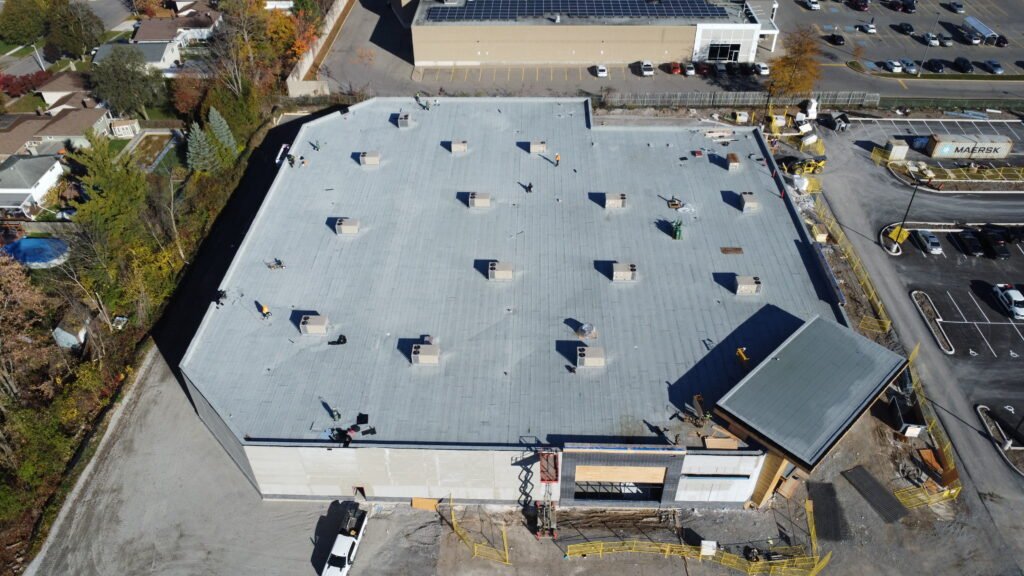
Mostly where the shop's equipment goes through the roof. An auto shop roof carries more fans, stacks and flues per square foot than a warehouse roof of the same size, and each one is a flashing that can fail.
| Where | Why it leaks | What the repair involves |
|---|---|---|
| Exhaust fans for tailpipe hoses and general ventilation | Many small curbs, fans that run all day and vibrate, and oily residue around the curb | Re-flash the curb to a proper height, with the fan's downtime planned with the shop (see below) |
| Paint booth stack, guy wires and the booth's air make-up unit | A large hot duct through the roof, guy-wire anchors that are penetrations of their own, and stack flashings drawn for sloped roofs | A metal collar with noncombustible insulation in the gap, and the membrane flashed to the collar (see below) |
| Heater flues | Hot pipes from gas-fired unit heaters and waste-oil furnaces, often with improvised flashings | An insulated sleeve or flue curb, with the heater disconnected by a licensed technician (see below) |
| Rooftop units and gas lines | Low curbs, condensate lines and gas piping laid on the membrane | Curbs raised and piping properly supported; see our rooftop equipment guide |
| Roof drains | Blocked strainers and low spots, made worse by debris left after equipment work | Clear, reset or replace the drain; see our roof drain repair guide |
Contamination is the other auto shop problem. Oil mist from exhaust fans, solvent vapour and paint overspray land on the roof around the equipment that discharges them. IKO's sample commercial warranty excludes damage from "chemical attack from any chemical materials including but not limited to greases, solvents, oils, or other chemicals"; our industrial guide compares which membranes stand up to chemicals and oils. The same warranty excludes damage after new equipment such as "fan housings" is added without IKO's written permission in advance, and after "any change in the use of the building". A new exhaust fan, a booth stack, or a warehouse turned into a body shop all start with a call to the warranty holder.
Can the exhaust fans be turned off while roofers work?
Only if the engines in those bays are off too. Ontario's Building Code requires a repair garage to have "a mechanical ventilation system designed to limit the exposure of workers to" carbon monoxide below 25 parts per million, averaged over an 8-hour day, and nitrogen dioxide from diesel vehicles below 0.72 parts per million (Division B, 6.3.1.3.(7), January 16, 2025 edition of the 2024 Code).
The Code then gives two ways to do it for bays that are not right beside an outside door:
- General ventilation of at least 700 L/s per internal bay, running continuously or switched on automatically by carbon monoxide monitors (6.3.1.3.(8) and (9)).
- Tailpipe exhaust: the general system is not needed "when tail pipes of vehicles are directly connected to local mechanical exhaust systems that terminate outdoors" (6.3.1.3.(10)). That is the hose reel and its fan on the roof.
Either way, a fan on the roof is what keeps the air safe in the bays. The Code has no rule for switching one off during construction, so it comes down to planning. If the roofer has to stop a fan to re-flash its curb, lift it for new insulation or torch near it, the shop stops running engines in the bays that fan serves until it is back on and discharging outdoors. Agree the bays, the day and the hours with the service manager before the crew arrives.
A re-roof also changes heights. The Code wants outdoor air intakes "not less than 0.3 m above roofs", allowing for snow (6.3.2.9.(3)), and keeps them 4.5 m from the entry of a garage for five or more vehicles (Table 6.3.2.9). New insulation raises the roof surface, so check the make-up air and rooftop unit intakes before the new roof goes on; our rooftop equipment guide covers curb heights.
How is a paint booth stack handled during roof repair?
As fire safety equipment. Ontario's Fire Code (O. Reg. 213/07, consolidation from January 1, 2026) treats everything within 6 m of a spray booth as a spraying area, and its Section 5.12 sets rules for booth ducts that reach the roof. A booth built to NFPA 33 (the Fire Code names the 2018 edition) follows that standard instead, so ask the booth contractor which one applies.
| Rule | What it says | What it means for the roof |
|---|---|---|
| 5.12.4.3 | Where a duct passes through a combustible roof, "metal collars shall provide not less than a 100 mm clearance between the duct and combustible material", and the gap is sealed "with noncombustible insulating material" | No foam, wood blocking or membrane tight against the stack. The roofer flashes to the collar, not to the duct |
| 5.12.4.2 | 457 mm clearance between unprotected combustible materials and the duct | Keep new insulation boards, cants and wood nailers back from the stack |
| 5.12.4.5 | The outlet must be 1.8 m from any combustible exterior wall or roof, and must not discharge toward a combustible surface or unprotected opening within 7.5 m | A thicker roof or a taller curb shortens the stack above the roof. A new skylight, hatch or intake in the discharge path is a conflict |
| 5.12.4.4 | Ducts need access doors for cleaning | Do not bury a clean-out door in a new curb or flashing |
| 5.12.7.1 | Spraying equipment must shut down if the ventilation fails | Covering the stack or stopping the fan for roof work stops the booth |
The strongest rule for roofers is about heat, and it applies to every booth. Before anyone torches, welds or grinds on a duct, the Fire Code requires that "the system has been shut down", the duct "has been cleaned of any accumulations of combustible deposits", and any combustible lining has been removed (2.6.1.10.(1)). Any activity that gives off flammable vapours "shall be interrupted" before hot work starts (5.17.3.1.(3)), and Section 5.12 bans open flames within the spraying area unless a 1-hour vapour-tight fire separation is in between (5.12.7.6). In plain terms: no spraying on the days the roofer works near the booth, and the duct is cleaned first.
Booth makers leave the roof to the roofer. Global Finishing Solutions' installation manual (U.S., March 2022) says the roofer or another agent "must cut the hole in the roof for the AMU ductwork and install the AMU curb on the roof", and leaves the tie-off points for the stack's guy wires to the customer or "a roofer or building contractor". Another booth seller's manual shows the stack flashing "nailed in place on roof top and sealed with tar", a sloped-roof detail. On a flat roof, the stack needs a collar that keeps the Fire Code clearances and a membrane flashing up the collar; see how hot stacks are flashed.
Clean before you heat. The same maker's service manual warns: "Paint-contaminated items are flammable and may cause spontaneous combustion." Overspray on the roof is also a membrane problem: Sika Canada's bulletin on protecting its PVC roofs (June 2024) lists paint overspray among the things the membrane must be protected from, and says a contaminated membrane "must be replaced and may void any warranty". If paint is reaching the roof, the booth's filters need attention before the roof does.
Check the environmental registration too. Most small collision shops register their booths on Ontario's Environmental Activity and Sector Registry under O. Reg. 347/12 (Automotive Refinishing). It says booth stacks "shall be vertical with no flow impediments and shall discharge at a velocity of not less than 12 metres per second", at a height of "at least 1.5 times the height of the building" (s. 4).
Stacks at shops that held an approval on October 31, 2011 are spared those two rules "unless a change has been made to the spray booth exhaust stack", so a re-roof that shortens, moves or re-caps the stack can bring it under today's rules. The shop keeps a five-year record of repairs to its refinishing equipment (s. 5) and corrects its Registry information within 30 days of a change (O. Reg. 245/11, s. 3). Agree any stack change with the booth contractor and the shop first.
Who moves heater flues and gas lines during roof work?
A licensed technician, not the roofer. Ontario's gas regulation bars anyone without a certificate from installing, altering, repairing or removing "any appliance, equipment or other thing employed or to be employed in the handling or use of gas" (O. Reg. 212/01, s. 6 (1)). A gas technician 1 may work on "any vent, vent connector, draft control device or other component in an appliance venting system", and a gas technician 2 may do the same on appliances of 400,000 Btuh or less (O. Reg. 215/01, ss. 20 and 21).
Oil-fired equipment follows the same rule under the fuel oil regulation, with oil burner technician certificates (O. Reg. 213/01, s. 4 (1)). For a waste-oil furnace, ask its service company who is certified to work on it.
This matters on a re-roof because the roof surface goes up. The Building Code sends heater venting to the appliance installation codes (Division B, 6.3.3.1.(1)), which set how far a vent must rise above the roof. New insulation shortens every vent above the new surface, so the technician checks and extends the vents and the roofer then flashes around them. On the day of the work:
- Book the technician to shut down, disconnect or extend heaters and their vents, and to restart and test them after.
- Keep torches off the gas lines. The Fire Code says a roofing torch "shall not directly expose" gas lines and electrical cables (5.11.2.2.(1)), and for other hot work, gas piping within 1 m of the torch is covered with wet noncombustible insulation 6 mm thick (5.17.3.2).
- Protect the piping. The Fire Code also asks for precautions so that renovations do not damage fuel supply piping (2.6.1.11). Gas lines lying on the roof are lifted onto proper supports, not buried in the new roof; see our guide to supporting pipes and cables on a flat roof.
Why do reels and heaters hung from the roof matter for a re-roof?
Because they hang from the same steel joists that carry the roof. Exhaust hose reels, lube and air reels, unit heaters and lights are usually bolted to the roof structure: Nederman's 2026 manual for one of its vehicle exhaust systems has the installer drill and bolt its rails to the "ceiling beam", and Reelcraft's exhaust reel instructions (2024) say to "Position reel on floor, wall, or ceiling" with bolts the customer supplies. Neither manual checks the structure; that is left to the owner.
Joists are not designed to take a load anywhere along their length. The U.S. Steel Joist Institute's rule, as explained in Modern Steel Construction (June 2018), allows small loads between the joist's panel points only if "the sum of the concentrated loads within a chord panel does not exceed 100 lb and the attachments are concentric to the chord"; heavier loads "must be applied at joist panel points". That is U.S. practice. Canadian joists are designed by their maker to CSA S16, so the joist maker or an engineer answers for a particular roof.
A re-roof adds to the same joists. Ontario's Building Code says that after a material alteration or repair, the building's performance level must be "at least equal" to what it was before (Division B, 11.3.1.1.(1)), and a "basic renovation" with the same or similar materials is allowed only if it will not adversely affect "the structural adequacy" of the building (11.3.3.1.(1)).
A recover over the old roof, or thicker insulation to meet today's energy rules, adds dead load, and a higher roof surface lets snow drift deeper against parapets and equipment; see our snow load guide on snow drifts. Before a recover, or a new reel, heater or fan, have an engineer check the joists with everything already hanging from them.
Can the shop stay open during auto shop roof repair?
Usually, yes, if the roof is worked in sections and the bays under each section are planned with the shop. Most repairs happen on top of the membrane and never reach the bays. A section where wet insulation or the steel deck is replaced is different, because work at deck level can drop dust, screws and water into the space below. The way we plan it:
- Clear the bays under deck work. No customer cars on hoists or in the bays below a section where the deck is opened or re-fastened, for the days that section is open.
- Cover what stays. Tools, parts racks and equipment near the work area go under 6 mil polyethylene.
- Keep the bay doors and parking clear. Material lifts, hoisting and debris chutes go on a side of the building away from the overhead doors and customer parking.
- Agree the fan and booth schedule. Which exhaust fans and which booth are off, on which days, and what that means for the work orders.
- Close each section the same day. A watertight tie-in every night, so a storm does not reach the bays.
Settle the insurance before the job. Section 6 of Ontario's standard garage policy (OAP 4, wording approved for use from July 1, 2026) pays what the shop is "legally obligated to pay" for a customer's car in its care, and only for collision or upset and listed perils such as fire, theft, vandalism, windstorm, hail and rising water. Water from an opened roof or a falling fastener is not on that list, and endorsements vary. The roofer's commercial general liability insurance should answer for damage the crew causes, so ask for its certificate and talk to your broker. The membrane warranty will not help: IKO's sample excludes damage to "any property contained therein".
If a leak reaches lift power units, air lines or electrical panels, our office roof guide covers what to do when water reaches electrical equipment.
What about car washes and detailing bays?
Their problem is moisture from inside as much as rain from outside. A wash bay fills the building with warm, wet air, and in winter that air reaches the cold underside of the roof. IKO, quoting the U.S. National Roofing Contractors Association, recommends a vapour barrier on the interior side of the roof where the average January temperature is below 4°C and the expected winter indoor humidity is "45 percent or greater"; every GTA city is well below that January figure. IKO lists "Corrosion of steel materials." among the effects of vapour in a roof.
A vapour barrier only works if it is continuous. The National Research Council's Canadian Building Digest 73 says the roof must be designed "to prevent the entry of water vapour by both diffusion and air leakage", and warns that "Complete protection against any vapour migration into a roof system is virtually impossible with conventional roof designs." So the seals around every penetration matter as much as the sheet itself.
When we inspect a roof over a wash or detailing bay, we look underneath first: rust on the underside of the steel deck and on the fasteners, drips that appear in cold weather without rain, and stained or sagging insulation. On top, we check for wet insulation with cores or an infrared scan and look at the seals around the wash equipment's vents and fans. Our industrial guide explains how to tell condensation from a roof leak.
Does OYH Roofing do auto shop roof repair?
Yes. OYH Roofing is an Oakville-based industrial, commercial and institutional flat roofing contractor working across the GTA. Our published projects do not include an auto shop, so we do not claim one. The closest are industrial roofs: a 53,000 sq ft industrial building in Mississauga, where we installed a 2-ply modified bitumen roof with a 20-year labour and materials warranty, and Millomat Stampings in Mississauga, where we installed 50,000 sq ft of 60 mil TPO over a new addition and the existing building.
On an auto shop, body shop, dealership or car wash, we can find and repair leaks, re-flash exhaust fans, booth stacks and heater flues, plan the work with your service manager, gas technician and booth contractor, and keep the bays running. See all our completed projects.
Frequently asked questions
How urgent is a roof leak over a service bay?
Same-day urgent. Water on a floor that already carries oil is a slip hazard, and water near lift power units, air lines and electrical panels needs an electrician's check before they are used again. Rope off the area, catch the water and call the roofer for a temporary seal. Wet insulation spreads past the leak, so a quick repair also keeps a small job from turning into a re-roof.
Can roofers work while cars are running in the shop?
Yes, as long as the exhaust fans that serve those bays keep running. Ontario's Building Code requires a repair garage's ventilation to keep carbon monoxide below 25 parts per million averaged over a workday. If a fan has to come off for re-flashing, the shop stops running engines in the bays it serves until the fan is back on and discharging outdoors.
Who pays if roof work damages a customer's car?
Usually the roofer's insurer, if the crew caused it. Ontario's standard garage policy covers customers' cars only where the shop is legally liable, and only for collision or upset and listed perils such as fire, theft and windstorm. Ask the roofer for its commercial general liability certificate, talk to your broker before the job, and keep customer cars out of bays under open deck work.
Does an auto body shop need a special roof membrane?
It needs one that suits what lands on it. No membrane resists every chemical, and IKO's sample commercial warranty excludes damage from greases, solvents and oils. Give the membrane maker a list of what your fans and booth discharge, keep the booth filters changed, and have the roofer flash the stack to a metal collar that keeps the Fire Code clearances.
Can I add an exhaust fan or a paint booth stack to my existing roof?
Yes, after three checks. Ask the warranty holder first: IKO's sample warranty excludes damage after new fan housings unless IKO gives written permission in advance. Have an engineer confirm the roof can carry the new load. For a booth stack, involve the booth contractor, because of the Fire Code clearances and the stack rules in the automotive refinishing registration. Then have a roofer flash it.
A leak over a service bay, or roof work to plan around the shop?
Send us photos of the leak and the roof, mark the exhaust fans, paint booth stack and heater flues on a sketch, and tell us your shop hours, and we will plan the repair around your bays.
Call 1-833-775-7663Request an assessment
Karol Rajkowski
Vice President · OYH Roofing
Karol Rajkowski is Vice President of OYH Roofing, an Oakville-based ICI flat-roofing contractor whose projects include a 53,000 sq ft industrial roof in Mississauga and 50,000 sq ft of TPO at Millomat Stampings. Learn more about the OYH team.
Sources
- Building and fire codes: Building Code, 2024 Building Code Compendium, Volume 1 (January 16, 2025 edition), Div. A 1.4.1.2 and Div. B 3.1.8.3, 3.3.5.5, 6.3.1.3, 6.3.2.9, 6.3.3.1, 9.10.9.19, 11.3.1.1 and 11.3.3.1; Fire Code, O. Reg. 213/07 (consolidation from January 1, 2026), Div. A 1.4.1.2 and Div. B 2.6.1.10, 2.6.1.11, 5.11.2.2, Section 5.12 and 5.17.3.
- Environmental registration: O. Reg. 347/12, Registrations under Part II.2 of the Act: Automotive Refinishing, ss. 2, 4 and 5 (consolidation from March 6, 2015); O. Reg. 245/11, Registrations under Part II.2 of the Act: General, s. 3.
- Gas and oil equipment: O. Reg. 212/01 (Gaseous Fuels), s. 6; O. Reg. 215/01 (Fuel Industry Certificates), ss. 20 and 21; O. Reg. 213/01 (Fuel Oil), s. 4.
- Insurance: Ontario Garage Automobile Policy (OAP 4), approved by the Financial Services Regulatory Authority of Ontario for use on or after July 1, 2026, Section 6 (liability for damage to a customer's automobile).
- Paint booths and exhaust equipment: Global Finishing Solutions, General Purpose Pressurized Downdraft Installation Manual (239-029, March 14, 2022, U.S.) and Auto Refinish Booths Service and Maintenance Manual (239-062, May 17, 2022, U.S.); JMC Automotive Equipment, RGI spray booth manual (U.S.); Nederman, Vertical Stack System user manual (142592, May 29, 2026); Reelcraft, exhaust hose reel instructions (Form 571-691, March 2024, U.S.).
- Steel joists: James M. Fisher, Concentrating on Loads, Modern Steel Construction (June 2018), quoting the Steel Joist Institute catalogue (U.S.).
- Membranes, warranties and moisture: IKO, commercial limited labour and membrane warranty sample and Introduction to vapour barriers and vapour retarders; Sika Canada, Technical Bulletin 015, Sika Sarnafil Roof Protection (June 13, 2024); National Research Council, Canadian Building Digest 73, Moisture Considerations in Roof Design (1966).
- OYH Roofing project records: Mississauga industrial building (53,000 sq ft, 2-ply modified bitumen), Millomat Stampings, Mississauga (50,000 sq ft, 60 mil TPO) and 777 Niagara St, Welland (52,300 sq ft).
OYH Roofing, 2120 Speers Rd, Oakville, ON L6L 2X8 · 1-833-775-7663 · info@oyhroofing.ca