
Modified Bitumen Roof Installation: 2-Ply, Step by Step
How a 2-ply SBS roof is built on a commercial building, and how to tell it was done right.
Call 1-833-775-7663 Oakville head office · Modified bitumen roofing on commercial, industrial and institutional buildings across Ontario
Karol Rajkowski
Vice President, OYH Roofing
Published October 17, 2026 · 11 min read
Short answer
Modified bitumen roof installation goes in layers: a dry, clean deck, a vapour retarder, insulation and a cover board, a base sheet, flashings, then a granule-surfaced cap sheet with every lap offset from the one below. The sheets can be torched, self-adhered, set in cold adhesive or mopped in hot asphalt, each with its own temperature limits.
What is a 2-ply modified bitumen roof?
A roof membrane made of two sheets of asphalt modified with rubber-like polymers: a base sheet that is never left exposed, and a granule-surfaced cap sheet on top. SOPREMA describes a 2-ply system as base and cap sheets that "can be installed in various application modes", and the sheets sit on a full assembly built up from the deck.
| Layer | What it does | Notes from makers and CRCA |
|---|---|---|
| Cap sheet | The exposed, weatherproof layer | Surfaced with ceramic-coated mineral granules; white reflective caps are available |
| Base sheet | The first membrane layer, under the cap | Designed not to be left exposed; can be torched, mopped, cold-applied, self-adhered or fastened |
| Cover board | Protects the insulation and spreads loads | Heat-applied membranes need a separation board; IKO Protectoboard and SOPREMA Sopraboard are made for torching |
| Insulation | Thermal resistance, often polyisocyanurate | Never torched directly; polystyrene is easily damaged by heat |
| Vapour retarder | Keeps indoor moisture out of the roof | IKO places it directly over the deck |
| Deck | The structure: steel, concrete or wood | IKO calls for steel decks of at least 22 gauge; concrete is primed before heat-applied materials |
So when people ask whether modified bitumen has an underlayment, the answer is the base sheet. IKO notes that, as with 2-ply systems generally, a roof should not be expected to be watertight until the cap sheet is on.
How is a modified bitumen roof installed?
From the deck up, one layer at a time, and only as much in a day as the crew can cover. Modified bitumen roof installation follows the maker's specification for each layer. IKO's specification says to install only as much of the assembly as can be covered by the completed roof the same day, so a sudden rain does not soak the insulation.
| Step | What happens | What the makers require |
|---|---|---|
| 1. Prepare the deck | Old roofing removed where needed; deck cleaned and dried | No water, dew, frost or snow; steel at least 22 gauge; concrete primed before heat-applied layers |
| 2. Vapour retarder | A sheet that keeps indoor moisture out of the roof | Placed directly over the deck |
| 3. Insulation and cover board | Boards laid and attached, joints offset | Boards span the deck flutes; a separation board before any torching |
| 4. Base sheet | First membrane layer, started at the low point | Side laps at least 90 mm and end laps at least 150 mm (IKO); laps never bucking the flow of water |
| 5. Flashings | Two plies up walls, curbs and penetrations | Base flashing at least 200 mm above the roof; polyester-reinforced plies |
| 6. Cap sheet | Granule-surfaced top layer | Laps offset 300 mm (side) and 610 mm (end) from the base sheet; end lap granules embedded |
| 7. Inspect and close out | Defects fixed, maker's inspection, warranty | Voids and fishmouths patched before the next ply; cap smooth, flat and fully adhered |
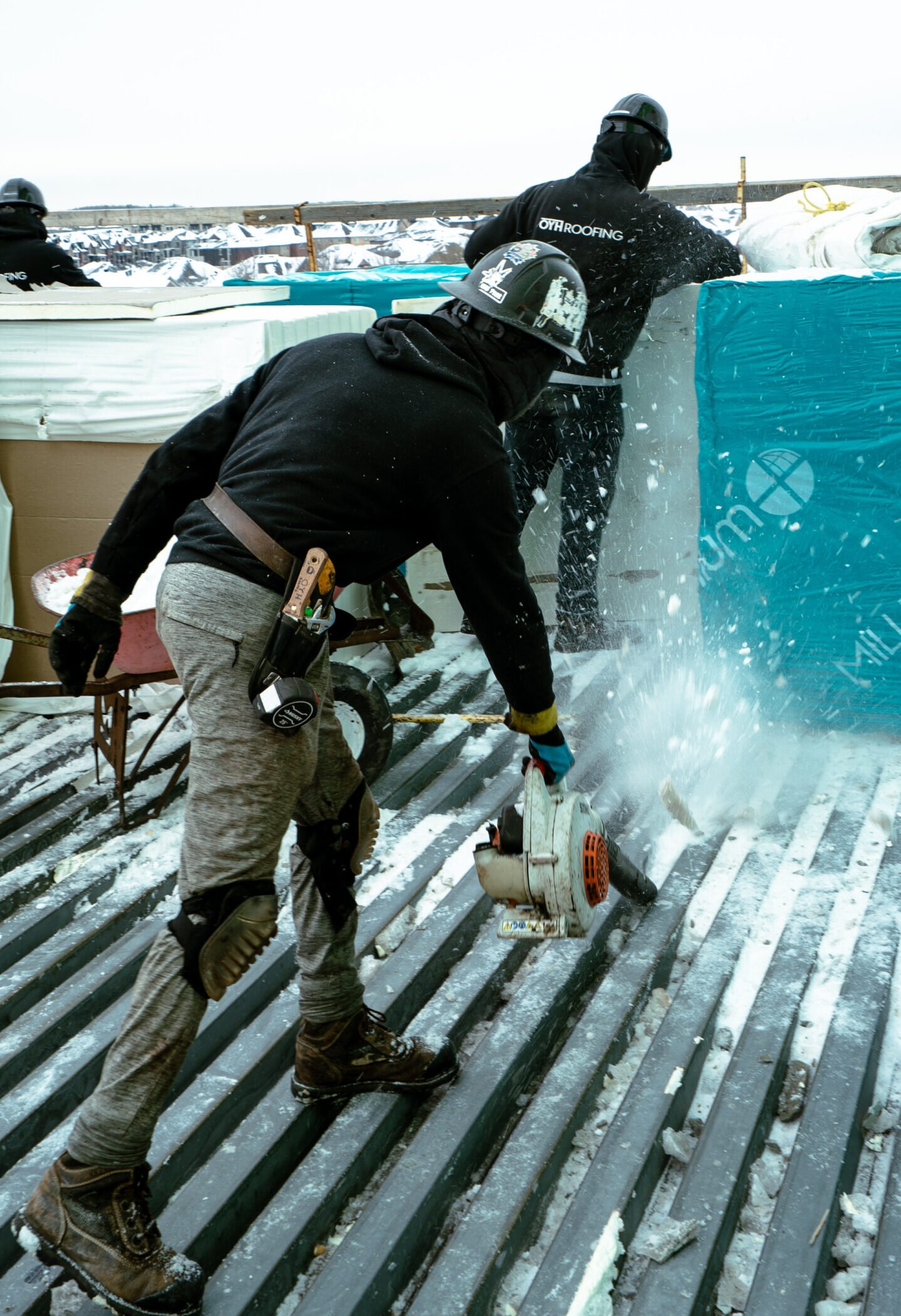
At the end of each day the crew seals the edge of the finished work. IKO's night seal sits at least 610 mm past the last insulation board, is checked daily and is cut away before work restarts. For a full re-roof, our warehouse roof replacement guide covers tear-off, permits and scheduling.
Torch-on, self-adhered, cold adhesive or hot asphalt?
All four are ways of installing the same kind of sheet. IKO lists hot asphalt, heat-fused (torch), mechanically fastened, cold process and self-adhered applications for its SBS membranes, and CRCA calls cold adhesive an alternative to torch or hot asphalt. None of the makers we checked ranks one method above the others; the choice depends on the weather, the substrate and the building.
| Method | How the sheet bonds | Temperature limits | Where it fits |
|---|---|---|---|
| Torch-applied (heat-fused) | A propane torch melts the back of the roll as it is unrolled | No IKO minimum, but work below 5°C needs special measures | Steel or concrete decks over a torch-rated board; never on combustible substrates |
| Self-adhered (peel and stick) | Release film removed; laps heat-welded | IKO: 5°C and rising. SOPREMA: 10°C summer grade, -10°C winter grade | Near combustible walls and where a flame or kettle is unwanted |
| Cold adhesive | Sheet set into a solvent-free, low-VOC adhesive; laps hot-air welded | IKO: above 4°C. CRCA: most products 5°C to 40°C | Low odour; no foot traffic during a 24 to 72 hour cure |
| Hot asphalt (mopped) | Sheet set into hot asphalt | IKO: asphalt at least 219°C at the point of application | Kettles are kept off the roof under the Fire Code, with a narrow exception for concrete roofs |
The trade-offs are practical. A torch works in colder weather but brings fire risk, so Ontario's Fire Code requires a firewatch until at least 3 hours after torching stops, and CRCA recommends flameless materials at walls, curbs and penetrations. Self-adhered sheets need no kettle or torch, which ARMA (U.S.) notes is less disruptive to occupants, but they need warm enough weather and well-sealed laps, because there is no layer of liquid bitumen to fill gaps. Systems often combine methods, such as a self-adhered or fastened base layer at combustible walls under a torched cap. Our flat roofing material guide covers cold-weather limits for every system.
What do good laps look like on a modified bitumen roof?
Wide enough, offset from the layer below, and fully bonded from edge to edge. Laps are where most installation defects start, so makers spell out the details.
- Width. IKO calls for side laps of at least 90 mm and end laps of at least 150 mm on both plies. SOPREMA's sheets carry a 75 mm side-lap selvedge, so the maker's own number governs.
- Offsets. IKO staggers laps at least 300 mm (side) and 610 mm (end) from each other and from the sheet below, so no two laps line up.
- End laps. Every end lap gets a 45-degree corner cut to form a water stop, and the granules on the sheet below are pressed into hot bitumen with a torch and trowel before the next roll goes on. CRCA calls that embedding mandatory.
- Bleed-out. On a torched lap, IKO looks for a small bead of bitumen, about 6 mm, along the edge. CRCA says granular side laps can be fully bonded without visible bleed-out, but that a visible bead is the immediate sign the lap is sealed.
- Cold rolls. IKO asks for rolls to be stored above freezing in winter, on end with the selvedge up, warmed in a heated area before use, and unrolled to relax before they are installed.
How are flashings installed on a modified bitumen roof?
In two plies, carried up the wall and over the field, and often by a different method than the field. IKO sets the base flashing at least 200 mm above the finished roof, runs the cap flashing 150 mm and the base flashing 200 mm out onto the field, and requires polyester-reinforced sheets for both flashing layers.
Combustible parapets and curbs get a fastened, glued or self-adhered base layer, or a torch-rated board, before any heat-welded flashing goes on. IKO says cant strips are not required for its modified bitumen systems, while CRCA notes that makers differ, so the specification decides. The top of the flashing is closed with metal counterflashing or a coping; IKO's counterflashing has a 100 mm face that laps the flashing by 100 mm. Our roof flashing repair guide covers how these details fail later.
How can you tell a modified bitumen roof was installed right?
Mostly during modified bitumen roof installation, because a finished cap hides the base sheet. CRCA's daily check is simple: heat a short length of roll, stop, pull it back and look at the bond. IKO requires voids and fishmouths to be cut out and patched before the next ply goes on, and the finished cap to be smooth, flat and fully adhered.
| Defect | Why it matters | Source |
|---|---|---|
| Unsealed end laps or unembedded granules | Laps can delaminate and let water in; a known cause of failures | CRCA, Johns Manville |
| Open seams, fishmouths, large unbonded areas | Must be corrected before the roof is accepted | CRCA |
| Blisters | From voids, debris, unrelaxed sheets or trapped moisture; a ruptured blister cut cap strength by more than half | NRC |
| Overheated sheets | Damaged bitumen and reinforcement; smoke is the warning sign | IKO, CRCA, Johns Manville |
| Granule loss | Exposed bitumen and reinforcement deteriorate | IKO |
| Minor wrinkles | Often cosmetic, especially in cold weather; not necessarily defective material | CRCA, IKO |
The maker's inspection is the other check. An IKO registered warranty needs a contractor registered in IKO's applicator program and an inspection on completion, and SOPREMA says its MAMMOUTH warranties include inspection visits by its own experts from start to finish. IKO does not recommend destructive test cuts on a new roof. Our commercial roof warranty guide explains what each warranty type covers.
What standards and code rules apply to modified bitumen?
In Canada, the sheets themselves are made to CSA A123.23, and the roof that is built from them must meet the Building Code, the Fire Code and the maker's warranty rules. The standard number on a data sheet tells you what the product is; it does not tell you how the roof was installed.
- CSA A123.23. The Canadian product standard for SBS and APP sheets (current edition A123.23-15, reaffirmed 2025). On a data sheet, the Type is the reinforcement (A glass, B polyester, C both), Grade 1 is an exposed granule-surfaced sheet, and Grade 3 is a sheet not meant to be exposed, such as a base sheet. CSA says it does not address fire, wind uplift or installation.
- ASTM (U.S.). D6162, D6163 and D6164 cover SBS sheets, and D6222 and D6223 cover APP. IKO lists CSA A123.23 for Canada and the ASTM numbers for the U.S.
- Slope. Ontario's Building Code sets 1 in 50 (2 per cent) as the minimum slope for modified bituminous membranes in Part 9, which covers buildings up to 3 storeys and 600 m². Larger buildings fall under Part 5, which requires drainage but sets no number, so IKO's recommended minimum of 2 per cent, or 1/4 in. per foot, is the working rule. IKO also says damage from ponding is not covered by its warranty.
- Fire and wind. Torch work follows the Fire Code's hot surface rules, including a firewatch until at least 3 hours after torching stops; see our industrial roof repair guide. Wind uplift and fire ratings for new roofs are covered in our new construction roofing guide.
Planning a modified bitumen roof?
We can review the deck, insulation and flashing details with you and recommend the application method that fits your building and schedule.
Call 1-833-775-7663Request an assessmentWhat modified bitumen roofs has OYH Roofing installed?
OYH Roofing handles modified bitumen roof installation on commercial, industrial and institutional buildings across Ontario, mostly 2-ply systems. Recent jobs include an IKO 2-ply roof of base and cap sheets on the 52,300 sq ft building at 777 Niagara St in Welland and on the City of Mississauga building at 3185 Mavis Rd (8,500 sq ft), both with 20-year system warranties, and a 2-ply modified bitumen roof on a 53,000 sq ft industrial building in Mississauga with 20 years on labour and materials.
See the 777 Niagara St project, the City of Mississauga roof, the 53,000 sq ft industrial roof and our other completed projects. To compare systems first, see modified bitumen vs TPO; for older roofs, see our membrane roof repair guide.
Frequently asked questions
What is 2 ply modified bitumen roofing?
A modified bitumen roof made of two layers: a base sheet bonded to the cover board or deck, and a granule-surfaced cap sheet bonded over it, with the laps of the two layers offset. The base sheet is designed never to be left exposed, and the cap sheet is the weathering surface.
Is torch down better than peel and stick?
Neither is better in every case, and the makers we checked do not rank them. Torch-applied sheets are fused with an open flame and need a firewatch under Ontario's Fire Code. Self-adhered sheets need no flame but have minimum temperatures, such as 5°C and rising for IKO's, and rely on well-sealed laps.
Is torch down the same as modified bitumen?
Not exactly. Modified bitumen is the material: asphalt modified with SBS or APP polymers. Torch-applied, or torch-down, is one way of installing it, with a propane torch. Depending on the product, the same type of sheet can also be self-adhered, set in cold adhesive, mopped in hot asphalt or mechanically fastened.
What is the minimum slope for a modified bitumen roof?
Ontario's Building Code sets 1 in 50, or 2 per cent, for modified bituminous membranes on smaller Part 9 buildings, and IKO recommends at least 2 per cent, or 1/4 inch per foot, on any roof. Larger buildings must still drain under Part 5 of the Code, and IKO's warranty does not cover damage from ponding water.
Does modified bitumen have underlayment?
Yes, in the sense that a 2-ply system has a base sheet under the cap. IKO describes base sheets as the first membrane layer, not intended to be left exposed. Below the base sheet there is usually a cover board, insulation and a vapour retarder laid directly over the deck.
Can you walk on a modified bitumen roof?
Yes, for inspections and service, but regular routes need protection. CRCA recommends walkway pads or pavers around rooftop units and along access paths, and catwalks for anything beyond occasional traffic. A new roof laid in cold adhesive should not be walked on while the adhesive cures, which CRCA puts at 24 to 72 hours.
Need a roof that lasts?
Tell us about your building and roof, and we will set up a roof assessment and a written quote.
Call 1-833-775-7663Request an assessment
Karol Rajkowski
Vice President · OYH Roofing
Karol Rajkowski is Vice President of OYH Roofing, an Oakville-based ICI flat-roofing contractor whose projects include the City of Mississauga building at 3185 Mavis Rd and the Marriott Hotel in Vaughan. Learn more about the OYH team.
Sources
- IKO Commercial Technical Specification Manual: Part 9, SBS application (VER1124); Parts 2, 3, 4, 5, 6, 15 and 16; product classifications (2023); IKO Advantage Applicator Program (Canada).
- SOPREMA Canada: SBS membrane environmental product declaration (May 2025); data sheets for Sopraply Flam Stick and Sopraflash Flam Stick (2024); warranties.
- CRCA Technical Bulletins: Vol. 43, wrinkling and ridging (1995); Vol. 43A, hot asphalt mopping and Vol. 43B, torch welding (1996); Vol. 50, cover boards (2001); Vol. 52, cant strips (2002); Vol. 54, cold adhesive (2004); Vol. 44, rooftop equipment (1995); Vol. 3, roof maintenance (1970).
- CSA Group: CSA A123.23-15 (R2025), polymer-modified bitumen sheet. ASTM International: D6162, D6163, D6164, D6222 and D6223 (U.S.). 2024 Building Code Compendium, Volume 1 (1.3.3.3, 5.6.2.2, Table 5.9.1.1, 9.26.2.1, Table 9.26.3.1), January 16, 2025 edition. Ontario Fire Code, O. Reg. 213/07, 5.11.
- National Research Council Canada: Construction Technology Update No. 38, blistering of modified bituminous membranes (2000). ARMA: self-adhesive modified bitumen systems (April 2024, U.S.). Johns Manville: T22-005, bituminous end lap installation (2022, U.S.).
- OYH Roofing project records: 777 Niagara St, Welland; City of Mississauga, 3185 Mavis Rd; 53,000 sq ft industrial roof, Mississauga (October 2026).
OYH Roofing, 2120 Speers Rd, Oakville, ON L6L 2X8 · 1-833-775-7663 · info@oyhroofing.ca