
Roof Flashing Repair: What Fails and How It Is Fixed
Where flashings sit on a flat roof, why they leak, how roofers repair them and when a flashing should be rebuilt instead of patched.
Call 1-833-775-7663 Oakville head office · Flat roof repairs, replacements and inspections for commercial, industrial and institutional buildings across Ontario
Karol Rajkowski
Vice President, OYH Roofing
Published October 7, 2026 · 8 min read
Short answer
Roof flashing repair seals the joints where a flat roof meets walls, curbs, pipes, drains and roof edges, the places most leaks start. Common faults are failed sealant, open laps, loose metal and flashing set too low. Small defects can be repaired; brittle, short or wet flashing should be rebuilt.
What is roof flashing on a commercial building?
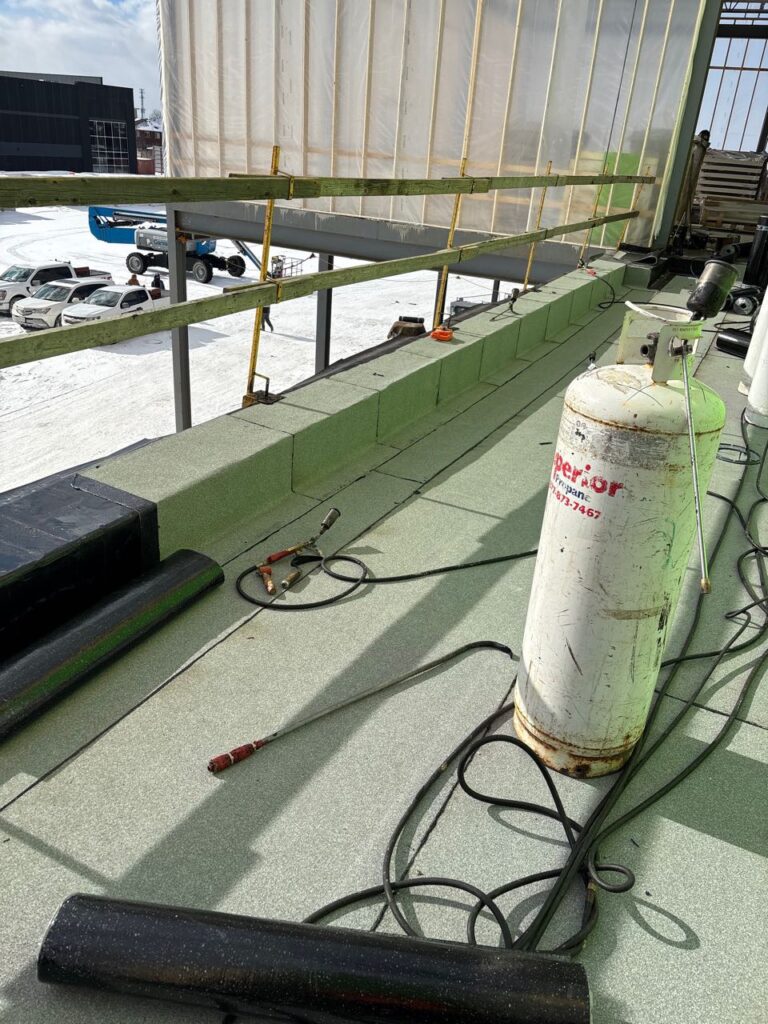
Roof flashing is the extra membrane and metal that seals every place where the roof membrane stops or turns: up a parapet, around a rooftop unit or pipe, into a drain or over the roof edge. On a commercial flat roof it has three main parts.
- Base flashing. Strips of roofing membrane that run from the roof up the wall or curb: torched or adhered plies on a 2-ply modified bitumen roof, heat-welded membrane on TPO and PVC roofs.
- Counterflashing. Metal that covers the top of the base flashing and sheds water over it, set into the wall or fastened to its face. IKO's TPO termination detail calls for 24-gauge pre-finished steel or 0.032 in (0.81 mm) aluminum, with metal work to SMACNA recommendations.
- Termination bar. A metal bar fastened through the top edge of the base flashing, no more than 12 in (300 mm) apart in that IKO detail, with sealant along the top.
Height matters most. IKO's detail sets the minimum flashing height at 8 in (203 mm) above the roof surface, and the Roofing Contractors Association of British Columbia (RCABC) standard for modified bitumen parapets carries at least two plies 203.2 mm up the wall. Lower flashing lets ponding water, slush and drifted snow reach its top edge, which is why a good commercial roof flashing repair checks the height, not just the leak.
Where are the flashings on a flat roof?
At every edge, wall, curb, penetration, drain and joint. IKO's flashing details for modified bitumen roofs cover more than 20 of them, from roof edges and parapets to pipes, HVAC units, pitch pans, drains and expansion joints.
| Flashing | What it seals | Common trouble spots |
|---|---|---|
| Parapets and walls (IKO MB-6, MB-8, MB-9) | The roof turning up a wall | Wrinkles and splits from movement, dried-out sealant at the top, loose counterflashing |
| Copings and roof edges (MB-3, MB-10, MB-11) | Parapet tops and the roof perimeter | Loose or lifted metal, open joints between sections |
| Curbs under rooftop units (MB-18) | HVAC units, fans and hatches | Flashing too low, damage when units are serviced or replaced |
| Pipes, vents and supports (MB-4, MB-5, MB-22) | Plumbing vents, columns, gas line and equipment supports | Cracked or loose collars, open laps |
| Pitch pans (MB-21) | Odd-shaped penetrations | Sealant filler that needs regular checks like any sealant |
| Drains and scuppers (MB-12 to MB-14) | Where water leaves the roof | Membrane loose at the drain, blocked scuppers |
| Expansion joints (MB-15 to MB-17) | Joints that let the building move | Splits where the joint cover cannot move as designed |
| Corners (MB-23, MB-24) and termination bars (MB-27) | Inside and outside corners, top edges | Open laps at corners, bars bent around corners instead of cut |
What are the most common roof flashing problems?
Most flashing leaks come from a short list of faults: sealant that has dried out, flashing that moves differently from the wall behind it, metal that has worked loose, flashing set too low, and damage from work around rooftop equipment.
- Dried-out sealant. IKO's details make sealant the building owner's job: all sealants and caulking are to be periodically inspected and maintained throughout the life of the roof.
- Movement. Roofing educator Richard Fricklas explained that diagonal wrinkles form in base flashing when the wall moves differently from the roof, and that the wall above the roof alternately freezes and bakes. Toronto Pearson averages about 81 freeze-thaw days a year in Environment Canada's 1991 to 2020 normals.
- Loose or missing metal. Without counterflashing or a coping over it, base flashing is left to the sun and wind. The RCABC requires counterflashing wherever the membrane on a parapet is not protected from UV light.
- Flashing too low. Below 8 in (203 mm), water from a blocked drain, slush or a snow drift can reach the top edge. Our guides to ponding water on a flat roof and flat roof snow load show where water and snow collect.
- Work around equipment. Curbs and pipe flashings sit where HVAC and other trades work, so they are worth checking after any rooftop equipment is serviced, moved or replaced.
- Shortcuts at corners and edges. IKO's detail says termination bars must be cut at inside and outside corners, not bent around them.
Fricklas put base flashings behind roughly 95 per cent of roof leaks. Whatever the exact share, flashings are the first place a roofer looks when a flat roof leaks.
How is roof flashing repair done on a flat roof?
A roofer first finds where water gets in, then repairs the flashing with materials that match the roof system: new sealant for a sound flashing, a patch for a small defect, new metal for loose counterflashing, and a full rebuild when the flashing is brittle, too low or sitting over wet insulation.
| Repair | When it fits | What to know |
|---|---|---|
| 1. Re-seal the top edge | Sealant cracked or pulled away; the flashing itself is sound | Use the sealant the membrane maker specifies; it stays on the maintenance list |
| 2. Patch an open lap or small split | A local defect in a sound flashing | Same membrane type and maker as the roof: heat-welded for TPO and PVC, torched or adhered for modified bitumen |
| 3. Refasten or replace counterflashing | Metal loose, bent or missing | 24-gauge steel or 0.032 in aluminum in IKO's detail, installed to SMACNA |
| 4. Replace the termination bar | Bar loose, bent around a corner or fastened too far apart | Cut at corners and fasten at 12 in (300 mm) or closer, per IKO |
| 5. Re-flash a pipe or pitch pan | Cracked or loose collar, worn pitch pan filler | Follow the maker's pipe or pitch pan detail |
| 6. Rebuild the flashing higher | Flashing under 8 in (203 mm), or water and snow reach the top | May need a taller curb, coordinated with the HVAC contractor |
| 7. Replace wet insulation and re-flash | Insulation behind or beside the flashing is wet | Wet material comes out before new flashing goes on |
Repairs should use the roof manufacturer's products and details. IKO's warranty guide, for example, says its products must be used and substitutions need approval from IKO Technical Services, and other makers set similar rules. Our commercial roof warranty guide explains what keeps coverage in place.
When flashings are failing all over the roof, or wet insulation shows up in many places, roof flashing repair may only buy time. Our commercial flat roof lifespan guide covers when replacement makes more sense.
Leak near a wall, curb or pipe?
Tell us where it shows up inside, and we will set up a free roof assessment and a written quote for the repair.
Call 1-833-775-7663Request an assessmentCan building owners repair roof flashing themselves?
Not on a commercial roof. Roof flashing repair happens at roof edges, parapets and openings, where Ontario requires fall protection, and the wrong product or detail can put the roof warranty at risk.
- Fall protection. Ontario's construction regulation, O. Reg. 213/91, requires fall protection where a worker could fall more than 3 metres, starting with a guardrail system (sections 26 and 26.1).
- Built-up roofs. When a built-up roof is repaired, section 207 requires a barrier at least 2 metres from the roof perimeter, made of a taut chain, cable or rope 1.1 metres above the roof.
- Warranty. Manufacturers expect their own products and approved details, as the IKO example above shows.
- Compatibility. Sealants and patches have to suit the membrane and metal they touch; roof makers name their products in each flashing detail.
If you see a leak, stay inside: move equipment, contain the water, photograph it and call a roofer. Our guides to commercial roof leak repair in Toronto and Mississauga cover the first steps, and our roof leak insurance guide explains what to record for your insurer.
How do you keep roof flashing from failing?
Inspect flashings twice a year, keep the sealant maintained, protect them from foot traffic and equipment work, and keep water moving off the roof. NRCA recommends inspecting roofs and making repairs twice a year.
| What the roofer checks | What they look for |
|---|---|
| Top edges and sealant | Cracked or missing sealant, gaps at termination bars |
| Counterflashing and copings | Loose, bent or missing metal, open joints |
| Base flashing on walls and curbs | Wrinkles, splits, blisters and height above the roof |
| Pipes, supports and pitch pans | Cracked or loose collars, worn filler |
| Drains and scuppers | Blocked strainers, membrane loose at the drain |
| Anything touched by other trades | Damage after rooftop equipment work |
Regular checks keep roof flashing repair small: a reseal instead of a rebuild. The fall visit matters most in Ontario, because flashing that fails in winter sits under snow until spring. Our guide on how to prepare a flat roof for winter covers the full fall checklist.
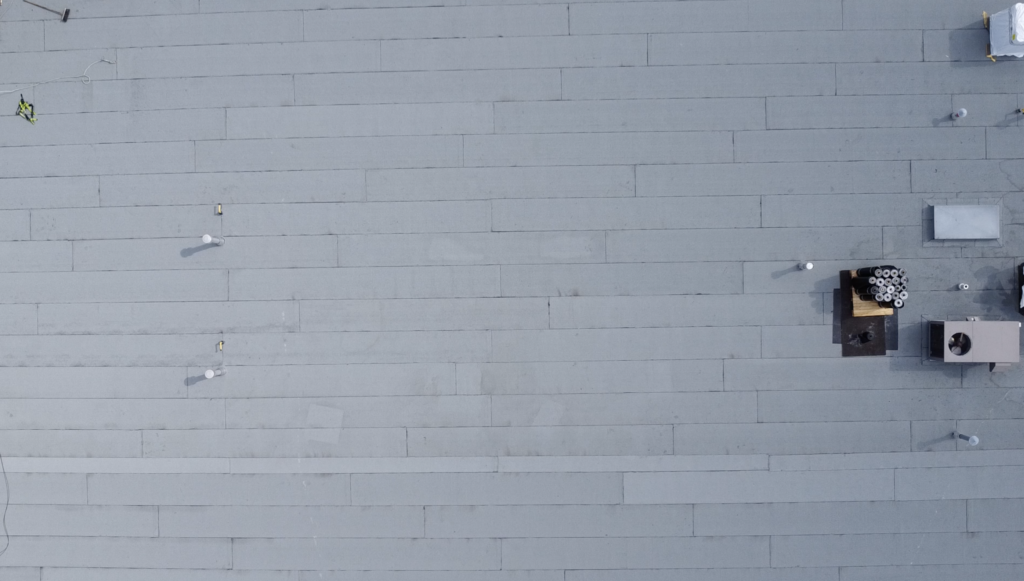
For more on how we work, see our roofing services and completed projects, including the 53,000 sq ft industrial recover in Mississauga shown at the top of this guide and the Marriott Hotel in Vaughan. If you are choosing a system for a new roof, our modified bitumen vs TPO guide compares how the two are flashed.
Frequently asked questions
Can roof flashing be repaired?
Yes, if the flashing itself is sound. Cracked sealant, a small split, an open lap or loose metal can be repaired with materials that match the roof system. Flashing that is brittle, lower than 8 in (203 mm) above the roof or sitting over wet insulation should be rebuilt, because a patch cannot fix those problems.
What are the common problems with roof flashing?
The usual problems are dried-out sealant at the top edge, wrinkles and splits from the wall and roof moving differently, loose or missing metal counterflashing and copings, flashing set too low, and damage from trades working on rooftop units. On flat roofs these faults often show up as leaks near walls, curbs and pipes.
My roof flashing is leaking. How can I fix it?
On a commercial building, do not go on the roof. Move people and equipment away from the leak, contain the water, photograph it and call a roofer. The roofer will find where water gets in and repair the flashing with matching materials, or rebuild it if it is too low, brittle or over wet insulation.
What do roofers use to seal flashing?
Mostly the roof membrane itself: heat-welded TPO or PVC, or torched and adhered modified bitumen plies, run up the wall and fastened with a termination bar. Metal counterflashing covers the top. Sealant is the last line, used where the manufacturer's detail calls for it, and it needs regular inspection and maintenance.
Can I replace roof flashing myself?
Not on a commercial roof. Ontario requires fall protection where a worker could fall more than 3 metres, the work is at roof edges and openings, and flashing has to match the roof's system and details. Unapproved products can also put the manufacturer's warranty at risk, so hire a roofing contractor.
What is the best sealant for roof flashing?
The one your roof's manufacturer specifies for that detail. Sealants have to suit the membrane and metal they touch, and roof makers name their own products in their flashing details. Whatever is used, IKO's details make sealant a maintenance item: it should be inspected and maintained for the life of the roof.
Karol Rajkowski
Vice President · OYH Roofing
Karol Rajkowski is Vice President of OYH Roofing, an Oakville-based ICI flat-roofing contractor whose projects include the City of Mississauga building at 3185 Mavis Rd and the Marriott Hotel in Vaughan. Learn more about the OYH team.
Sources
- Termination with Termination Bar and Thru-Wall Counter Flashing, IKO Commercial detail T-T-4, August 1, 2025.
- Part 11: Modified Bitumen Flashing Details, IKO Commercial, VER0525.
- Limited Warranty Programs, Commercial Roofing, IKO Commercial guide MM1L189 (08/2025).
- SBS Parapet (Typical), RCABC Roofing Practices Manual.
- Why Do Flashings Fail?, Richard L. Fricklas, Buildings, April 1, 2013.
- O. Reg. 213/91: Construction Projects, sections 26, 26.1 and 207, Ontario e-Laws.
- Maintaining compliance, Professional Roofing (NRCA), February 2024.
- Canadian Climate Normals 1991 to 2020: Toronto Pearson, Environment and Climate Change Canada.
- OYH Roofing project records: Mississauga industrial recover; Marriott Hotel, Vaughan (October 2026).
OYH Roofing, 2120 Speers Rd, Oakville, ON L6L 2X8 · 1-833-775-7663 · info@oyhroofing.ca