
Flat Roof Snow Load in Ontario: Design Loads and Safe Removal
How much snow a commercial flat roof is designed to carry in your area, where it drifts, the warning signs of overload and how snow should come off.
Call 1-833-775-7663 Oakville head office · Flat roof inspections, repairs and replacements for commercial, industrial and institutional buildings across Ontario
Karol Rajkowski
Vice President, OYH Roofing
Published October 7, 2026 · 9 min read
Short answer
In Ontario, flat roof snow load is set by the Building Code for each location. For a typical flat roof, the basic design load is 0.8 times the 1-in-50-year ground snow load plus the rain load: about 1.1 kPa (23 lb per sq ft) in Toronto, 1.3 kPa in Mississauga and 2.0 kPa in Newmarket, before drifts.
What is flat roof snow load?
Flat roof snow load is the weight of snow, ice and rain that a roof must be designed to carry. In Ontario, Article 4.1.6.2 of the Building Code sets it with one formula: S = Is[Ss(CbCwCsCa) + Sr].
- Ss, ground snow load. The 1-in-50-year snow load on the ground where the building stands, in kPa, listed in Supplementary Standard SB-1.
- Sr, rain load. The 1-in-50-year rain that comes with the snow: 0.4 kPa in every area in our table.
- Cb, basic roof factor. 0.8 for most roofs, and higher for very large roofs.
- Cw, wind exposure. 1.0, unless a building in a rural area is fully exposed to the wind and meets the code's other conditions.
- Cs, slope. 1.0 on a flat roof.
- Ca, accumulation. 1.0 for an even layer, and higher where snow drifts.
- Is, importance. 1.0 for most buildings at the ultimate limit state, 1.15 for High importance buildings and 1.25 for post-disaster buildings.
For a typical flat roof on a building of normal importance, the factors reduce to 0.8 times the ground snow load plus the rain load. That is the basic flat roof snow load in the table below. The code treats snow as a variable load, separate from the dead load of the roof itself, and small buildings designed under Part 9 use a simpler version of the formula in Article 9.4.2.2.
One rule matters to every owner. Article 4.1.6.14 says snow removal by mechanical, thermal, manual or other means shall not be used as a rationale to reduce design snow loads. A roof has to carry its full load whether anyone shovels it or not.
What is the flat roof snow load in my area?
For a typical flat roof under the current Building Code, it runs from about 1.1 kPa (23 lb per sq ft) at Toronto City Hall to 2.2 kPa (45 lb per sq ft) in Caledon, and reaches 2.9 kPa (60 lb per sq ft) in Sault Ste. Marie.
| Area (SB-1 location) | Ground snow load Ss, kPa | Rain load Sr, kPa | Basic flat roof load, kPa | Same in lb per sq ft |
|---|---|---|---|---|
| Toronto | ||||
| Toronto (City Hall) | 0.9 | 0.4 | 1.12 | 23.4 |
| Etobicoke | 1.1 | 0.4 | 1.28 | 26.7 |
| North York | 1.2 | 0.4 | 1.36 | 28.4 |
| Scarborough | 1.2 | 0.4 | 1.36 | 28.4 |
| Peel Region | ||||
| Mississauga (Port Credit: 0.9) | 1.1 | 0.4 | 1.28 | 26.7 |
| Brampton | 1.3 | 0.4 | 1.44 | 30.1 |
| Caledon | 2.2 | 0.4 | 2.16 | 45.1 |
| Halton Region | ||||
| Oakville | 1.1 | 0.4 | 1.28 | 26.7 |
| Burlington | 1.1 | 0.4 | 1.28 | 26.7 |
| Milton | 1.3 | 0.4 | 1.44 | 30.1 |
| Halton Hills (Georgetown) | 1.4 | 0.4 | 1.52 | 31.7 |
| York Region | ||||
| Vaughan (Woodbridge) | 1.1 | 0.4 | 1.28 | 26.7 |
| Markham | 1.3 | 0.4 | 1.44 | 30.1 |
| Richmond Hill | 1.5 | 0.4 | 1.60 | 33.4 |
| Newmarket | 2.0 | 0.4 | 2.00 | 41.8 |
| Aurora | 2.0 | 0.4 | 2.00 | 41.8 |
| Durham Region | ||||
| Pickering (4 zones) | 1.0 to 2.3 | 0.4 | 1.20 to 2.24 | 25.1 to 46.8 |
| Ajax | 1.0 | 0.4 | 1.20 | 25.1 |
| Whitby (Brooklin: 1.9) | 1.2 | 0.4 | 1.36 | 28.4 |
| Oshawa | 1.4 | 0.4 | 1.52 | 31.7 |
| Beyond the GTA | ||||
| Hamilton (below to above the escarpment) | 1.1 to 1.5 | 0.4 | 1.28 to 1.60 | 26.7 to 33.4 |
| Welland | 2.0 | 0.4 | 2.00 | 41.8 |
| Sault Ste. Marie | 3.1 | 0.4 | 2.88 | 60.1 |
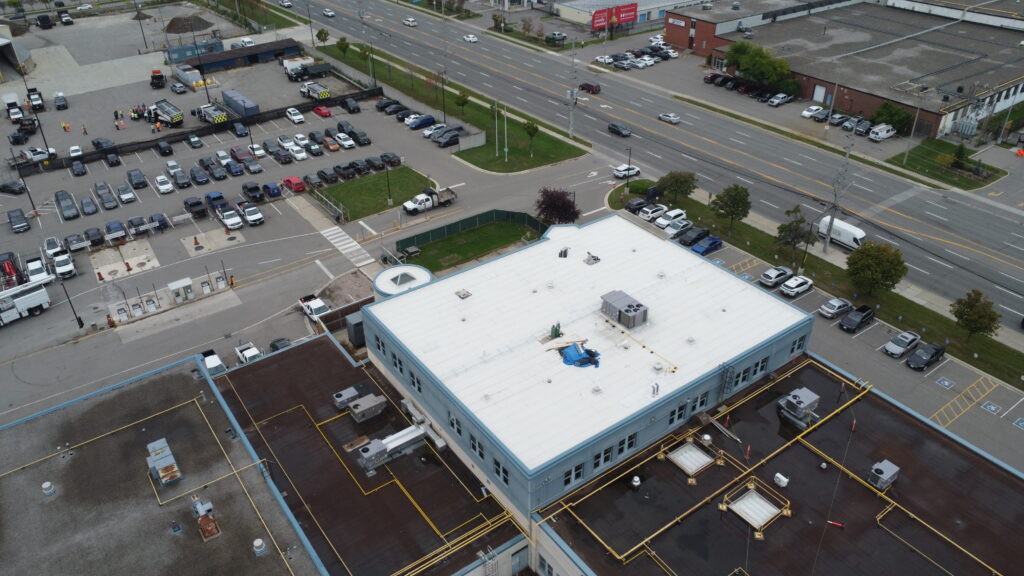
Snow loads climb quickly away from Lake Ontario and with elevation. Caledon, at 425 m, has more than twice the ground snow load of Toronto City Hall; Newmarket and Aurora sit at 2.0 kPa; and Pickering's four zones run from 1.0 to 2.3 kPa. Our own projects show the spread: 1.1 kPa for the City of Mississauga building at 3185 Mavis Rd, 2.0 kPa at 777 Niagara St in Welland and 3.1 kPa for the residential building in Sault Ste. Marie.
These numbers are a starting point, not your roof's rating. Older buildings were designed under earlier codes, very large roofs and important buildings use higher factors, and drifts add load in specific places. Your structural drawings, or an engineer, can tell you what your roof was actually designed for.
How much does snow weigh on a flat roof?
A 30 cm (1 ft) layer of snow weighs about 7 lb per sq ft when it is new and dry and about 30 lb per sq ft when it is old and compacted, using the Ontario Ministry of Labour's figures of 7 to 30 lb per cubic foot. Rain soaking into the snow adds more.
| On the roof | kPa | lb per sq ft | kg per m² |
|---|---|---|---|
| 30 cm (1 ft) of new, dry snow | 0.34 | 7 | 34 |
| 30 cm (1 ft) of wind-packed snow in a Toronto drift | 0.79 | 16.5 | 80 |
| 30 cm (1 ft) of old, compacted snow | 1.44 | 30 | 146 |
| 2.5 cm (1 in) of rain held in the snow | 0.25 | 5.2 | 25 |
That is why the same snowfall can be harmless in January and a concern in March. Snow settles and gets denser, rain and thaws soak it, and meltwater that cannot reach a blocked drain freezes in place. Sault Ste. Marie averages 325 cm of snowfall a year and Toronto Pearson 115 cm in Environment Canada's 1991 to 2020 normals, but the load on a roof depends on how much snow sits there at once and how heavy it has become.
Design loads include safety margins, so snow at the design load does not mean a roof will fail. But deterioration, damage and equipment added since the roof was designed can use up part of that margin, so treat snow approaching the design load as a reason to call an engineer. Clear drains help too; see our guide to ponding water on a flat roof.
Where does snow pile up on a flat roof?
Snow piles up where the wind slows down: against walls between roof levels, beside rooftop units and penthouses, at corners and below sloped roofs. The Building Code designs these spots for extra snow, and Ontario's Ministry of Labour warns that drifting snow may put excessive loads on the areas where it piles up.
| Where | Why it gets more snow | Building Code |
|---|---|---|
| A lower roof beside a higher roof, or beside a taller building up to 5 m away | Wind drops snow into the step and builds a drift | Articles 4.1.6.5 and 4.1.6.6 |
| Beside rooftop units, penthouses and large chimneys | Snow drifts against the projection; projections less than 3 m long are exempt | Article 4.1.6.7 |
| Corners of a higher roof, parapet or obstruction | Drifts wrap around outside corners and overlap at inside corners | Article 4.1.6.8 |
| Below a sloped or slippery upper roof | Snow slides down onto the lower roof | Article 4.1.6.11 |
| Around rooftop solar panels | Panels change how snow builds up, so the code has separate rules | Article 4.1.6.16 |
| Below meltwater from roof projections and nearby building elements | Meltwater adds snow and ice where it drains and refreezes | Sentence 4.1.6.2.(8) |
Drifted snow is also denser. For drift calculations the code uses a specific weight of 0.43 Ss + 2.2 kN/m³, up to 4.0 kN/m³, so a drift in a snowier area weighs more per centimetre than the same drift in Toronto.
What are the warning signs of too much snow on a roof?
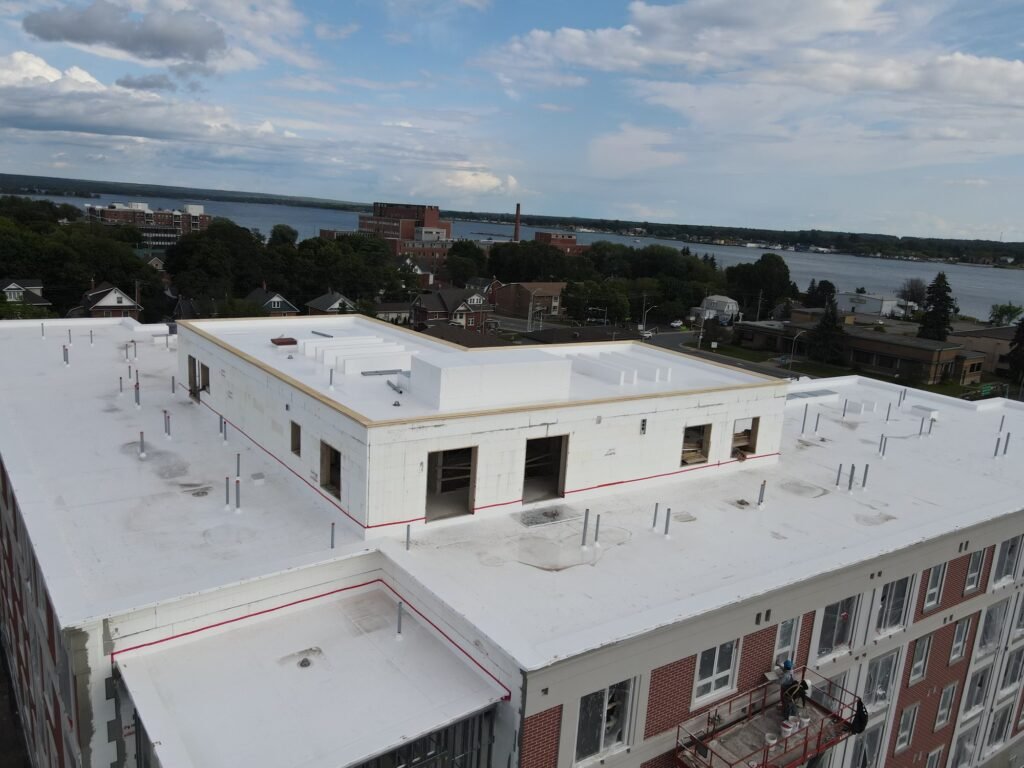
The main warning signs are a ceiling that sags, sprinkler lines or heads that hang lower than normal, and twisting, bending or cracking in beams, joists or walls. Any of them means people should leave the area below and an engineer should look at the roof.
| Sign | Where to look | What to do |
|---|---|---|
| A ceiling that sags | Top floor, especially below walls between roof levels and near rooftop units | Keep people out of the area and call an engineer and your roofer |
| Sprinkler lines or heads lower than normal | Top-floor ceilings and exposed piping | Keep people out of the area and call an engineer |
| Twisting, bending or cracking in beams, joists or walls | Exposed structure in warehouses and plants, top-floor walls | Clear the area and have a professional engineer assess the roof |
| Deep drifts against units, penthouses or walls between roof levels | From an upper window or the ground, never from the roof | Ask an engineer or roofer whether snow should come off |
| Rain forecast on deep snow, or a sudden thaw | Weather forecasts after a big storm | Make sure drains are open; watch the top-floor ceilings |
Staff should check from inside and from the ground only. Never send anyone onto a snow-covered roof to look: IKO notes that snow hides roof features, and skylights, drains and roof edges are among them.
Worried about the snow load on your roof?
Tell us about your building, and we will set up a free roof assessment and a written quote for any repairs.
Call 1-833-775-7663Request an assessmentHow is commercial roof snow removal done safely?
Commercial roof snow removal should be planned with a structural engineer and done by an experienced roofing crew with fall protection, using plastic shovels and taking snow off evenly, drifts first, with nothing piled on the roof. IKO advises that decisions about when and whether to remove snow be made in consultation with a structural engineer.
- Decide with an engineer. Ontario's Ministry of Labour advises a professional engineer's assessment for roofs carrying significant snow or showing signs of distress.
- Hire a crew with fall protection. Workers on a roof must use fall-arrest or travel-restraint equipment, under the fall-protection rules in section 85 of Regulation 851, the Ministry says.
- Mark what the snow hides. IKO has roofers flag skylights, vents and HVAC equipment before anyone starts shovelling.
- Use plastic shovels. Metal-tipped shovels and mechanical snow removal equipment can damage the membrane and roof features.
- Take off drifts first, then work in sections. IKO has crews remove the snow piled by the wind behind units and on lower roofs first, then divide the rest of the roof into sections. The Ministry warns against uneven or concentrated loading during removal.
- Never pile snow on the roof. Not even for a short time. Dump it at spots on the ground chosen in advance, and fence off the area where it lands.
- Inspect the roof afterwards. A shovel can cut a membrane, and a quick check catches damage before the spring thaw.
Keep dated photos of the snow, any damage and the work done. That record helps your roofer and your insurer; our roof leak insurance guide explains what insurers look for.
What should owners do about flat roof snow load before winter?
Find out what your roof was designed for, clear the drains in the fall, and decide now who will assess the roof and who will take snow off if it has to come off.
- Find the design snow load. Structural drawings often list it; if yours do not, an engineer can work it out.
- Get the drains ready. Our guide on how to prepare a flat roof for winter covers the fall checks.
- Know your drift zones. Lower roofs, rooftop units, penthouses and corners are where snow builds first.
- Plan the calls. Line up an engineer, a roofing crew for commercial roof snow removal, and a drop zone on the ground before the first big storm.
- Watch after storms, rain and thaws. Check top-floor ceilings and sprinkler lines from inside.
- Check for leaks after the thaw. See what to do first in our guides to commercial roof leak repair in Toronto and Mississauga.
For more on how we work, see our roofing services and the completed projects page, including the 52,300 sq ft roof at 777 Niagara St at the top of this guide. For big roofs at the end of their life, our warehouse roof replacement guide explains the options.
Frequently asked questions
How to calculate snow load on a flat roof?
Under Part 4 of Ontario's Building Code, the specified snow load is S = Is [Ss (Cb Cw Cs Ca) + Sr]. For a typical flat roof on a building of normal importance, that comes to 0.8 times the 1-in-50-year ground snow load plus the rain load. At Toronto City Hall that is 0.8 x 0.9 + 0.4 = 1.12 kPa, about 23 lb per sq ft, before drifts are added.
How much weight can my flat roof hold?
Only your structural drawings or an engineer can say, because each roof was designed for the code and loads that applied when it was built. As a guide, today's Ontario Building Code asks a typical flat roof to carry about 1.1 kPa (23 lb per sq ft) of snow in Toronto and 2.9 kPa (60 lb per sq ft) in Sault Ste. Marie, plus drifts.
What does 20 psf snow load mean?
It means the roof is designed to carry 20 pounds of snow on every square foot, about 0.96 kPa or 98 kg per square metre. Using Ontario's figures of 7 to 30 lb per cubic foot, that is roughly 8 inches of old, compacted snow or nearly 3 feet of new, dry snow. Every area in our table needs more than 20 psf on a typical flat roof.
What is a good snow load for a roof?
A good snow load is at least what the Building Code requires where the building stands. In Ontario, that starts with the ground snow load for the location in Supplementary Standard SB-1, from 0.9 kPa at Toronto City Hall to 3.1 kPa in Sault Ste. Marie in our table. Engineers then add drifts, roof size and the building's importance.
Is snow on a roof a dead load?
No. Ontario's Building Code defines dead load as a permanent load due to the weight of building components. Snow is a separate variable load, S, which includes ice and associated rain. Engineers calculate it on its own, with the formula in Article 4.1.6.2, and combine it with the dead load using different load factors.
What is the best tool for removing snow from roofs?
On a commercial flat roof, a plastic shovel. IKO advises roofers to use only plastic shovels, because metal-tipped shovels and mechanical snow removal equipment can damage the membrane and roof features. The crew also needs fall protection, markers for skylights and vents hidden under the snow, and a spot on the ground to dump it.
Karol Rajkowski
Vice President · OYH Roofing
Karol Rajkowski is Vice President of OYH Roofing, an Oakville-based ICI flat-roofing contractor whose projects include the City of Mississauga building at 3185 Mavis Rd and the Marriott Hotel in Vaughan. Learn more about the OYH team.
Sources
- 2024 Building Code Compendium, Volume 1 (updated to January 16, 2025), Division B: Articles 4.1.2.1, 4.1.6.2 to 4.1.6.16 and 9.4.2.2. Publications Ontario.
- 2024 Building Code Compendium, Volume 2: Supplementary Standard SB-1, Climatic and Seismic Data, Table 2, in force January 1, 2025. Publications Ontario.
- O. Reg. 163/24: Building Code, Ontario e-Laws.
- Alert: Snow loading and roof failures, Government of Ontario, updated September 15, 2026.
- Removing Snow from Commercial Flat Roofs, IKO Commercial.
- Canadian Climate Normals 1991 to 2020: Toronto Pearson and Sault Ste. Marie, Environment and Climate Change Canada.
- OYH Roofing project records: 777 Niagara St, Welland; residential building, Sault Ste. Marie; City of Mississauga, 3185 Mavis Rd (October 2026).
OYH Roofing, 2120 Speers Rd, Oakville, ON L6L 2X8 · 1-833-775-7663 · info@oyhroofing.ca