
Restaurant Roofing: Keep Grease Off the Roof
What kitchen exhaust grease does to a flat roof, which membranes hold up, and the five habits that keep a restaurant roof dry in Ontario.
Call 1-833-775-7663 Oakville head office · Flat roofs for commercial, industrial and institutional buildings across Ontario
Karol Rajkowski
Vice President, OYH Roofing
Published October 2, 2026 · 7 min read
Short answer
Restaurant roofing has a problem most roofs never face: grease from kitchen exhaust fans. Grease breaks down many roof membranes and blocks drains, so restaurants in Ontario need a membrane rated for grease near the fans, containment on every fan, regular exhaust cleaning and roof inspections twice a year.
Why does grease damage a restaurant roof?
Grease damages a restaurant roof because it attacks the membrane. Kitchen exhaust fans blow grease-laden air onto the roof, where the grease settles around the fan, runs toward the drains and soaks into the roofing.
Over time the membrane softens, swells or cracks, seams open, and water gets in. Grease also clogs drains, so water ponds on the roof, and it makes the area around each fan slippery for service crews.
Warranties are part of the problem too. Some roofing manufacturers state that their warranties do not cover damage from grease, so restaurant roofing has to be planned around containment from the first day.
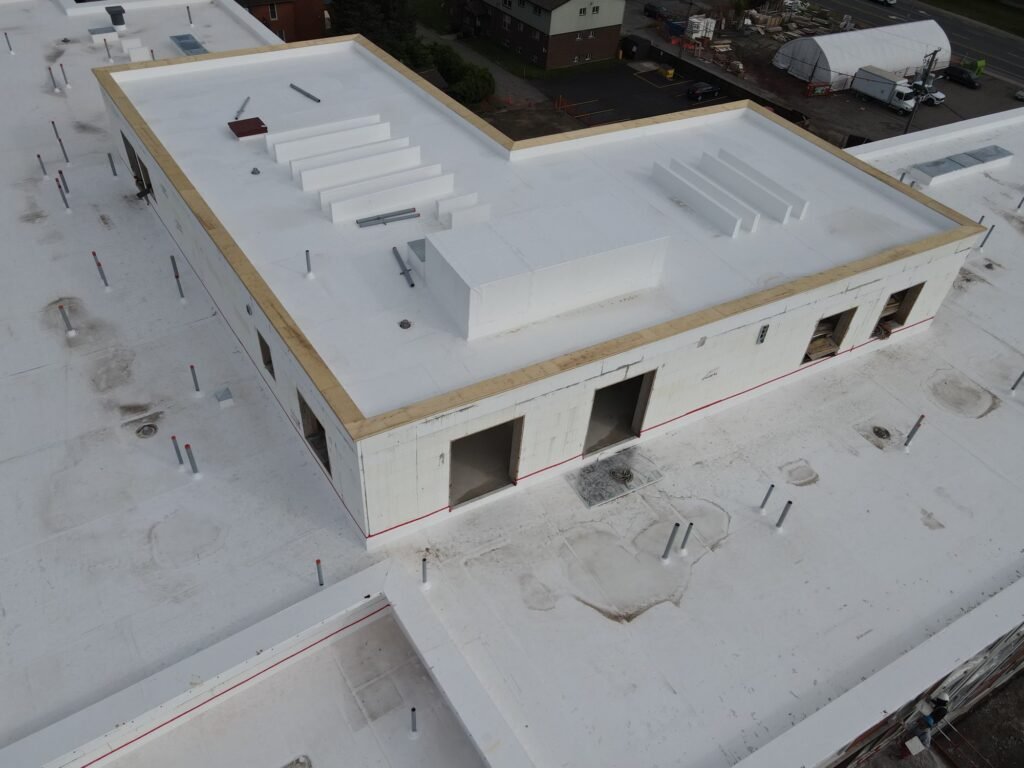
Which membranes work best for restaurant roofing?
No membrane is grease-proof, so the best one for restaurant roofing is the product its manufacturer rates for grease. Asphalt-based roofs and EPDM rubber suffer most, while some thermoplastic membranes hold up much better.
One manufacturer's chemical resistance chart shows how much the product matters: it rates its KEE membrane best for grease, its TPO next and its standard PVC lowest of the three. Some manufacturers make grades meant for grease exposure, so ask your roofer for the grease rating of the exact membrane.
| Membrane | How it handles grease | What it means for a restaurant |
|---|---|---|
| Built-up roofing and modified bitumen | Asphalt-based; grease softens and breaks down the asphalt | Needs containment and a protected zone around every exhaust fan |
| EPDM | Rubber; grease and oils make it swell and seams can open | A poor choice near kitchen exhaust unless the area is protected |
| TPO | Limited effect in that chart, though staining and some loss of heat and UV resistance can occur | Use with containment and keep the fan area clean |
| Standard PVC | Rated lower for grease than TPO in that chart | Ask for the grease rating of the exact product before choosing it |
| KEE | Rated best for grease in that chart | Often chosen where grease exposure is heavy |
In practice, restaurant roofing often uses a grease-rated membrane or protective layer in a zone around each exhaust fan and a standard system on the rest of the roof, with containment at every fan.
OYH Roofing installs PVC, TPO and modified bitumen systems. The crew installed PVC with 30 years on labour and materials on a 17,500 square foot residential new build in Sault Ste. Marie, and 60 mil TPO on the Devi Mandir temple in Pickering after tearing off two layers of modified bitumen and a coating.
How do you stop grease damage on a restaurant roof?
You stop grease damage on a restaurant roof with five habits that work together. Good restaurant roofing needs all five, because no single one is enough on its own.
- Contain grease at every exhaust fan. A containment system, such as a tray, box or absorbent guard under the fan, catches grease before it reaches the membrane. Replace the filters or pads on the schedule the maker sets.
- Have the kitchen exhaust cleaned on schedule. A kitchen exhaust cleaning company cleans the hood, ducts and fan. Less grease in the system means less grease on the roof.
- Use a grease-rated membrane around the fans. A membrane or protective layer rated for grease in a zone around each fan keeps the main roof from being the first thing the grease reaches.
- Keep drains and fan areas clean. Grease that reaches a drain can block it and leave water ponding on the roof. The exhaust cleaner or roofer removes the build-up, never kitchen staff.
- Inspect twice a year and after cleaning visits. Spring and fall inspections, plus a check after each exhaust cleaning, catch softened areas and open seams while they are still small repairs.
| When | What gets checked | Who does it |
|---|---|---|
| Spring, after the snow melts | Seams, flashings, drains and any grease-soaked areas | Commercial roofer |
| Fall, before winter | Drains, fan curbs, flashings and the containment units | Commercial roofer |
| Every exhaust cleaning visit | The fan area, containment filters or pads, any spills | Kitchen exhaust cleaning company |
| On the containment maker's schedule | Filter or pad replacement | Exhaust cleaner or containment supplier |
| After heavy storms | Drains, debris and wind damage | Commercial roofer |
Restaurant staff should not go on the roof to check fans or clean up grease. Roof work belongs to trained crews with proper fall protection.

Grease on your restaurant roof?
Tell us about the building and we will set up a free roof assessment and a written quote.
Call 1-833-775-7663Request an assessmentWhen does a restaurant roof need repair or replacement?
A restaurant roof needs a repair when the grease damage is local, such as one softened area around a fan or one open seam, and a replacement when damage and trapped water have spread across large areas of the roof.
| What you notice | What it usually means | Usual fix |
|---|---|---|
| Soft, sticky or swollen membrane around a fan | Grease has broken down the membrane | Cut out and replace the damaged area, then add containment |
| Leak above the kitchen after rain | Water is getting in at a fan curb, flashing or seam | Trace the leak and repair it |
| Water ponding near a drain | Grease is blocking the drain | Clean the drain and repair any damage around it |
| Blisters or open seams in many places | The roof system is wearing out | Plan a replacement |
| Wet insulation found in a moisture survey | Water has been getting in for a while | Replace the wet areas, or the roof if they are widespread |
For an active leak, our guide to commercial roof leak repair in Toronto explains what to do first. If the whole roof is due, the warehouse roof replacement guide shows how a roof is replaced in sections while the building stays open.
Restaurants rarely close for the work. Plan the noisiest tear-off outside service hours where possible, keep rooftop air intakes clear of adhesive odour, and coordinate any exhaust fan shutdowns with the kitchen.
Which restaurant roofing systems does OYH Roofing install?
OYH Roofing installs PVC, TPO and modified bitumen on commercial, institutional and multi-residential buildings across Ontario. These projects show each system:
| Project | System | Size | Warranty |
|---|---|---|---|
| Residential building, Sault Ste. Marie | PVC single-ply | 17,500 sq ft | 30 years on labour and materials |
| Devi Mandir, Pickering | 60 mil TPO | 6,500 sq ft | 20 years on labour and materials |
| Marriott Hotel, Vaughan | 2-ply modified bitumen | 15,000 sq ft | 20 years on labour and materials |
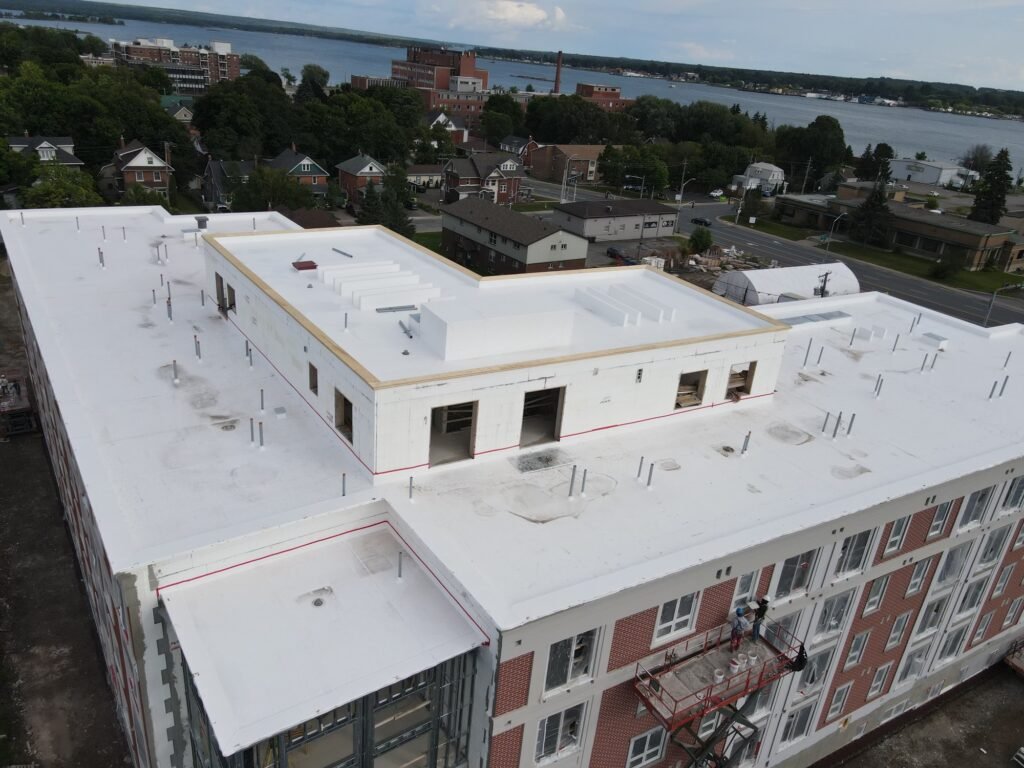


See the rest on the completed projects page, or read about our roofing services.
Frequently asked questions
What is the best type of roof for a commercial building?
It depends on how the building is used. Most low-slope commercial roofs in Ontario use TPO, PVC, modified bitumen, EPDM or built-up roofing. For restaurant roofing, the deciding factor is grease: pick a membrane the manufacturer rates for grease near the kitchen exhaust, and protect the rest of the roof with containment.
What damages the roof the most?
On most flat roofs, standing water does the most damage, followed by sun, freeze-thaw cycles and foot traffic. In restaurant roofing, kitchen exhaust grease is often the biggest threat, because it breaks down many membranes and blocks drains, which then lets water pond on the roof.
What type of roof is the most durable?
No single system wins everywhere. Built-up roofing and 2-ply modified bitumen are tough under foot traffic, while TPO, PVC and KEE have heat-welded seams. For restaurant roofing, the most durable roof is the one rated for the grease it will see, installed well and inspected twice a year.
What is the least maintenance roof?
No flat roof is maintenance-free. Single-ply roofs with welded seams usually need the least repair, but every commercial roof needs spring and fall inspections and clear drains. Restaurant roofing also needs the grease containment changed and the exhaust area cleaned on a schedule.
What is a grease guard?
A grease guard is a rooftop grease containment product that sits under or around a kitchen exhaust fan. It catches grease from the fan in an absorbent filter or pad, usually inside a tray or box, so the grease does not reach the roof. The filters are replaced on a schedule.
Can a restaurant stay open during a roof replacement?
Usually, yes. The roof is replaced in sections and each section is sealed the same day, so the kitchen and dining room stay dry. Plan the noisy tear-off outside service hours where possible, keep rooftop air intakes clear of adhesive odour, and coordinate any exhaust fan shutdowns with the kitchen.
Karol Rajkowski
Vice President · OYH Roofing
Karol Rajkowski is Vice President of OYH Roofing, an Oakville-based ICI flat-roofing contractor whose projects include the City of Mississauga building at 3185 Mavis Rd and the Marriott Hotel in Vaughan. Learn more about the OYH team.
Sources
- Chemical Resistance of Thermoplastic Membranes, Tremco Roofing technical bulletin, Rev. 03/04/26.
- National Roofing Contractors Association (NRCA), guidance on low-slope roof inspection and maintenance.
- OYH Roofing project records: residential building, Sault Ste. Marie; Devi Mandir, Pickering; Marriott Hotel, Vaughan (October 2026).
OYH Roofing, 2120 Speers Rd, Oakville, ON L6L 2X8 · 1-833-775-7663 · info@oyhroofing.ca