
PVC Roof Installation and Repair in Ontario
How a PVC roof is laid, welded and repaired on a commercial building, what must never touch it, and what to ask the contractor.
Call 1-833-775-7663 Oakville head office · PVC roofing on commercial, industrial and multi-residential buildings across Ontario
Karol Rajkowski
Vice President, OYH Roofing
Published October 21, 2026 · 14 min read
Short answer
PVC roof installation follows the same order as any single-ply roof: deck, vapour retarder, insulation and cover board, then the PVC sheet, fastened, glued or induction welded, with every seam hot-air welded. What sets PVC apart is its plasticizers: asphalt, coal tar, polystyrene and oils must never touch it, and repairs need PVC-compatible cleaning and welding, never roofing cement.
What goes under a PVC roof?
A PVC roof is one sheet of plasticized polyvinyl chloride, reinforced with polyester or fibreglass and usually 1.2 to 2.0 mm (about 48 to 80 mil) thick, over the same layers as any flat roof. Plasticizers make up about 25 to 35 per cent of a typical PVC membrane by mass (National Research Council of Canada, or NRC, and Sarnafil, 2004). They keep the sheet flexible, and they are why the layers under and beside it matter more on PVC than on TPO.
| Layer | What it does | What is different on PVC |
|---|---|---|
| PVC membrane | The waterproof top layer, usually white | Polyester scrim for fastened sheets, fibreglass mat for adhered ones (Sika S 327 and G 410); fleece-back versions for adhered systems |
| Cover board or separation layer | A firm surface that also keeps incompatible materials away from the PVC | RCABC requires "an intermediate separation layer" between PVC and foam plastic insulation |
| Insulation | Thermal resistance, usually polyisocyanurate | Sika: "Not to be applied directly to polystyrene products." In a Spanish lab study, contact with XPS caused five to nine times more mass loss than with a barrier |
| Vapour retarder | Keeps indoor moisture and air out of the roof | Sika: its mastic must not come into direct contact with the membrane |
| Deck | The structure: steel, concrete or wood | RCABC does not allow an adhered membrane directly on a wood deck; Sika lists "some preservative materials" among those PVC must not touch |
Our TPO roof installation guide covers cover boards and vapour retarders in more detail; this page sticks to what PVC needs on top of that.
What must never touch a PVC roof?
Asphalt, coal tar and polystyrene, above all. Sika Canada lists its PVC as incompatible with "asphalt, coal tar, heavy oils, roofing cements, creosote and some preservative materials". Plasticizer migrates out of the PVC into what it touches, and the sheet shrinks and turns brittle; the 2014 study found that shrinkage ends in torn sheets or failed welds.
| Material | What happens | What makers do about it |
|---|---|---|
| Old asphalt or built-up roof left in place | Not compatible with PVC; tear-off dust can also contaminate a new membrane (BD+C, U.S.) | Insulation, a cover board or a separator sheet between old and new; tie-ins made with an asphalt-resistant PVC sheet (Sika G459) |
| Coal tar pitch | Incompatible with PVC | Sika Canada asks to be contacted before tying into or covering coal tar |
| EPS or XPS polystyrene insulation | Plasticizer migrates into the foam and the PVC loses flexibility | A separation layer (RCABC); never laid directly on polystyrene (Sika) |
| Self-adhered bituminous wall membranes | The PVC discolours, stiffens and ages early; the asphalt sheet bleeds and stains it | Metal strips or aluminum tape between the two; Sika (U.S.) says any contaminated PVC must be removed and replaced |
| Roofing cement, asphalt caulks, pitch pocket fillers | Many contain asphalt and "should never be used on PVC" (BD+C, U.S.) | Only sealants the PVC maker accepts |
| Grease, oils, refrigerants, bird droppings | Listed by RCABC as contaminants to protect PVC from | Kept off the membrane under RCABC's standard; see our PVC vs TPO guide on grease |
Hot asphalt is the one exception, and only through a fleece backing: RCABC allows only fleece-backed PVC to be set in hot asphalt, mopped at 205°C or hotter. Sika's warranty excludes damage from "membrane contact with incompatible materials", so before PVC roof installation over an old roof, find out what that roof is made of.
How is a PVC roof installed?
In seven steps, following the maker's specification and a tested assembly chosen for the wind load. RCABC's PVC standard, cited throughout, is written for B.C.'s RoofStar guarantee, but it is the most detailed Canadian PVC standard we found.
| Step | What happens | What makers and RCABC require |
|---|---|---|
| 1. Approvals and design | Maker, membrane and tested assembly chosen; old roof and insulation checked | Non-standard details accepted by Sika Canada first; wind design to CSA A123.21 test reports (SOPREMA) |
| 2. Prepare the deck or old roof | Tear-off, or a separation layer over an asphalt roof left in place | Asphalt dust and debris cleaned off first (BD+C, U.S.) |
| 3. Vapour retarder, insulation, cover board | Boards laid and fastened or glued | SOPREMA: 4 fasteners per 1.2 x 1.2 m board, 6 per 1.2 x 2.4 m board; no polystyrene against the PVC |
| 4. Unroll and attach the sheet | Screws, adhesive, hot asphalt (fleece-back only) or induction plates | Rolls kept on pallets under breathable tarps (Sika) |
| 5. Weld and probe the seams | Robotic welder in the field, hand welder at details | Laps at least 75 mm by machine, 100 mm by hand; no tack welding; test cuts 3 times a day (Sika) |
| 6. Flashings and details | Walls, curbs, pipes and edges finished in PVC and PVC-coated metal | Flashings at least 200 mm high, fastened along the top and fully adhered (Sika) |
| 7. Inspection and warranty | The maker inspects the roof | Sika's warranty form records the inspection date |
For tear-off, daily seals and keeping a building open during the work, see our commercial roof replacement guide.
Mechanically fastened, fully adhered or induction welded?
All three are used for PVC, and Canadian PVC specifications add two more: fleece-back PVC set in hot asphalt, and self-adhered PVC. The deck, the wind load and the old roof decide which.
- Mechanically fastened. Screws and plates in the side lap, covered by the next sheet: Sika uses a 150 mm overlap with fasteners 25 mm into the deck, never overdriven, and machine-welded seams wherever possible.
- Induction welded. Coated plates are fastened through the insulation and the sheet is welded to them from above. Sika recalibrates the tool whenever it is turned on or the temperature changes by more than 9°C, and welds every plate the same day.
- Fully adhered. Solvent contact adhesive (never within 3°C of the dew point, never in the seam area, rolled in with a 45 kg roller), water-based adhesive laid wet (up to a 2:12 slope, with an initial set of 24 to 72 hours), or two-part foam in 25 mm ribbons under fleece-back sheet (Sika).
- Hot asphalt. Fleece-back PVC only, with the asphalt at 205°C or more and mopped no more than 1 m ahead of the roll (RCABC).
- Self-adhered. Sika's G 410 SA sheet uses 75 mm side laps; end laps are butted and covered with a 200 mm strip welded over them.
Whatever the method, fasteners, plates and adhesive must match the assembly wind-tested under CSA A123.21, which Ontario's Building Code points to. The TPO guide explains that test and solvent adhesive fumes; the same rules apply to PVC.
How are PVC seams welded and tested?
With hot air, and a good PVC weld shows itself. Unlike TPO, PVC flows when it melts, so a sound seam leaves a continuous bead along its edge, which makers call bleed-out. Sika Canada describes "an uninterrupted flow of grey material from the edge of completed welds"; Carlisle (U.S., 2025) says a missing bead suggests the seam did not get enough heat.
- Laps and welds. Sika lays laps at least 75 mm wide for machine welding and 100 mm for hand welding. RCABC asks for welds at least 38 mm wide by robotic welder and 50 mm by hand.
- Hand welding. Sika accepts hand-welding temperatures of 375 to 475°C, in two passes: a continuous pre-weld, then the final weld with the nozzle at 45 degrees and a silicone roller behind it. Tack welding before machine welding is not allowed.
- Test cuts. Sika takes 51 mm (2 in) samples across the seams at least three times a day and every time the welder is restarted, each marked with the date, time, temperature and speed. A correct weld tears the membrane before the weld lets go. Every cut is patched at no charge to the owner.
- Probing. Every seam is probed once cooled, with a screwdriver or pin puller filed to a dull, rounded tip (Sika). Carlisle (U.S.) notes PVC is a softer membrane, so the probe must be blunt.
- Settings change through the day. Carlisle adjusts speed for cold, sun, substrate and wind, so there is no single correct temperature. Sika wants a dedicated generator of at least 7,500 W.
A 2007 Sika study of five membranes found a continuous, straight inner weld edge matters more than absolute width. Solvent welding, once used on PVC, had been abandoned 15 to 20 years before it; Sika Canada requires every side and end lap to be hot-air welded. Our TPO guide covers peel tests and probing in general.
How are flashings, PVC-coated metal and T-joints finished?
By hand, in PVC, to the maker's details. Sika's flashings rise at least 200 mm above the roof, are fully adhered, fastened along the top edge and secured at the base every 300 mm, with at least four fasteners per penetration.
- PVC-coated metal. Edges and copings are made from steel coated with PVC, so the membrane can be welded straight to them. Sika nails a flange at least 100 mm wide in two staggered rows, leaves a 7 mm gap between metal sheets, covers it with 50 mm aluminum foil tape and welds a 100 mm PVC strip over the joint.
- Do not paint it. Painted PVC-coated metal can no longer be welded to, so later repairs get harder (BUILDINGS, U.S.).
- T-joints. Sika requires a 100 mm patch over each T-joint on membranes thicker than 1.5 mm (60 mil); RCABC covers every T-joint with unreinforced PVC.
- Walkway pads. RCABC puts pads that absorb sunlight on a non-bonding slip sheet, so their heat does not damage the membrane.
Curbs and units are covered in our rooftop equipment guide, and how details fail later in our roof flashing repair guide.
Can PVC roof installation be done in winter?
The sheet can; the adhesives are the limit. Sika Canada's current data sheets allow its adhered PVC membrane to be installed in air as cold as -20°C, but its water-based adhesive needs more than 4°C while it dries, and its initial set takes 24 to 72 hours.
| Product or step | Sika Canada limit | Notes |
|---|---|---|
| Sarnafil G 410 membrane | Air -20°C, substrate -30°C | Minimums during application |
| Water-based adhesive (Sarnacol 2121) | Above 4°C, air and surface | During application and drying; product warmed to at least 22°C; never stored below 5°C |
| Solvent contact adhesive (Sarnacol 2170 R) | Not within 3°C of the dew point | No wet weather or wet surfaces; open time varies with temperature |
| Membrane rolls | On pallets, under breathable tarps | Moisture trapped under polyethylene "may affect membrane weldability" |
So winter PVC work leans on fastened, induction-welded or solvent-adhered systems. New PVC sheet must bend without cracking at -40°C under ASTM D4434; old PVC is another matter: when NRC tested samples from 17- to 22-year-old roofs at -20°C, 8 samples failed with coating cracks or fractures, one of them from Sarnia. BUILDINGS (U.S.) advises keeping foot traffic off aged PVC below 10°C. Our flat roofing material guide compares cold ratings for every system.
What standards and Ontario rules apply to PVC?
A product standard for the sheet, wind and fire tests for the assembly, and Ontario's workplace rules. These are the points specific to PVC.
- ASTM D4434. The specification for PVC sheet roofing (current edition D4434/D4434M-21), which requires reinforcing fibres or fabric. Carlisle (U.S.) gives a minimum of 45 mil for Types II and III and 36 mil for Type IV. Makers' data sheets quote a cold bend test at -40°C.
- CAN/CGSB-37.54-95. Canada's own PVC membrane standard, dated 1995. Sika Canada's 2024 data sheets cite it next to ASTM D4434, but its type numbers differ: Sika's polyester sheet is CGSB Type 4 and ASTM Type III.
- ASTM D6754. A separate standard (D6754/D6754M-23) for sheet in which ketone ethylene ester (KEE) is the main polymer.
- Wind and fire. CSA A123.21 for wind uplift and CAN/ULC-S107 for fire are rated by assembly, as on TPO; see our TPO standards section for the Fire Code and O. Reg. 213/91 rules on hot work and solvent adhesives.
- Welding fumes. Overheated PVC gives off hydrogen chloride. Duro-Last's safety data sheet (U.S.) puts hazardous decomposition above 204°C (400°F) and calls for ventilation when heat welding; Ontario's limit for hydrogen chloride is a 2 ppm ceiling (Reg. 833), and TWI (U.K.) flags a possible risk where plastics are welded in confined spaces.
- Recycling. PVC can be melted and reprocessed. CFFA's Vinyl Roofing Division (U.S.) says its members recycled 1.1 million pounds of old PVC membrane in 2023, and its FAQ points to mechanically fastened, bare-backed sheet as recyclable. We found no program page for Ontario job sites.
Planning a PVC roof?
We can check what the old roof and insulation are made of, set out the attachment method and details, and compare PVC membrane and warranty options for your building.
Call 1-833-775-7663Request an assessmentWhat does PVC roof repair involve?
A PVC roof repair usually means welding a PVC patch over the damage, after the right cleaning. Old PVC can usually still be welded: in the NRC and Sarnafil study, every one of 25 roofs aged 17 to 22 years "could be easily patched by hot air welding", and a 2005 follow-up of 44 roofs up to 34 years old found the same. Both studies were co-written by the maker.
- Clean only the patch area. Sika Canada wipes it one way with a cloth damp with MEK and lets it flash off, typically 20 minutes; Carlisle (U.S.) uses its PVC membrane cleaner and waits at least 10. Sika does not accept weathered membrane cleaners on its PVC, and solvent strips the factory lacquer, so nothing else is cleaned.
- Patch. The patch reaches 100 mm (4 in) past the damage on every side, with rounded corners (CRCA), and is hand-welded and probed like any seam.
- Open seams and voids. Opened back to a solid weld, cleaned and rewelded or patched (Sika).
- Blisters and loose flashings. Blisters from too much or damp adhesive are cut out and patched; loose flashings are cut, re-adhered and covered with a welded strip, and replaced if large areas are loose (Sika).
- What not to use. Asphalt roof cement, asphalt-based caulks and pitch pocket fillers, bituminous tapes, duct tape (it stains and contaminates the weld), wire brushes, and narrow high-pressure spray: Sika washes PVC at low pressure with the wand 400 to 600 mm above the sheet.
Early unreinforced PVC could lose plasticizer, turn brittle and shatter underfoot, and those roofs were replaced rather than repaired (BUILDINGS, U.S.; NRC seminars, 1996/97). Today every sheet is reinforced, so a crack should need only a local PVC roof repair (NRC, 2004); IIBEC (U.S., 2024) uses test cuts to see whether fine surface cracks reach the underside. Under Sika's warranty, repairs through the roof need its written authorization first. See also our membrane roof repair guide and our repair or replace guide.
How do you choose a PVC roofing contractor?
Check who is allowed to weld. Sika Canada states that "Non-certified individuals are not permitted to weld" on its membranes: its fitters pass a three-day course, renew their cards every two years, and at least two card-holders must be on site for every eight workers. A PVC roofing contractor's standing with the maker decides the warranty. For WSIB clearance, insurance and other checks, see our guide to choosing a commercial roofing contractor.
| Question | Why it matters |
|---|---|
| Which maker, which membrane and what thickness? | Sika's 25- and 30-year warranties need at least 72 and 80 mil membrane and an approved cover board |
| Are your welders certified by that maker now? | Sika's cards are valid for two years and only card-holders may weld |
| What is under the new PVC, and how is it separated? | Sika's warranty excludes contact with incompatible materials; coal tar needs the maker's input |
| Will you keep test cut and probing records? | Sika asks for labelled test cuts at least three times a day and every seam probed |
| Who inspects the roof, and what warranty will we get? | A Sika system warranty runs 5 to 30 years with no monetary limit on leak repairs, needs Sika materials from the deck up, records a Sika inspection, and binds Sika only once all invoices are paid |
Our commercial roof warranty guide explains each warranty type.
What PVC roof has OYH Roofing installed?
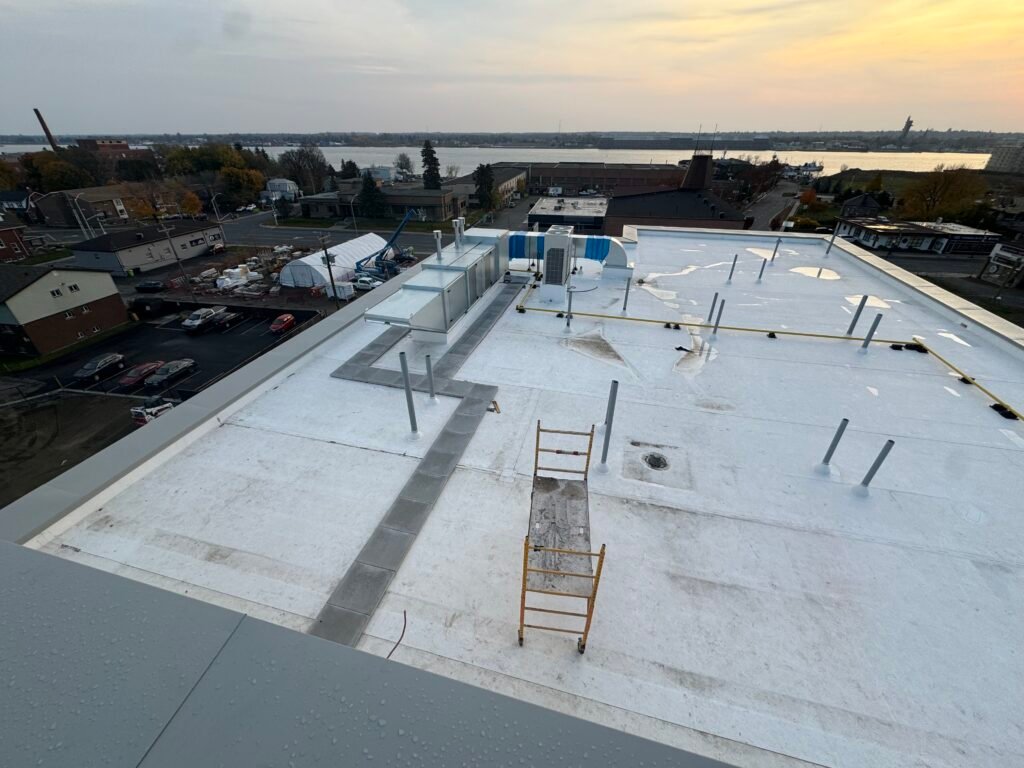
OYH Roofing handles PVC roof installation on commercial, industrial and multi-residential buildings across Ontario. In Sault Ste. Marie, we installed a 17,500 sq ft PVC single-ply roof on a new residential building, with every flashing at parapets, drains, vents and curbs made from PVC and welded to the field sheet. It carries a 30-year warranty on labour and materials, the longest we offer on any system.
See the Sault Ste. Marie PVC project and our other completed projects. To compare systems first, see PVC vs TPO; for coatings on an older roof, see our commercial roof coating guide; for lifespans, see how long a commercial flat roof lasts.
Frequently asked questions
What goes under PVC roofing?
On a commercial roof, from the deck up: a vapour retarder, insulation (usually polyisocyanurate), often a cover board, then the PVC sheet. Polystyrene insulation and old asphalt roofing must be kept apart from the PVC by a separation layer, because plasticizer migrates into them. Sika Canada says its PVC is not to be applied directly to polystyrene.
How is PVC roofing installed?
The deck is prepared, insulation and a cover board are fastened or glued, and the PVC sheet is laid and attached with screws in the seams, adhesive, hot asphalt (fleece-back only) or induction-welded plates. Every seam is hot-air welded and probed, flashings are welded in PVC, and the maker inspects the roof before issuing a warranty.
How to weld PVC roofing?
With a hot-air welder: a robotic welder on long seams and a hand welder at details. Sika Canada hand-welds at 375 to 475°C in two passes, rolling the seam behind the nozzle, and looks for a continuous bead of melted PVC at the edge. Test cuts are taken several times a day and every seam is probed once it cools.
How do I seal the seams of my PVC roofing?
By welding them, not with tape or sealant. An open seam is opened back to solid weld, cleaned with the maker's PVC cleaner or solvent, and rewelded or covered with a welded PVC patch. Never use asphalt roof cement, asphalt caulk or bituminous tape on PVC: they are incompatible and can void the warranty.
Can you coat a PVC roof?
Sometimes, but only with a product both makers accept. RCABC requires any liquid membrane used with PVC to be accepted by the PVC maker and the liquid membrane maker. Elevate (U.S.) says a primer may be needed and treats paint or coating as overburden that needs its waiver, and Sika's warranty excludes alterations made without its written authorization.
Need a roof that lasts?
Tell us about your building and roof, and we will set up a roof assessment and a written quote.
Call 1-833-775-7663Request an assessment
Karol Rajkowski
Vice President · OYH Roofing
Karol Rajkowski is Vice President of OYH Roofing, an Oakville-based ICI flat-roofing contractor whose projects include the 17,500 sq ft PVC roof on a new residential building in Sault Ste. Marie and the Marriott Hotel in Vaughan. Learn more about the OYH team.
Sources
- Sika Canada: Sika Sarnafil Roofing Applicator Handbook; data sheets Sarnafil G 410-60 and Sarnafil S 327-72 (May 2024), Sarnacol 2121 (June 2022) and Sarnacol 2170 R (January 2022); Warranty Selection Guide (March 2023); sample Sarnafil System Warranty (March 2022).
- Research: B.J. Whelan, S.P. Graveline, A.H. Delgado, K.K.Y. Liu and R.M. Paroli (Sarnafil and NRC), Field Investigation and Laboratory Testing of Exposed PVC Roof Systems (CIB World Building Congress, Toronto, 2004); H.R. Beer, A.H. Delgado, R.M. Paroli and S.P. Graveline, Durability of PVC Roofing Membranes (10DBMC, 2005); S. Graveline, Welding of Thermoplastic Roofing Membranes (Journal of ASTM International, 2007); NRC, Building Better Roofs seminar papers (1996/97); A. Pedrosa, M. Del Río and C. Fonseca, plasticized PVC and XPS in inverted roofs (Materiales de Construcción, 2014, Spain).
- RCABC Roofing Practices Manual: PVC Roof Systems Standard (edition adopted January 20, 2026). SOPREMA: Sentinel P200 data sheet (Canada, 2020). CRCA Canadian Roofing Reference Manual: 13.2.4, thermoplastic membrane repairs (2020).
- Standards and Ontario rules: ASTM D4434/D4434M-21; ASTM D6754/D6754M-23; CAN/CGSB-37.54-95; CSA A123.21; CAN/ULC-S107; Ontario occupational exposure limits under Reg. 833 (June 2025).
- U.S. and other sources: Carlisle Mastering PVC Welding (2025), Sure-Flex PVC welding guide (2022) and ASTM D4434 Types III and IV (2024); Sika Technical Bulletin 16-05 (2022); Duro-Last PVC membrane safety data sheet (2018); Elevate painting of single-ply membranes (February 2025); Building Design + Construction, PVC and asphalt should never meet (2011); BUILDINGS, repairing weldable single-ply systems (2004); IIBEC Interface, surface fracturing of PVC and KEE membranes (November 2024); CFFA Vinyl Roofing Division, recycling of PVC roof membranes (March 2024); TWI (U.K.), health and safety of welding plastics.
- OYH Roofing project record: residential building, Sault Ste. Marie (October 2026).
OYH Roofing, 2120 Speers Rd, Oakville, ON L6L 2X8 · 1-833-775-7663 · info@oyhroofing.ca