
Municipal and Institutional Roofing in Ontario
How public owners buy roofing work: the tender, the bonds, the contract, how the roofer gets paid, and what has to happen before work starts on a public building that stays open.
Call 1-833-775-7663 Oakville head office · Roofing for municipal, school, college and other public buildings across the GTA
Karol Rajkowski
Vice President, OYH Roofing
Published November 7, 2026 · 14 min read
Short answer
Municipal and institutional roofing uses the same roof systems as any commercial building, but the work is bought differently. Ontario public owners buy it through a public tender under written procurement rules, often ask for a bid bond, and on contracts of $500,000 or more must get performance and payment bonds under the Construction Act. The roof itself follows the owner's design standard.
What counts as municipal and institutional roofing?
Municipal and institutional roofing is roofing for buildings owned by public bodies: municipalities and their local boards, school boards, hospitals, colleges and universities, a group often called the MASH sector (municipalities, academic institutions, school boards and hospitals). The membranes are the ones used on any commercial flat roof. What changes is how the work is bought, which rules apply to the contract, and who is in the building while the roof is done.
| Owner | Typical buildings | Procurement rules | What changes on the roof job |
|---|---|---|---|
| Municipalities and local boards | City halls, community centres, libraries, arenas, fire stations, works yards | The council's own procurement policy, plus the Municipal Buy Ontario directive | The public uses the building; council or staff approve the award |
| School boards | Elementary and secondary schools | The Broader Public Sector (BPS) Procurement Directive and the Buy Ontario directive | Work is usually timed to the summer break |
| Hospitals | Hospitals and their outbuildings | BPS and Buy Ontario directives | Open around the clock; air intakes and infection control |
| Colleges and universities | Campus buildings, residences | BPS and Buy Ontario directives | Detailed design standards for the roof system (see below) |
How do public owners in Ontario buy roofing work?
By competition, under rules set in advance. Ontario's Municipal Act requires every municipality to adopt a policy on its procurement of goods and services, and school boards, hospitals, colleges and universities follow the province's BPS Procurement Directive, which since April 13, 2026 requires an open competitive process for construction worth $139,000 or more. Several sets of rules can apply to one roofing tender at once.
| Rule | Who it applies to | What it means for a roofing job |
|---|---|---|
| Municipal procurement policy | Municipalities and local boards (Toronto under the City of Toronto Act) | Each council sets its own thresholds and methods in its procurement by-law or policy |
| BPS Procurement Directive | School boards, hospitals, colleges, universities | From $10,000 to under $139,000, at least three suppliers are invited to bid; at $139,000 or more, the tender is open to all. A job may not be split to stay under a threshold |
| Canadian Free Trade Agreement | Municipalities, school boards and publicly funded academic, health and social service bodies | Construction worth $347,400 or more is open to bidders from across Canada (2026 and 2027 threshold) |
| Buy Ontario directives | School boards, hospitals, colleges and universities since April 13, 2026; municipal construction since May 15, 2026 | New construction tenders list the major goods, with roofing systems named as one, and ask bidders for a Domestic Supply Chain Plan; Ontario content earns an advantage in the evaluation |
The Buy Ontario rules are the newest change. They cover new construction procurements, including repairs or renovations to a building's structure, but not routine maintenance or emergencies.
Below $347,400, the bidder with the highest proportion of Ontario-made goods and Ontario services gets a 10 per cent evaluation advantage; at or above it, the owner may instead make the plan 10 per cent of the score. Or the owner can skip scoring and make a minimum share of Ontario or Canadian content a condition of bidding: the City of St. Thomas told bidders on its 2026 community centre roof replacement to show a supply chain of 90 per cent or more Ontario or Canadian goods and services.
What a public roofing tender usually asks of a roofing contractor:
- Find it and register. There is no single board. The province posts on the Ontario Tenders Portal run by Supply Ontario; cities, school boards and hospitals use MERX, bids&tenders (each owner has its own page), Biddingo or their own system, such as the City of Toronto's Ariba; federal buildings are on CanadaBuys. Documents and addenda usually go only to registered plan takers.
- Get on the list. Some school boards prequalify roofers first: the Ottawa Catholic School Board's 2024 roofing prequalification, which runs to April 2029, is how roofers qualify to bid on its roof replacement and repair contracts. CCDC 11, the Contractor's Qualification Statement, is the standard form for company, capacity and experience. The Town of Renfrew's 2025 garage roof tender asked for at least three references from municipal or institutional projects of the past five years.
- Go to the site visit. Many are mandatory. Renfrew's tender said bidders "must attend a mandatory site visit", and a 2025 National Research Council roof tender in Ottawa offered no other appointment.
- Prove manufacturer approval. Two 2025 Huron-Perth Catholic District School Board re-roofing tenders required the roofer to be a qualified installer under one maker's warranty program, with proof "required before tender prices are opened".
- Meet every mandatory item. On the City of Toronto's 2024 tender for the York Recreation Centre roof and green roof, several of the lower bids were found "non-compliant with mandatory requirements". The winning bidder in Toronto must also comply with the city's Fair Wage Policy. A bid is usually irrevocable once it closes; Renfrew's ran for 90 days.
Behind many tenders is a consultant who wrote the specification. IIBEC describes its Registered Roof Consultants as independent "from suppliers, product manufacturers, and contractors", advising owners through bidding and installation. Some owners use a manufacturer instead: the Town of Deep River's 2025 town hall and water plant roofs were designed, tendered among four approved contractors and overseen by a roofing manufacturer. Either way, the specification decides the system, so read it before pricing.
What bonds, insurance and certificates does a public roofing tender ask for?
On a public contract of $500,000 or more, Ontario's Construction Act requires the contractor to give the owner a performance bond and a labour and material payment bond, each covering at least 50 per cent of the contract price. A public contract is one where the owner is the Crown, a municipality or a broader public sector organization. Below that amount, the tender decides, and most ask for bid security, insurance and a WSIB clearance.
| Document | When | What it does | Rule or example |
|---|---|---|---|
| Bid bond or bid deposit | With the bid | Guarantees the bidder will enter into the contract if it wins | Often 10 per cent of the bid price before taxes: Renfrew (bond, certified cheque or draft) and Leeds and Grenville (CCDC 220 bond, valid 90 days) |
| Performance bond | On signing | Guarantees the contract is carried out | Required on public contracts of $500,000 or more, at least 50 per cent, on Form 32 |
| Labour and material payment bond | On signing | Guarantees subcontractors, suppliers and workers are paid | Same threshold and minimum, on Form 31; claims under it can go to adjudication |
| Liability insurance | Before work starts | Covers damage and injury claims during the work | Set by the owner: Renfrew asked for $5 million commercial general liability with the town as an additional insured |
| WSIB clearance | Before work starts, then for the whole job | Shows the contractor is registered and in good standing | Required in construction; valid up to 90 days, so it is renewed on longer jobs |
| Safety certification | With the bid, where asked | Shows an audited health and safety program | IHSA's Certificate of Recognition (COR) was mandatory on the 2025 National Research Council roof tender in Ottawa |
| Warranty security | After completion | Covers the contractor's warranty period | Renfrew keeps a 2 per cent maintenance guarantee through its two-year workmanship warranty |
The Act also lets an owner ask for other bonds or security, and each tender sets its own terms: Leeds and Grenville asked for a 10 per cent bid bond and a 50 per cent performance bond on its 2026 roof replacement, and St. Thomas for 50 per cent performance and 50 per cent labour and material bonds. The Toronto District School Board's 2026 Regent Heights roof tender accepts only digital Form 31 and Form 32 bonds on bids over $500,000. Ask your surety early, because the bond capacity it gives you limits the size of job you can bid.
COR is voluntary in Ontario. IHSA grants it after an internal and an external audit of the company's safety program, it lasts three years, and the company must hold an active WSIB account in good standing. The same Ottawa tender also required membership in the Canadian Roofing Contractors Association, the Ontario Industrial Roofing Contractors Association or another recognized Ontario roofing association. For the checks any owner should make, see our guide to choosing a commercial roofing contractor.
Which contracts are used for public roofing work?
A tendered roof replacement is usually let on CCDC 2, which CCDC calls the industry standard prime contract between an owner and a prime contractor, with the owner's supplementary conditions added. When the roof is part of a larger project run by a construction manager, the owner signs CCDC 5A or 5B with the manager, and the roofer signs a trade contract: CCDC 17 with the owner on a 5A project, or a subcontract with the manager under 5B. Smaller owners sometimes use their own short form instead; Renfrew's 2025 garage roof tender did.
| Document | What it is | Where the roofer fits |
|---|---|---|
| CCDC 2 (2020) | Stipulated price contract: one fixed price for the project, with monthly progress payments | Prime contractor on a roof replacement tender |
| CCDC 5A (2025) | Construction management for services: the manager advises the owner and administers the trade contracts | Trade contractor signing directly with the owner, on CCDC 17 |
| CCDC 5B (2025) | Construction management for services and construction: the manager advises before construction, then performs the work | Subcontractor to the construction manager |
| CCDC 17 (2025) | Stipulated price contract between the owner and a trade contractor on a 5A project | The roofing trade contract itself |
| CCDC 11 (2019) | Contractor's qualification statement | Prequalification |
| CCDC 220, 221, 222 (2024) | Bid, performance, and labour and material payment bond forms | Bid security and bonds; Ontario public contracts of $500,000 or more use the prescribed Forms 31 and 32 |
| CCDC 41 (2020) | Insurance requirements for CCDC contracts, free to download | Sets the insurance the contractor carries |
Read the supplementary conditions as closely as the standard form: that is where a public owner adds its own rules on schedule, working hours, warranties, liquidated damages and site rules. The Ontario Association of Architects and the Ontario General Contractors Association publish joint recommended supplementary conditions for CCDC 2 2020.
How does a roofer get paid on a public contract?
Under the same prompt payment rules as any construction contract in Ontario. The owner pays a proper invoice within 28 days unless it gives a notice of non-payment within 14 days, the contractor pays its subcontractors within seven days of being paid, and 10 per cent holdback is kept at every level, now released every year. Our payment and holdback table sets out each step; a few points matter more on public work:
- The consultant cannot hold up the invoice. A contract term that makes giving a proper invoice conditional on prior certification by a payment certifier, or on the owner's approval, is of no force or effect (s. 6.3), except for testing and commissioning.
- Invoices are monthly unless the contract says otherwise, and since January 1, 2026 an invoice missing a required item is treated as proper unless the owner points out the gap in writing within seven days. The owner may also ask for information its accounts payable system needs.
- Disputes go to adjudication. Ontario Dispute Adjudication for Construction Contracts (ODACC) appoints the adjudicator, who decides within 30 days of receiving the documents. Since January 1, 2026, adjudication must start within 90 days after the contract is completed or ended, and an amount ordered must be paid within 15 days; a contractor that is not paid may suspend the work.
- The yearly holdback notice is public. The owner publishes a notice of annual release of holdback (Form 6) on a construction trade news website: the Daily Commercial News, Link2Build or Ontario Construction News.
- Subcontractors have the bond. On a bonded public contract, a sub or supplier that is not paid can claim on the labour and material payment bond, and can refer that claim to adjudication.
What has to happen before roofing starts on an older public building?
The owner has to find out what is on the roof and in it before anyone prices the work. Ontario's Occupational Health and Safety Act requires the owner to determine which designated substances are present and list them, and "if any work on a project is tendered", the tender must include a copy of that list. Ontario designates 11 substances, including asbestos, lead and silica.
- The list protects the bidders. An owner that leaves off a designated substance it ought reasonably to have known about is liable for the loss when it is found during the work, and the constructor must pass the list to every subcontractor before they sign. For asbestos in older roofs, see the checks before replacing a tar and gravel roof.
- A condition assessment comes first. Renfrew's garage roof was put to tender after a 2023 building condition assessment found it needed replacing, and Deep River's 2025 roofs after a thermal scan and roof analysis. The University of Toronto's roofing standard asks for a full condition assessment, core samples and a thermal scan before any overlay or retrofit, to find wet insulation before it is covered.
- Permits and notices. Whether the job needs a building permit, a Notice of Project or other approvals is covered in our roof replacement permit guide.
How does a public building stay open during roof work?
With a schedule built around the people who use it. School boards push the work into the summer: the Toronto District School Board's 2026 Regent Heights roof replacement had to be substantially complete by August 31, with any work affecting the school done after hours or on weekends, and the St. Thomas community centre roof ran from late June to August 31.
- Accessible routes. Ontario's accessibility standards require a provider to post public notice when a facility people with disabilities usually use is temporarily disrupted, with the reason, how long it will last and any alternative. If a hoist, bin or barricade closes an accessible entrance, ramp or parking space, the owner needs to know in time to post that notice.
- Noise. After-hours work still has to fit the municipal noise by-law; see our GTA noise-hours table.
- Exits, fire routes and the fire safety plan. Community centres, libraries and schools are assembly buildings, so the Fire Code rules on clear exits, fire routes and a revised fire safety plan before torch work apply; see keeping a building open during roof work.
- Fumes, dust and drips. Our roof replacement guide has a table of the usual disruptions in an occupied building and how each is handled.
What do public owners specify for the roof itself?
Their own design standard, and it differs from owner to owner. The Toronto District School Board's elementary school guideline calls for a 4-ply built-up roof with a 20-year no-dollar-limit manufacturer warranty and inspections in years 2, 5 and 10. The University of Toronto wants 2-ply SBS modified bitumen and does not accept torch-applied or hot asphalt systems, while the University of Ottawa uses 2-ply modified bitumen for general use and allows torching.
On any institutional roofing job, read the owner's standard and the consultant's specification before pricing, because a bid that offers a different system is usually not compliant. Our best flat roof system guide compares the standards of four Ontario public owners, and our roof replacement guide lists the warranty and close-out papers to expect at the end.
Does OYH Roofing work on municipal buildings?
Yes. Our published institutional roofing projects include an 8,500 sq ft IKO 2-ply modified bitumen roof on the City of Mississauga building at 3185 Mavis Rd, a full-system installation on a low-slope municipal building, with a 20-year system warranty. It is the building in the photo at the top of this page.
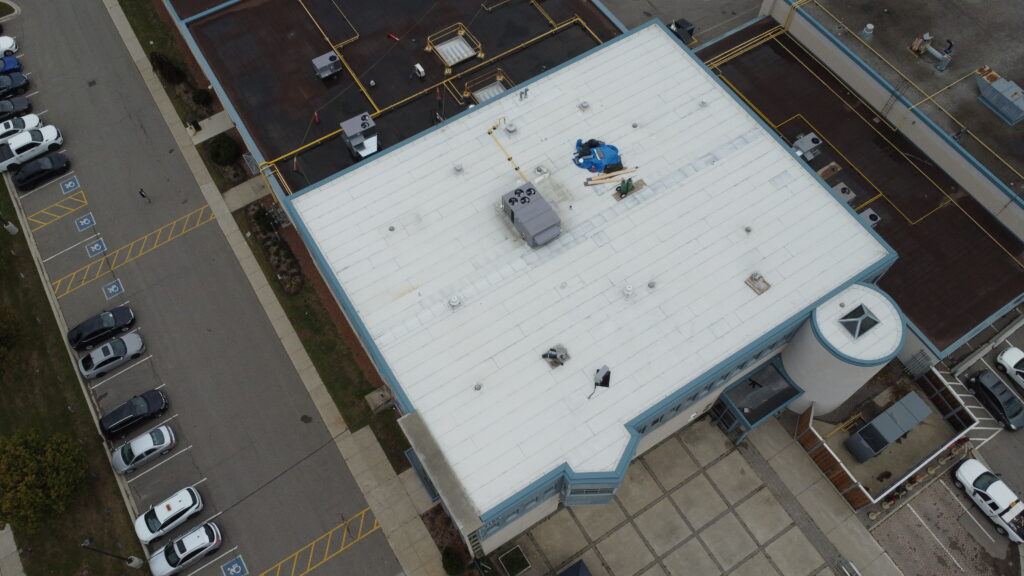
See all our completed projects and the systems we install on our services page.
Frequently asked questions
What is institutional roofing?
Institutional roofing is roofing for buildings owned by public and non-profit institutions, such as schools, hospitals, colleges, universities and municipal buildings. The roof systems are those used on any commercial flat roof, mostly modified bitumen, built-up or single-ply, but the work is bought through public tenders, often needs bonds, and is built to the owner's own design standard while the building stays in use.
What type of contract is CCDC 2?
CCDC 2 is the Canadian standard stipulated price contract between an owner and a prime contractor: the work is done for a single fixed price, paid through monthly progress payments. The current edition is the 2020 one. Public owners add their own supplementary conditions, which change working hours, warranties and other terms, so read them as closely as the standard form.
What are the differences between CCDC 2 and CCDC 5B contracts?
CCDC 2 sets one fixed price between the owner and a prime contractor. Under CCDC 5B, the owner hires a construction manager who advises before construction and then performs the work, at first on actual cost plus a percentage or fixed fee; the parties may add a guaranteed maximum price or convert to a stipulated price. A roofer signs CCDC 2 as prime or works as a trade under 5B.
Does a municipal roofing contract need a performance bond?
Yes, if the contract price is $500,000 or more. Ontario's Construction Act then requires the contractor to give a municipality, school board, hospital or other public owner a performance bond and a labour and material payment bond, each covering at least 50 per cent of the contract price, on the prescribed forms. Below that, the owner may still ask for bonds in its tender, and many do.
What does WSIB clearance mean?
A clearance certificate from the Workplace Safety and Insurance Board confirms that a contractor is registered and in good standing with the WSIB. In construction, whoever hires the roofer must get one before work starts and keep a valid one for the whole job, or risk paying the roofer's unpaid premiums. Each lasts up to 90 days, and most expire on the 20th of February, May, August and November.
Planning a roof project for a public building?
Send us the building address, the roof area and any consultant report or tender documents you already have, and we will review the roof and the scope with you.
Call 1-833-775-7663Request an assessment
Karol Rajkowski
Vice President · OYH Roofing
Karol Rajkowski is Vice President of OYH Roofing, an Oakville-based ICI flat-roofing contractor whose projects include the IKO 2-ply modified bitumen roof on the City of Mississauga building at 3185 Mavis Rd and the 52,300 sq ft IKO 2-ply modified bitumen roof at 777 Niagara St in Welland. Learn more about the OYH team.
Sources
- Ontario laws (e-Laws): Construction Act, R.S.O. 1990, c. C.30, consolidation of January 1, 2026, ss. 6.1 to 6.5, 13.5, 13.13, 13.19 and 85.1; O. Reg. 304/18, General, ss. 1, 7, 12 and 12.1; O. Reg. 303/18, Forms, Forms 31 and 32; O. Reg. 264/25, Adjudications, ss. 19 and 33. Occupational Health and Safety Act, s. 30; O. Reg. 490/09, Designated Substances, s. 2. Municipal Act, 2001, s. 270; City of Toronto Act, 2006, s. 212. Workplace Safety and Insurance Act, 1997, ss. 141.1 and 141.2. O. Reg. 191/11, Integrated Accessibility Standards, s. 80.48.
- Ontario procurement: Broader Public Sector Procurement Directive (effective April 13, 2026); Buy Ontario Procurement Directive and Municipal Buy Ontario Procurement Directive (2026); Supply Ontario, Buy Ontario Act FAQs; Doing business with the Government of Ontario (updated April 13, 2026). Canadian Free Trade Agreement, covered procurement thresholds, January 1, 2026 to December 31, 2027.
- WSIB: Clearance Certificate in Construction (policy 14-02-19) and Questions and answers: Clearances. ODACC, Ontario Dispute Adjudication for Construction Contracts. IHSA, COR frequently asked questions.
- CCDC: CCDC 2 (2020); CCDC 5A (2025); CCDC 5B (2025); CCDC 17 (2025); CCDC 11 (2019); CCDC 41; CCDC 220, 221 and 222 (2024). Ontario Association of Architects and Ontario General Contractors Association, Recommended Supplementary Conditions for CCDC 2 2020.
- Public tenders and reports: Town of Renfrew, Tender 2025-12-IPWE, Roof Replacement for the Municipal Garage (September 2025); United Counties of Leeds and Grenville, CSS-2026-02 Roof Replacement (April 2026); City of St. Thomas, 2026-008 Joe Thornton Community Centre Roof Replacement (May 2026); Toronto District School Board, PCM26-322T Roof Replacement at Regent Heights PS (May 2026); City of Toronto, Bid Award Panel report, York Recreation Centre roofing and green roof (January 11, 2024); Ottawa Catholic School Board, ARCH-2024-1 RFSQ Roofing Contractor Services (2024); Huron-Perth Catholic District School Board re-roofing tenders as listed by the Daily Commercial News (Jeanne Sauve and St. James, 2025); National Research Council Canada, M35 roof replacement, Ottawa (2025); Town of Deep River, report 2025-PW-008, 2025 Roof Projects (May 21, 2025).
- Owner standards and industry: Toronto District School Board Elementary School Design Guideline C4.7.1 (Edition 4.0); University of Toronto Roofing Design Standard, Revision 02 (November 28, 2023); University of Ottawa Design and Construction Standards (June 1, 2026); full links in our best flat roof system guide. IIBEC, Registered Roof Consultant flyer. Tender portals: MERX, bids&tenders, CanadaBuys.
OYH Roofing, 2120 Speers Rd, Oakville, ON L6L 2X8 · 1-833-775-7663 · info@oyhroofing.ca