
Plaza Roof Repair and Strip Mall Roofing in Ontario
Who pays for the roof, who answers for the tenants' rooftop units, how the walls between units are roofed, and how the work goes on while the stores stay open.
Call 1-833-775-7663 Oakville head office · Roof repair and replacement for retail plazas and strip malls across the GTA
Karol Rajkowski
Vice President, OYH Roofing
Published November 4, 2026 · 13 min read
Short answer
Plaza roof repair is one roof shared by many tenants, so the lease decides who pays, not Ontario law. The roofer works for whoever holds the repair duty, usually the landlord, and has to plan around each tenant's rooftop units, the firewall parapets between units and stores that stay open, while keeping the roof warranty valid.
What makes a plaza roof different from other flat roofs?
A plaza or strip mall roof is one roof over many businesses. The membrane is the same as on any commercial flat roof, but the roof is crossed by walls between units, carries a rooftop unit or two for every tenant, and sits over stores that open every day. Each of those changes how a plaza roof repair is planned and who has to agree to it.
| Feature | Why it matters | More detail |
|---|---|---|
| Firewalls rising through the roof as parapets | Each one is two more runs of flashing and a coping to keep watertight | Firewalls |
| A rooftop unit for each tenant | Many curbs, gas lines and service visits by trades the landlord did not hire | Rooftop units |
| Roofs at different heights | An anchor store is often taller; snow drifts against the higher wall | Snow drifts |
| Signs on the parapet or false front | Sign conduit run through a wall without proper sealing lets in water that looks like a roof leak; conduit hidden in the roof is a shock and fire hazard during a tear-off | Flashings |
| A steel deck running under several units | Water follows the deck flutes, so a leak can show up in the store next door | Leaks |
| Stores open below | Odour, noise, parking and exits have to be planned with every tenant | Open stores |
Who pays for plaza roof repair: the landlord or the tenant?
Whoever the lease says. Ontario's Commercial Tenancies Act has no section that splits repairs between a commercial landlord and tenant, so plaza roof repair is paid for under the lease: its repair clause, its operating cost clause (often called common area maintenance, or CAM) and any clause on capital costs. Ontario courts read those clauses word by word.
| Case | What the lease said | Result |
|---|---|---|
| Metro Ontario Real Estate v. Hillmond Investments, 2026 ONCA 370 (shopping centre, lease from 1978) | The landlord repairs and replaces the exterior; a separate clause called it a "completely carefree net lease" | The tenant that replaced its leaking roof could recover the cost from the landlord; the net lease clause did not override the landlord's express duty |
| 402 Mulock Investments v. Wheelhouse Coatings, 2022 ONCA 718 (multi-unit building in Newmarket) | The landlord maintains, repairs or replaces the roof membrane; another clause sets what the tenant pays as additional rent | The tenant could be charged a share of a membrane replacement over the whole building, but as a capital replacement spread over its useful life, not in one invoice |
- Repair is not always replacement. McMillan LLP's review of the 2026 case notes that "repair" in a lease does not always include replacement, so the two can fall on different parties. In that case the landlord had accepted it must repair the roof but refused to replace it.
- The roof is shared. In the Newmarket case, the tenant argued it should pay only for the roof over its own unit; the court disagreed, because the roofing contract covered the whole roof.
- Rent keeps running. Unless the lease gives a right to reduce or set off rent, a tenant generally pays full rent and pursues the repair claim separately (McMillan).
- Time limits apply. In the 2026 case, the landlord's claim for CAM it said was underpaid from 2009 to 2011 was out of time under the six-year limit in Ontario's Real Property Limitations Act. The landlord has since applied for leave to appeal to the Supreme Court of Canada.
As a starting point, Ontario firm Pacific Legal describes the usual split: the tenant repairs the inside of its unit, the landlord handles the structure, roof and common areas, and "in a triple-net lease the tenant may assume those costs." A lawyer should read the actual lease before anyone signs a roofing contract; we can give both sides the same written roof assessment to work from.
What should happen when a plaza roof leaks?
The tenant reports it to the landlord or property manager, who sends the roofer: the roof is shared, the warranty is usually in the landlord's name, and its notice deadline starts when the leak is found. The water may not be coming from the roof right above the stain: CRCA's manual warns that on steel decks the flutes "act as gutters", letting water travel a long way before it finds an opening, so in a plaza the source can be over the neighbouring unit.
- Report it fast. Manufacturer warranties set short deadlines: IKO's Diamond Shield asks for written notice within 30 days of discovery, and Sika Canada's Sarnafil warranty asks for notice on the next business day.
- Write down where and when. The unit, the spot on the ceiling, the weather and the time all help the roofer trace the leak; see what to tell the roofer.
- Check the neighbours. Ask the tenants on both sides whether they have stains too.
- Insurance comes after the roof. Our roof leak insurance guide explains why policies usually pay for the water damage inside, not the worn roof.
For emergency leak repair, see our pages for Toronto and Mississauga.
Who looks after the tenants' rooftop units, and what do they do to the warranty?
Whoever the lease names. Some leases make each tenant responsible for its own heating and cooling unit and others keep it with the landlord, so check the lease. The roof under the units, though, usually carries the landlord's warranty, and every manufacturer warranty we checked excludes or ends coverage when equipment is added or the roof is cut without the maker's written approval.
| Manufacturer | Added equipment or cuts without approval | Who may do the work |
|---|---|---|
| IKO (Canada) | Damage is excluded if the roof is altered by equipment "including but not limited to HVAC equipment, aerials, signs" without IKO's written approval in advance | A roofing contractor, with IKO's written permission |
| Sika Canada | Excluded if anything is placed on or attached to the roof, or the roof is altered, without Sika Canada's written authorization | Sika Canada authorized roofing applicator |
| Carlisle (U.S.) | Warranty "null and void" for alterations or objects placed on the roof without Carlisle's written authorization | A Carlisle authorized applicator, ideally the original one |
| Elevate (U.S.) | Warranty void without Elevate's approval for an alteration; the owner must notify in writing | A licensed Elevate applicator |
Two more lines in these warranties matter in a plaza. Sika Canada excludes damage from a failure by "the Owner or his lessee" to maintain the roof, so a tenant's neglect can cost the landlord coverage. And IKO and Elevate both exclude or end coverage after a change in the building's use, which can happen when a store becomes a restaurant. Grease from kitchen exhausts softens asphalt and swells modified bitumen, and CRCA's bulletin on rooftop grease says the repairs it causes are "NOT covered by any roof warranties" (see how to stop grease damage).
- Control access. Carlisle recommends restricted roof access and provides a log of who went up, for what and whether the roof or the unit was leaking; we suggest the same for every plaza.
- Check the roof after service calls. Carlisle advises a roof check after regular maintenance of any rooftop unit, because service work can damage the membrane and flashings.
- Lifting units for a re-roof. The roofer does not touch the services. In Ontario, gas appliances may be altered, removed or reactivated only by a certified gas technician (a G.2 certificate covers units up to 400,000 Btuh), opening a refrigerant circuit takes a certified refrigeration technician, and disconnecting power is electrical work for a licensed electrical contractor. Book them with the tenant before the roofing dates are set.
- Old units and curbs. When a tenant leaves or upgrades, the old unit, curb and vents should come off and the openings be closed with compatible roofing. A U.S. facilities guide warns that abandoned parts can blow loose, block drains and puncture the roof, and that unit swaps done without a roofer often leave poor flashings.
Curb heights, supports and adding a new unit are covered in our rooftop equipment guide, and what else can void a warranty in our warranty guide.
How are firewall parapets between plaza units roofed?
As walls the roof stops against on each side, because a firewall usually does not stop at the deck. Ontario's Building Code requires a firewall to extend above the roof surface as a parapet at least 150 mm high where it is rated 2 hours and at least 900 mm high where it is rated 4 hours, and a firewall separating retail (Group E) floor areas needs the 4-hour rating, in masonry or concrete.
- Two exceptions. The parapet is not required where the firewall stops under a fire-rated reinforced concrete roof slab, or where the roofs on each side differ in height by more than 3 m (3.1.10.3 and 3.1.10.4).
- Nothing combustible across the top. Combustible material may not extend across the end of a firewall, and may cross over one only where it stops under a rated concrete slab (3.1.10.7). CRCA's technical bulletin on roofing and firewalls reads "the end" as the top of the wall: carrying felts or membrane up and over it "contravenes the requirements of the Code".
- Not every wall between units is a firewall. Many demising walls between stores are fire separations, which the Code requires between suites (1 hour in Part 3 buildings, 45 minutes in smaller Part 9 buildings, with an exception for sprinklered malls). They usually stop at the underside of the deck, sealed with a rated firestop, so any pipe or conduit run through one needs a rated firestop too.
That makes a firewall harder to keep dry than an ordinary parapet. NRC's digest on flashings says parapets face "the most severe weathering" and that coping joints "are vulnerable to rain leakage". On an ordinary parapet, NRCA's detail carries the membrane over the top under the metal coping as a second line of defence. On a firewall that is not allowed, so the flashing stops on each face and the top is waterproofed with non-combustible materials, which CRCA notes "may require the use of non-traditional waterproofing materials". If a re-roof uncovers membrane already run over a firewall, CRCA tells the roofer to raise it with the owner.
Whether a given wall is a firewall or a fire separation is a question for the drawings or a designer, not a guess made on the roof. Our flashing repair guide covers parapet repairs, and where an anchor store's roof is higher, snow also drifts against the taller wall (see where snow piles up).
Can the stores stay open during plaza roof work?
Usually, yes: a strip mall can keep trading through a plaza roof repair or replacement if the work is planned with the tenants rather than around them. IKO's guidance for roof replacements on occupied buildings is that the owner or property manager, not the roofer, writes to the tenants to explain the work, posts signs saying when it starts, and warns them they may notice an unusual odour.
- Hours. IKO suggests working outside normal business hours where possible and avoiding each business's peak hours, within the municipal noise hours (see our GTA noise-hours table).
- Rooftop units. CRCA asks roofers to find out from the building operator which rooftop equipment can be shut down or moved during the work, and IKO says tenants should know in advance whether their heating or air conditioning will be off, on which days and for how long. Air intakes matter most while adhesives, asphalt or torches are in use near them, less during tear-off.
- Parking, exits and fire routes. Keep the parking lot usable, deliver materials in as few trips as possible, and never place a bin in front of an entrance or a fire exit (IKO). Ontario's Fire Code requires exits to be kept free of obstructions and fire access routes clear of vehicles and building materials, and it keeps bitumen kettles off most roofs, out of fire access routes and at least 3 m from any building exit.
- The fire safety plan. A plaza with a restaurant or another assembly occupancy, or a store with more than 300 occupants, needs a fire safety plan under the Fire Code, and the plan has to be revised before construction, including torch work, starts. After torching, the firewatch also covers places under the roof where combustibles could ignite, which in a plaza means the stores (see torch-on roofing over occupied space).
- Access to each store. Blocking it can cost a landlord: in 2025 an Ontario court treated a landlord's deliberate blocking of a flower shop's loading docks as a fundamental breach of the lease (Convocation Flowers v. Anisa Holdings, summarized by McMillan). Keep bins, lifts and materials clear of every store's front and rear doors.
- Shoppers below. Ontario's construction regulation (O. Reg. 213/91) defines a public way broadly, as any open space the public has access to by invitation. Where work is within 4.5 m of a public way it calls for a covered way over it unless the work is enclosed, a fence at least 1.8 m high where the work may endanger people using it, and debris lowered by chute, container or hoist, never dropped. Ask how the storefront sidewalk and entrances will be protected.
Our roof replacement guide has a table of the usual disruptions in an occupied building (fumes, dust, drips, noise, fire risk and access) and how each is handled.
Should a plaza roof be replaced all at once or section by section?
Either works, if the sections are planned. CRCA's manual recommends dividing large roofs into sections with area dividers, so that "sections can be replaced or repaired instead of the whole roof" and a leak in one section cannot travel into the next. Area dividers rise at least 200 mm above the finished roof, and NRCA notes they suit reroofing in stages, between sections that differ in age or type.
- Seal each phase every night. CRCA requires the edge of each day's work to be sealed to the finished membrane, and no old roofing to be removed unless the space below can be kept watertight.
- Strip, don't stack. CRCA advises removing the old roof and flashings and installing a completely new system when re-roofing; blistered, buckled or wet layers are not a base for a new roof. See when a recover is allowed.
- Older plazas. Many have more than one roof stacked on the deck. NRCA recommends removing every existing layer before a replacement, and warns that phenolic foam insulation, sold in Canada from about 1982 to 1992, can corrode a steel deck once wet. Old roofing can also contain asbestos, which the owner must have examined before requesting tenders; see the checks before replacing a tar and gravel roof and the other approvals a re-roof needs.
To choose the new system, see the best flat roof system for a retail plaza.
Which OYH Roofing projects share a plaza roof's details?
Our published projects include commercial and municipal roofs with the same details a plaza roof has: many rooftop units, roofs at different heights and new work tied into old.
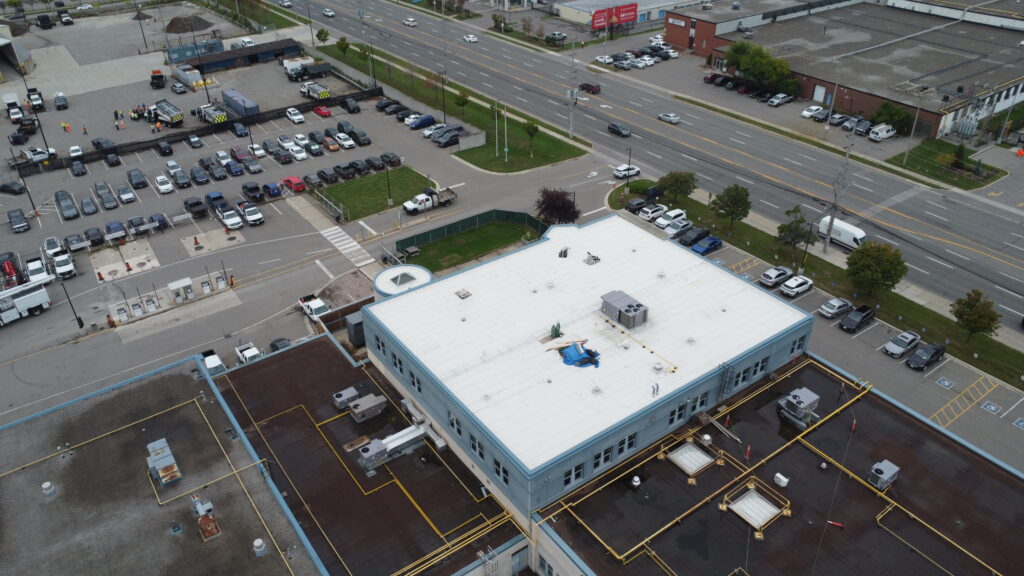
- Many rooftop units: 52,300 sq ft of IKO 2-ply modified bitumen on a commercial building at 777 Niagara St in Welland, with a 20-year system warranty (the photo at the top).
- Roofs at different heights: 8,500 sq ft of IKO 2-ply modified bitumen on the City of Mississauga building at 3185 Mavis Rd, beside lower roofs with their own units and gas lines.
- New tied into old: one 60 mil TPO system across a new addition and the existing building at Millomat Stampings in Mississauga, 50,000 sq ft.
See all our completed projects and the systems we install on our services page.
Frequently asked questions
Who is responsible for roof repairs in a commercial lease in Ontario?
The lease decides. Ontario's Commercial Tenancies Act does not split repairs between a commercial landlord and tenant, so the repair, operating cost and capital cost clauses govern. Courts enforce the exact words: in 2026 the Court of Appeal held that a shopping centre landlord had to pay for a tenant's roof replacement, because the lease put exterior repair and replacement on the landlord.
What needs to be included in a commercial lease?
For the roof, at least: who repairs it and who replaces it; whether a replacement can be charged through operating costs, and over how many years; who owns, services and replaces each rooftop unit; whether tenants need written consent before adding equipment or cutting into the roof; how fast leaks must be reported; and whether rent is reduced if a unit cannot open.
Can a plaza stay open during a roof replacement?
Usually, yes. The roof is replaced in sections, each sealed watertight at the end of the day, while the stores trade below. The property manager tells tenants in advance about odour, noise and any shutdown of their rooftop units, noisy work stays within municipal noise hours and away from peak hours, and exits, entrances and fire routes stay clear throughout.
Can a tenant put a rooftop unit or a sign on a plaza roof?
Only as the lease allows, which usually means the landlord's written consent first. On a roof under a manufacturer's warranty, the maker's written approval and an approved roofing contractor are needed too; IKO, Sika Canada, Carlisle and Elevate warranties all exclude or end coverage for equipment added without approval. A new unit or sign may also need a building permit.
What is a firewall on a plaza roof?
A fire-rated masonry or concrete wall that divides a building into separate buildings for fire safety. In Ontario it usually rises above the roof as a parapet, at least 900 mm high for the 4-hour firewalls retail buildings need. The roof is flashed up each side, but no membrane or other combustible material may cross the top, so each firewall adds two runs of flashing to keep watertight.
Managing a plaza with a roof that leaks?
Send us the plaza address, the units affected and the age of the roof if you know it, and we will set up a roof assessment and a written quote.
Call 1-833-775-7663Request an assessment
Karol Rajkowski
Vice President · OYH Roofing
Karol Rajkowski is Vice President of OYH Roofing, an Oakville-based ICI flat-roofing contractor whose projects include the 52,300 sq ft IKO 2-ply modified bitumen roof at 777 Niagara St in Welland and the IKO 2-ply modified bitumen roof on the City of Mississauga building at 3185 Mavis Rd. Learn more about the OYH team.
Sources
- Ontario: Commercial Tenancies Act, R.S.O. 1990, c. L.7; 2024 Building Code Compendium, January 16, 2025 edition, Volume 1 (Div. A 1.3.3.3 and 1.3.3.4; Div. B 3.1.8.3, 3.1.10.2 to 3.1.10.4, 3.1.10.7, 3.3.1.1 and 9.10.9.15), amended since; confirm with your designer. Fire Code, O. Reg. 213/07, Div. B 2.5.1.2, 2.7.1.7, 2.8.2.1, 5.11.2.3 and 5.11.2.5. Construction Projects, O. Reg. 213/91, ss. 1, 35, 64 and 65. O. Reg. 212/01, Gaseous Fuels, s. 6; O. Reg. 215/01, Fuel Industry Certificates, s. 21; O. Reg. 463/10, Ozone Depleting Substances and Other Halocarbons, s. 22; O. Reg. 570/05, Licensing of Electrical Contractors and Master Electricians, ss. 1 and 3.
- Court decisions and summaries: Ontario Bar Association, Court of Appeal Summaries (May 25 to 29), on Metro Ontario Real Estate Limited v. Hillmond Investments Ltd., 2026 ONCA 370 (June 2, 2026); McMillan LLP, Repair and Replacement in Commercial Leases (June 2, 2026); Miller Thomson LLP, Contractual clarity and honest testimony, on the 2024 trial decision (2024 ONSC 2625); Supreme Court of Canada, case 42492 (leave application); Law Times, on 402 Mulock Investments Inc. v. Wheelhouse Coatings Inc., 2022 ONCA 718 (November 2, 2022); Pacific Legal PC, Renting a Commercial Property in Ontario (July 15, 2025).
- CRCA Canadian Roofing Reference Manual (2020): 3.1.4, expansion joints, area dividers and curbs; 3.2.2, removal and disposal; 3.2.3, keeping roof watertight; 13.1.1, locate the problem area. CRCA bulletins: Vol. 55, Roofing and Firewalls (September 2005); Roof Top Effluence Management (No. 44A, July 1996); Uncommon Rooftop Hazards.
- National Research Council Canada: Baker, CBD-69, Flashings for Membrane Roofing (1965, historical series).
- Manufacturers: IKO, Diamond Shield limited warranty, sample (2021) and Ways to make your next commercial roof replacement less distracting for building tenants (updated 2024); Sika Canada, Sarnafil system warranty, sample (March 2022). U.S.: Carlisle, owner's manual (March 2025); Elevate, Red Shield limited warranty (2026).
- Other U.S. sources: NRCA, Professional Roofing: area dividers (December 2007), parapet coping detail BUR-1 (January 2005) and Low-slope reroofing guidelines (July 2005). FacilitiesNet: Common problems found during roof inspections (2015), Roof failure: effect and cause (2003) and Avoiding roof project pitfalls (2002).
OYH Roofing, 2120 Speers Rd, Oakville, ON L6L 2X8 · 1-833-775-7663 · info@oyhroofing.ca