
BUR Roof Repair and Built-Up Roofing Contractors
How a built-up roof is patched and re-gravelled, asphalt or coal tar, Ontario kettle rules, and what to ask a built-up roofing contractor.
Call 1-833-775-7663 Oakville head office · Built-up roof repair on commercial, industrial and institutional buildings across Ontario
Karol Rajkowski
Vice President, OYH Roofing
Published October 24, 2026 · 15 min read
Short answer
BUR roof repair rebuilds the plies that failed. On a gravel roof, the stone is spudded off at least 450 mm (18 in) around the damage, wet insulation is replaced, the area is primed, and at least two new plies go down in hot bitumen or cold adhesive, the first 150 mm (6 in) past the damage and each next one 75 mm (3 in) further. New gravel finishes it. Asphalt and coal tar are never mixed.
What goes wrong on a built-up roof?
Mostly the surface and the edges, which is where most BUR roof repair starts. A built-up roof (BUR) is several plies of felt mopped together with hot asphalt or coal-tar pitch, four plies in the most common version according to the Canadian Roofing Contractors Association (CRCA). The gravel, mineral-surfaced sheet or coating on top protects the plies from UV rays, foot traffic and impacts, and from fire from outside.
When the surfacing goes, the felts weather. IKO, which reprints the CRCA's repair advice, names wind scour in the corners, running water, foot traffic, ice and air from ventilators as the usual causes of lost gravel. Metal edges are the other weak point: gravel stop flashings expand and contract more than the felts bonded to them and can split them at the joints. National Research Council (NRC) research found that splits also follow insulation joints or start at corners and penetrations, and that ridges form over insulation joints. Our tar and gravel roof guide covers what the roof is and when to replace it.
Which fixes work best in BUR roof repair?
For BUR roof repair, the CRCA's reference manual gives one patch procedure for most defects, plus a few fixes of their own. If water got in, the membrane is opened and the insulation and deck are checked first; wet insulation comes out before any patch goes on.
| Problem | What it usually means | The fix |
|---|---|---|
| 1. Bare spot in the gravel | Stone gone from the flood coat, nothing else wrong yet | Clean and prime, then a heavy pour of hot bitumen or a thick layer of roof cement with new gravel embedded |
| 2. Scoured or eroded surface over an area | Wind in the corners, flowing water, traffic or ice has stripped the gravel | Recoat the membrane and reapply the surfacing; if the felts underneath have deteriorated, new felts first |
| 3. Alligatoring on a smooth roof | The bitumen coating has oxidized and shrunk into small cracks | Remove excess bitumen, prime, add reinforcing felts and a clay or asphalt emulsion coating; a new pour coat will not hold |
| 4. Split | The membrane has torn under movement | Cut it longer at both ends, lay a slip sheet over it, then patch (see the dimensions below) |
| 5. Ridge | Felts moving with temperature; unlike blisters, ridges are hard | Monitor it; exposed ridges eventually crack, and a cracked ridge needs repair |
| 6. Blister | A spongy bubble between plies | Leave small ones that keep water out. Cut out and patch if it is broken or cracked, sits in a lap or a traffic area, or has lost its gravel |
| 7. Fishmouth or dry lap edge | An unbonded felt edge that lets moisture wick in | Cut away the unbonded edge back to an adhered area, prime and patch |
| 8. Split at a gravel stop joint | The metal moves more than the felts bonded to it | Scrape the gravel back to the felts, prime, install new reinforcing felts in hot asphalt or cold mastic, then topcoat and resurface |
| 9. Pitch pocket low or cracked | The filler has shrunk or pulled away from the sides | Remove loose filler and water, prime, and top it off with a compatible pourable sealer, crowned so water runs off |
| 10. Loose base flashing | The flashing has pulled away from the wall or curb | Cut back to adhered material, fasten the top every 150 mm (6 in) or with a termination bar, seal with roof cement and fabric, add counterflashing |
More on blisters, flashing repairs and ponding water is in our other guides.
How is a built-up roof patched?
With new plies of felt, not just roof cement. The CRCA's typical procedure for BUR roof repair, which IKO endorses, covers tears, punctures, fishmouths, blisters and splits:
- Check for water. Open the membrane, inspect the insulation and deck, and replace anything wet. Our guide to finding wet insulation explains the methods.
- Clear the area. Spud the gravel free and sweep the membrane clean for at least 450 mm (18 in) around the defect.
- Cut back and prime. Remove loose or damaged felt back to a well-adhered area, prime with asphalt primer and let it dry.
- Rebuild the plies. Install as many plies as were removed, and never fewer than 2, in hot bitumen kept at its proper EVT (equiviscous temperature) or in cold-applied adhesive.
- Restore the surface. Embed gravel in hot asphalt or roof cement, or apply a coating that suits the existing surface.
| Part of the patch | CRCA figure |
|---|---|
| Cleared and prepared area | At least 450 mm (18 in) beyond the defect |
| Number of plies | The same number as removed, at least 2 |
| First (bottom) ply | At least 150 mm (6 in) beyond the repair area |
| Each following ply | At least 75 mm (3 in) beyond the ply below |
| Splits | Cut 150 mm (6 in) further at each end, T-cuts of 150 to 200 mm (6 to 8 in), slip sheet about 225 mm (9 in) wide |
| Mod bit patch instead of felts | On asphalt BUR only: torched, in hot Type 3 asphalt at 204°C (400°F), or in cold adhesive |
Over a split, the slip sheet goes on granules down so that the patch does not bond to the split itself. The NRC recommended leaving that strip unbonded in 1976, so that further movement does not open a new split.
Some do-it-yourself guides say to slit a blister, fill it with roof cement and nail the edges. The CRCA's method for a commercial roof is to cut the damage out and rebuild the plies. Roof cement has its place at flashings, pitch pockets and small bare spots, but it does not replace a ply patch.
The materials should match the roof. The CRCA lists Type IV or VI glass felt or No. 15 organic felt, and an asphalt type that suits the slope: Type 1 up to 1:16, Type 2 up to 1:8 and Type 3 up to 1:4. Hot asphalt goes on within 15°C (25°F) of its EVT, the temperature at which it mops best, which the supplier prints on the packaging or bill of lading.
When does a built-up roof need a new flood coat and gravel?
When the gravel is gone over a whole area and the felts underneath are still sound. The NRC explained why the stone goes: the coating that holds it oxidizes, hardens and cracks, so the gravel blows or washes away. Caught early, a flood coat and new gravel correct the problem; once the felts are damaged and curled, replacement may be needed. The CRCA's fix is to sweep, clean and prime the bare area and set new gravel in a pour coat of asphalt on a dry surface. Three details decide whether it lasts:
- Enough flood coat. IKO specifies 2.9 kg/m² (60 lb per 100 sq ft) of asphalt and 19.5 kg/m² (400 lb per 100 sq ft) of gravel. A CRCA bulletin warns that too thin a top pour leads to early gravel scouring by wind and water.
- A double pour where the wind works hardest. The CRCA calls for one on wind-exposed corners, around penthouses and in valleys where running water erodes the stone, but not on slopes over 1:25.
- A dry roof underneath. New gravel over wet insulation only hides the problem; our repair or replace guide explains why a moisture survey comes first.
Not every built-up roof has gravel, and the finish of a repair follows the surface:
| Surface | How you recognize it | How the repair is finished |
|---|---|---|
| Gravel in a flood coat | Loose stone over black bitumen; IKO specifies round stone of 9 to 20 mm | A flood coat with new gravel embedded so that no bitumen shows |
| Smooth surface | No stone; the felts are covered with a coating, such as aluminum or an emulsion | A compatible coating, which may need a waiting period before it goes on |
| Mineral-surfaced sheet or hybrid | A granulated sheet, often an SBS modified bitumen cap, over plies of felt | A like-material patch with granules, as in our mod bit roof repair guide |
On a smooth roof with alligatoring, the CRCA says a new pour coat is unlikely to help, because the bitumen underneath keeps shrinking. Liquid systems are another route: Tremco brought its AlphaGrade restoration system for gravel-surfaced built-up roofs to Canada in 2022, sealing the remaining gravel under three coats. Our roof coating guide lists the checks before any coating, and our repair or replace guide covers when a recover is allowed.
Is your built-up roof asphalt or coal tar?
A roofer needs to know before any BUR roof repair starts. The CRCA explains that pitch and asphalt are both bitumen but are incompatible: their felts and bitumens cannot be used together or mixed, and Ontario's Building Code says the same. The NRC described the risk in 1963: asphalt over pitch can soften and flow off, and pitch over asphalt can harden and crack. Pitch softens at about 60°C (140°F), so it was used only on very flat roofs, under 1:25 (4 per cent).
No Canadian standard sets a field test for telling them apart, so roofers use clues and, where in doubt, a lab test or the original specifications:
- Slope: a dead-level roof, under 1:25, is a candidate for pitch.
- Smell: pitch has a sharp, naphthalene-like odour, especially when warm.
- Solvent test: a pea-sized sample left in mineral spirits dissolves into a black liquid if it is asphalt; coal tar stays intact or turns the liquid yellow-green (a U.S. field tip from the Infraspection Institute).
The patch follows. The CRCA allows modified bitumen sheets as a patch on asphalt built-up roofs only, and U.S. guidance is to repair coal-tar roofs with coal-tar-based compounds and never to gravel them in with asphalt. That is harder in Canada now, since coal-tar roofing sealants can no longer be sold without a federal permit; the rule does not say whether hot-applied roofing pitch counts, and it does not touch roofs already in place. Ask your roofer which compatible material they will use. Pitch roofs are no longer common in Canada, the CRCA notes, so choose a contractor who has worked on one.
| Question | Coal-tar pitch | Asphalt |
|---|---|---|
| Heating | Not above 205°C; flash point only about 120°C (NRC, 1980) | Roofing asphalt has a minimum flash point of 260°C (CRCA), and the Fire Code caps kettles at 260°C |
| Ontario exposure limit (8-hour average) | 0.2 mg/m³ for coal tar pitch volatiles | 0.5 mg/m³ for asphalt (bitumen) fume |
| Designated substance in Ontario? | No (the list has 11 substances; coke oven emissions means metallurgical coke ovens only) | No |
| Federal sales ban | Coal-tar pavement and roofing sealants cannot be sold after December 31, 2025 without a permit | None |
| Extra precautions in the CRCA manual | Skin protection, washing facilities, and respiratory and eye protection where ventilation is poor, also when old pitch is removed | Standard hot bitumen precautions |
What rules apply to hot asphalt kettles in Ontario?
A hot-mopped BUR repair needs a kettle, and Ontario's Fire Code and construction regulation both set rules for it. The one owners notice: a bitumen kettle may not sit in a building or on its roof, except on a concrete roof where openings within 15 m are diked against spills.
| Topic | Rule | Source |
|---|---|---|
| Location | Not in a building or on a roof (concrete roofs excepted with diked openings), not in a fire access route, not within 3 m of an exit | Fire Code 5.11.2.3 |
| Temperature | Never heated above 260°C; the CRCA recommends staying at least 14°C (25°F) below the bitumen's minimum flash point | Fire Code 5.11.2.3; CRCA 1.2.3 |
| Supervision | Under constant supervision by a person who knows the hazards and is trained on extinguishers; operated only by a competent worker | Fire Code 5.11.2.3; O. Reg. 213/91 s. 211 |
| Lids and extinguisher | Close-fitting steel lids at least 2 mm thick; a 4A:40B:C extinguisher between 1.5 m and 7.6 m from the kettle | Fire Code 5.11.2.3 and 5.11.2.6 |
| Propane | Cylinder at least 3 m from any source of ignition; a propane-fired tar pot heater is run by the holder of an RE-O certificate or a record of training | O. Reg. 213/91 s. 211; O. Reg. 215/01 s. 51 |
| Getting it to the roof | A pipe discharging within 2 m of the roof edge needs a guardrail, as do both sides of a roof hoist; hot bitumen is never carried up a ladder | O. Reg. 213/91 ss. 208, 209; CRCA 1.2.4 |
Temperature control also cuts fumes: the CRCA notes that heating bitumen 28°C (50°F) less can halve a worker's exposure, and that today's roofing asphalt works close to its flash point, so crews use thermometers, not guesswork. Torch-applied patches follow other rules, covered in our mod bit roof repair guide and industrial roof repair guide.
Can a built-up roof be repaired in cold weather?
Yes, with care. The CRCA treats 4.4°C (40°F) as the usual threshold for cold-weather roofing and tells crews to check each product's minimum temperature. Cold-applied adhesives are mainly used above 4.4°C unless the maker allows less, can take hours to weeks to cure, and in cold weather need felts stored at about 20°C (68°F) for 24 hours before use.
Hot asphalt loses heat fast. The NRC linked cold-weather work to thick moppings and poor adhesion that show up as ridges the next spring, and advised insulated lines and buckets, or stopping work when the temperature cannot be held. Hot bitumen is never carried across frost, dew, ice or snow, and IKO notes that gravel may need heating. Our mod bit roof repair guide covers winter patches with modified bitumen.
Bare spots, splits or a leaking pitch pocket?
We can inspect your built-up roof, check the insulation for water and set out which repairs it needs, in writing.
Call 1-833-775-7663Request an assessmentHow do you choose a built-up roofing contractor?
Start with the usual checks in our guide to choosing a commercial roofing contractor: WSIB, insurance, references and a written quote. A built-up roofing contractor also needs hot work experience, and these questions show quickly whether one knows built-up roofs.
| Ask | A good answer |
|---|---|
| Is my roof asphalt or coal tar, and how will you check? | A clear plan to identify it before any material is ordered, since the two cannot be mixed |
| How many plies will the patch have, with which felt and which asphalt? | At least 2 plies; a named felt (the CRCA lists Type IV or VI glass and No. 15 organic); an asphalt type that suits the slope |
| How will you check for wet insulation? | Opening the membrane at the damage, and a moisture survey for larger areas |
| Hot kettle or cold process, and where will the kettle sit? | On the ground, never on the roof (unless it is concrete and diked), with a trained attendant and a thermometer |
| How will the gravel be put back? | A flood coat with new gravel at a stated rate, and a double pour at corners where wind scours the stone |
| What warranty comes with the work? | In writing. Only CRCA Active members offer the CRCA Standard Form of Warranty, two years of workmanship on new roofs; ask what covers a repair, and check the maker's warranty before any work |
Associations help with a short list. The Ontario Industrial Roofing Contractors Association (OIRCA), founded in 1964, groups union and non-union industrial, commercial and institutional roofing contractors. OIRCA says every member and new applicant must pass a Safety Evaluation Audit of their compliance with Ontario's health and safety law.
Maker approval matters for a system warranty. IKO still warrants built-up roofs under its Labour and Membrane and Diamond Shield programs, with 10, 15 and 20-year pour and gravel systems with 2-ply modified bitumen flashings, installed by a contractor registered in the IKO Approved Applicator Program. Our commercial roof warranty guide explains the types.
How do you keep a built-up roof from needing repairs?
Inspect it at least twice a year and fix problems as soon as they are found, as the CRCA recommends. SOPREMA Canada's maintenance guide suggests the fall and the end of winter; Johns Manville's owner manual says spring and fall. On a built-up roof, look at:
- Gravel cover: bare spots, scour in the corners and around penthouses, and gravel washed toward the drains.
- Pitch pockets: filled to the top and crowned, with no gaps at the sides. IKO calls them high-maintenance items, and SOPREMA Canada leaves them out of its top warranties.
- Metal edges: splits at gravel stop joints and loose counterflashings.
- The membrane: new blisters, ridges, splits and dry lap edges.
- Drains and scuppers: clear of gravel and debris, with the clamping ring bolts snug.
- Traffic: service routes kept to walkways.
Keep inspection and repair records with the warranty. Our guide to a commercial roof maintenance program sets out the full list of tasks.
Does OYH Roofing repair built-up roofs?
Yes. Built-up roofing is one of the systems on OYH Roofing's services page, alongside modified bitumen, TPO, PVC and EPDM, for commercial, industrial and institutional buildings across Ontario. We have not published a built-up roof project yet. Our closest published work is 2-ply modified bitumen, the asphalt-based system that most often replaces a built-up roof:
- 777 Niagara St, Welland: IKO 2-ply, 52,300 sq ft, 20-year system warranty.
- City of Mississauga, 3185 Mavis Rd: IKO 2-ply, 8,500 sq ft, 20-year system warranty.
- Industrial building, Mississauga: 2-ply, 53,000 sq ft, 20 years on labour and materials.
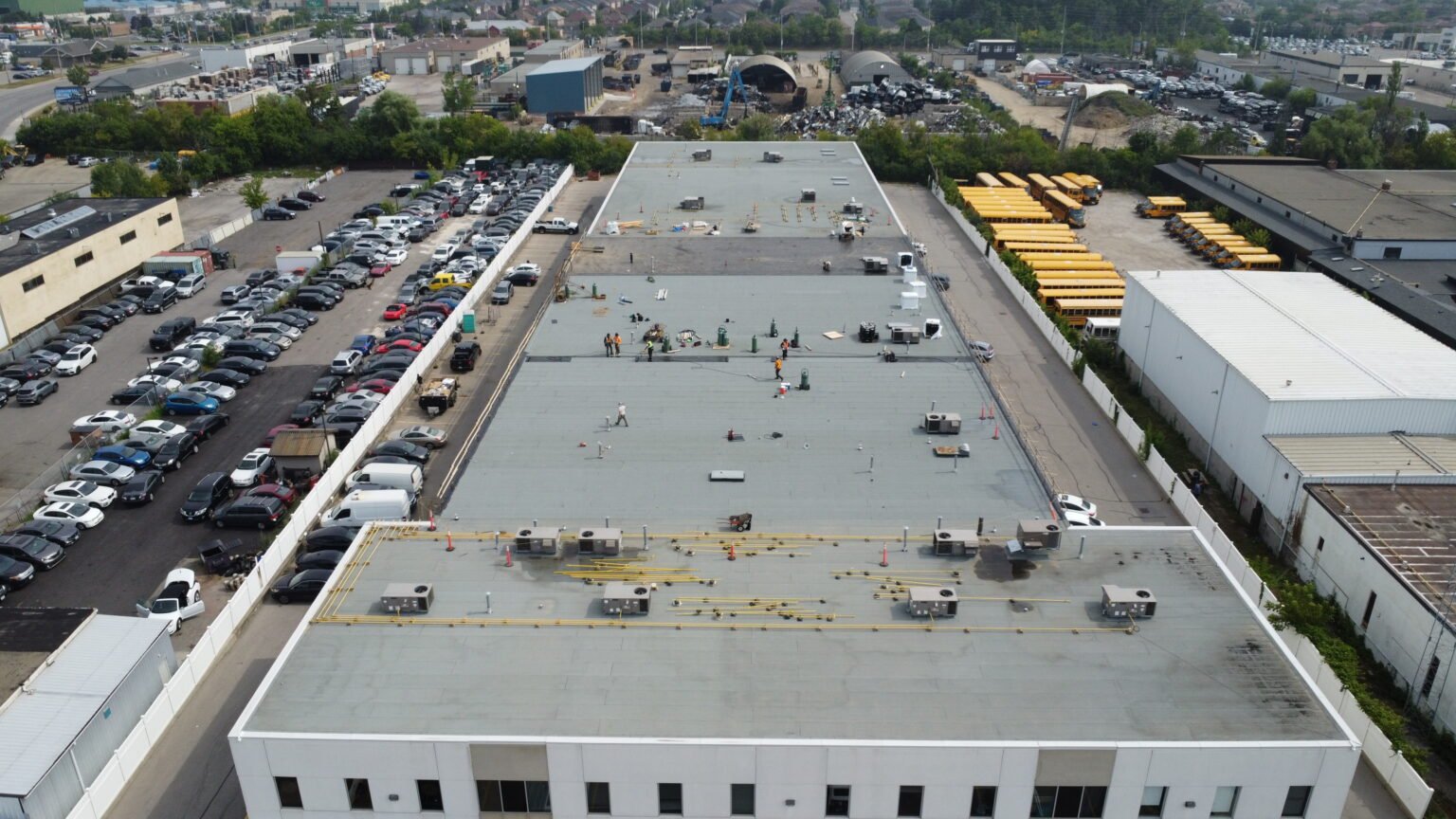
See our completed projects. If repairs no longer make sense, our tar and gravel roof guide compares the replacement options. For a leak that cannot wait, see roof leak repair in Toronto and in Mississauga.
Frequently asked questions
Is a built-up roof good?
Yes, for many low-slope commercial buildings. Its several plies give back-up protection, and the gravel shields it from the sun, foot traffic and fire. The trade-offs are weight, hot asphalt work for many repairs, and gravel that has to be kept in place. Most problems start at the surface or the metal edges, so twice-yearly inspections pay off.
What is alligatoring in roofing?
Alligatoring is a pattern of small cracks in the surface of a smooth-surfaced built-up roof, like an alligator's skin. The CRCA explains that the bitumen coating shrinks as it oxidizes, and the cracks can reach the membrane and damage the felts. The repair is primer, reinforcing felts and an emulsion coating; a new pour of hot bitumen does not last, because the old bitumen keeps shrinking.
Why would you put gravel on a roof?
To protect the bitumen. On a built-up roof, the gravel set in the flood coat shields the membrane from the sun's UV rays, from foot traffic and from impacts, and it gives the roof its resistance to fire from outside. That is why bare spots are re-gravelled: without stone, the flood coat and then the felts weather much faster.
Is coal tar banned in Canada?
Not completely. Since December 31, 2025, coal-tar pavement and roofing sealants cannot be sold in Canada without a federal permit, and since October 1, 2025 they cannot be made or imported. The rule covers products, not coal-tar roofs already in place. In Ontario, coal tar pitch volatiles have a workplace exposure limit of 0.2 milligrams per cubic metre.
Can you repair just a section of a roof?
Yes. On a built-up roof, most repairs are local: the gravel is cleared around the damage, the failed plies are cut out, and new plies are built up and tied into the old membrane, each one lapping further past the damage. It works when the insulation around the area is dry and the new bitumen matches the old one. A roof under a maker's warranty needs the maker's approval first.
Need a roof that lasts?
Tell us about your building and roof, and we will set up a roof assessment and a written quote.
Call 1-833-775-7663Request an assessment
Karol Rajkowski
Vice President · OYH Roofing
Karol Rajkowski is Vice President of OYH Roofing, an Oakville-based ICI flat-roofing contractor whose projects include the 52,300 sq ft IKO 2-ply modified bitumen roof at 777 Niagara St in Welland and the 8,500 sq ft roof for the City of Mississauga. Learn more about the OYH team.
Sources
- CRCA Canadian Roofing Reference Manual (2020): 13.2.1, built-up roof membranes; 13.1.2, potential problem areas; chapter 4, built-up roof membranes; 4.1.1, application of bitumen; 4.1.4, surfacing; 4.2.1 and 4.2.2, cold process; 3.3, cold weather; 1.2.1, 1.2.2, 1.2.3, 1.2.4 and 1.2.5, hot bitumen and kettles. CRCA technical bulletin Equiviscous Temperatures (EVT) (June 2003) and CRCA Standard Form of Warranty.
- IKO Commercial Technical Specification Manual: Part 12, BUR application (VER1219); Part 13, BUR flashing details (VER0521); Part 16, roof repair (VER1022). IKO Limited Warranty Programs (08/25).
- National Research Council Canada, Canadian Building Digests: CBD-179, Inspection and Maintenance of Flat Roofs (1976); CBD-211, Bituminous Roofing Membranes: Practical Considerations (1980); CBD-65, Mineral Aggregate Roof Surfacing (1965); CBD-38, Bituminous Materials (1963).
- Ontario: Fire Code, O. Reg. 213/07, Division B, 5.11.2; O. Reg. 213/91, Construction Projects, ss. 208, 209 and 211; O. Reg. 215/01, Fuel Industry Certificates, s. 51; R.R.O. 1990, Reg. 833 and the Ministry's current occupational exposure limits (updated June 26, 2025); O. Reg. 490/09, Designated Substances; Building Code, O. Reg. 163/24, 9.26.11.2.
- Canada: Certain Products Containing Toxic Substances Regulations, SOR/2025-36, ss. 13 to 15; Environment and Climate Change Canada compliance guide.
- Industry: OIRCA, about and safety; CRCA alliances. SOPREMA Canada Preventive Maintenance Guide and General Conditions for Warranties (March 2026). Johns Manville Owners Manual (2026, U.S.). Canadian Consulting Engineer, AlphaGrade system restores gravel-surfaced roofs (August 2022).
- U.S. practice: Infraspection Institute, asphalt or coal tar: how to tell the difference (2018); Buildings, coal-tar pitch roofing (2009) and keeping on top of it (2001).
OYH Roofing, 2120 Speers Rd, Oakville, ON L6L 2X8 · 1-833-775-7663 · info@oyhroofing.ca